Notebook
00:05
12 Apr 2026

Confident Single-Step Division with Bracketing and Verification

Welcome! Today we're building a bulletproof method for division — the foundation you'll need before tackling Euclid's Division Algorithm.

Euclid's Division Algorithm chains together many division steps, and a single arithmetic mistake at any step sends the entire computation off track.

So before we learn the algorithm itself, we need a bulletproof method for getting each individual step right.

The Bracketing Technique:

Trapping the dividend between two consecutive multiples of the divisor — a systematic way to find the quotient without guessing.

Paired with a two-part verification check, it makes errors almost impossible to miss.

Why this matters:

ProblemCause
Most marks lost on HCF problemsA wrong quotient in one step that cascades through the rest

Building a reliable single-step habit now means you can trust your HCF computations later.

1. Quotient estimation via bracketing

We are trying to find the quotient when dividing two numbers that are too large for mental arithmetic.

The core challenge is to avoid guessing and instead use a systematic approach:

Compute consecutive multiples of the divisor until the dividend is trapped between two of them.

The Bracketing Method

To find the quotient when dividing 1032 by 272, you bracket 1032 between consecutive multiples of 272.
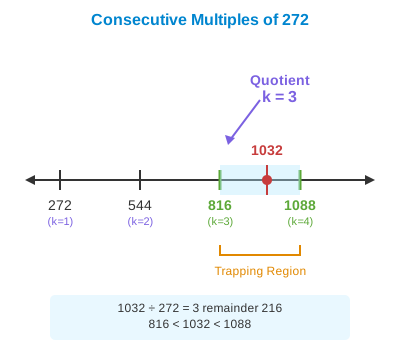
Number line showing consecutive multiples of 272 (272, 544, 816, 1088) with 1032 marked between 816 and 1088, brackets highlighting the trapping region, arrow pointing to quotient k=3

If you find that 272×k1032272 \times k \leq 1032 but 272×(k+1)>1032272 \times (k+1) > 1032, then the quotient is kkanswer.

✍️ Question

Your Turn ✏️

Divide 1032 by 272 using the bracketing method.

Show the consecutive multiples you computed, identify the quotient, and find the remainder.

The bracketing methodHunting for consecutive multiples that sandwich your dividend is a reliable way to find the quotient. You compute multiples of the divisor until you've trapped the dividend between two consecutive onesOnce you find that trap, the quotient is right there.

Let's compute the multiples of 272 step by step:

272×1=272272 \times 1 = 272

272×2=544272 \times 2 = 544

272×3=816272 \times 3 = 816

272×4=1088272 \times 4 = 1088closest

✍️ MCQ
Choose one
Looking at the multiples we computed, which two consecutive multiples of 272272 does 10321032 fall between?
A number line shows exactly where 1032 sits among the multiples of 272, making the bracketing method visual and concrete.
-15-10-551015-5038220 ÷ 196Hint: 196 × 195 = 38220Formulate the division equation below:020040060080010001200272×1272×2272×3272×4Dividend: 1032Target Dividend: 1032816 < 1032 < 1088
✍️ MCQ
Choose one
Since 10321032 falls between 272×3=816272 \times 3 = 816 and 272×4=1088272 \times 4 = 1088, what is the quotient?

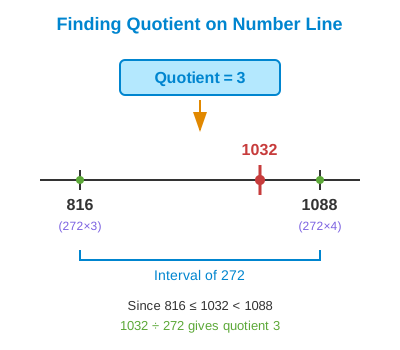
Now look: 8161032<1088816 \leq 1032 < 1088The dividend is trapped between two consecutive multiples. The dividend 1032 falls between 272×3272 \times 3Three times 272 gives the lower bound and 272×4272 \times 4Four times 272 exceeds our dividend.

Number line showing 816 and 1088 as boundaries (labeled 272×3 and 272×4), with 1032 marked between them, arrow indicating quotient is 3

This means 272 fits into 1032 exactly 3 timesThe answer falls between the bracketing multiples (not 4, because 4 would overshootYou cannot use a number that exceeds the dividend). The quotient is 3AnswerThis is how you verify your answer.

✍️ MCQ
Choose one
If the dividend had been 11001100 instead of 10321032, what would the quotient be?

The remainderWhat remains after fitting the largest multiple is what's left: 1032816=2161032 - 816 = 216Always subtract the largest multiple that fits.

✍️ Yes/No
Yes or No?
Does 272×3+216=1032272 \times 3 + 216 = 1032?

Pro Tip: The beauty of bracketingYou're finding the answer step by step is that you don't need to guess the quotient — you systematically find itNarrowing down to the exact quotient.

For larger numbers, you can jump in bigger steps (try ×10\times 10, ×20\times 20Jump by tens or twenties to get there faster, etc.) to narrow down faster(Speeds up finding your answer).

2. Two-part verification of a division step

Finding the quotient and remainder is only half the job. The next piece we need is a reliable way to confirm the answer is correct.

A single verification check is not enough — an equation can pass one check and still be wrong.

We need both checks working together.

📋 Given Info

You've found that 1032=272×3+2161032 = 272 \times 3 + 216.

A complete verification checks two things:

  1. Does the equation reconstruct the dividend?
  2. Does the remainder satisfy 0r<b0 \leq r < b?
✍️ Question

Verify the equation 1032=272×3+2161032 = 272 \times 3 + 216 by checking both conditions explicitly.

Then explain: Why is checking just one condition not enough?

After every division, verify with TWO checksThis is non-negotiable:

Both conditions must passChecking only one can hide errors that slip through — checking only one can hide errors!

Check 1 — ReconstructionMultiply divisor by quotient, add remainder: Does bq+rbq + rSee if you get back the original dividend actually equal aa?

272×3+216=816+216=1032272 \times 3 + 216 = 816 + 216 = 1032

✓ The equation reconstructs the dividend correctly.Something went wrong in your division

Check 2 — Remainder ConstraintYour remainder must follow this rule: Is 0r<b0 \leq r < bThis is the remainder constraint?

0216<2720 \leq 216 < 272

✓ The remainder is non-negative and smaller than the divisor.Your quotient is incomplete

✍️ Yes/No
Yes or No?
The equation 1032=272×2+4881032 = 272 \times 2 + 488 reconstructs correctly. Is this a valid division result?

Why checking just one condition isn't enough:

  • If you only check reconstruction, you might accept 1032=272×2+4881032 = 272 \times 2 + 488 — but 488272488 \geq 272The quotient is too small, so the quotient is actually too small!You could have divided one more time
  • If you only check the remainder constraint, you might have made an arithmetic errorBy coincidence it looks correct that still gives a valid-looking remainder.

Both checks togetherThe only way to guarantee correctness guarantee the quotient and remainder are correct.

Why do you need both checks?You need both checks working together

Consider 1032=272×2+4881032 = 272 \times 2 + 488.

Reconstruction checkMultiply quotient by divisor, add remainder: 544+488=1032544 + 488 = 1032Works perfectly, we get the original number. It adds up!(Adding up doesn't mean the answer is right)

But the constraint check failsThe crucial rule for valid division: 488272488 \geq 272(Remainder too large means quotient too small). The quotient is too small.

This shows why checking just one condition isn't enough — the equation can reconstruct the dividend perfectlyThe math can check out numerically, yet still be wrongWrong because remainder exceeds divisor because the remainder is too largeBoth verification methods are essential!

✍️ MCQ
Choose one
If someone claims 1032=272×4+(56)1032 = 272 \times 4 + (-56), the reconstruction gives 108856=10321088 - 56 = 1032. Which check fails?

Or suppose you miscalculated and wrote 1032=272×3+2001032 = 272 \times 3 + 200.

Constraint check: 0200<2720 \leq 200 < 272(Remainder passed the less-than check). Looks fine!Passing one check is not enough

But reconstruction fails: 816+200=1016816 + 200 = 1016Reconstruction gave wrong result 1032\neq 1032Should have been 1032. There's an arithmetic error.This is how you find hidden mistakes

✍️ MCQ
Choose one
For the equation 1032=272×3+2001032 = 272 \times 3 + 200, which verification check fails?

Each check catches a different kind of mistake.

  • The constraint checkCatches when remainder is bigger than it should be catches when your quotient is too small (remainder too big)
  • The reconstruction checkCatches arithmetic errors in your work catches arithmetic errors in your calculation

Together, they guarantee the answer is correctTogether they ensure your answer is right. One without the other leaves a blind spotMissing either check leaves room for error.

3. Self-correction when the quotient is wrong

Now that we know how to verify, we need to know what to do when verification fails.

If the remainder constraint is violated, the quotient is wrong — but:

  • Which direction is it wrong in?
  • How do we fix it?

We're trying to turn the constraint into a diagnostic tool, not just a pass/fail check.

📋 Given Info

Here's a situation:

A student divides 1032 by 272 and writes:

1032=272×2+4881032 = 272 \times 2 + 488

They claim the quotient is 2q=2 and the remainder is 488r=488.

✍️ Question

What went wrong? How should they fix it?

State the general rule for self-correction when the remainder constraint is violated.

The remainder constraintThis rule saves you from wrong answers is your safety net for catching quotient errorsBig remainder means wrong quotient.

Here, 1032=272×2+4881032 = 272 \times 2 + 488. The remainder is 488488 is bigger than 272, and the divisor is 272The divisor we're comparing against. Since 488272488 \geq 272This breaks the constraint, the constraint r<br < bRemainder must be smaller than divisor is violated.

✍️ MCQ
Choose one
If the remainder 488488 is greater than the divisor 272272, what does this tell us about the quotient 22?

What does this mean? Having 488 left over means you can still make more groups of 272You haven't divided enough yet. The quotient 2 is too smallError!Remainder bigger than divisor means this.

When the remainder exceeds the divisor, the quotient is too small. Let's mark this visually on the number line to see exactly why 488 as a remainder signals an error.
-15-10-551015-5038220 ÷ 196Hint: 196 × 195 = 38220Formulate the division equation below:020040060080010001200272×1272×2272×3272×4Dividend: 1032Target Dividend: 1032816 < 1032 < 1088Remainder: 488Divisor: 272488 > 272r ≥ b → quotient too small

Fix: increase qq by 1The fix when remainder is too big. Try q=3q = 3:

remainder=1032272×3=1032816=216\text{remainder} = 1032 - 272 \times 3 = 1032 - 816 = 216

Check: 0216<2720 \leq 216 < 272A valid remainder is always less than the divisor. ✓ Valid.

Now our remainder (216) is less than the divisor (272)Must be smaller than this number, so this is the correct answer!That confirms your answer is right

✍️ MCQ
Choose one
When the remainder constraint r<br < b is violated (remainder is too big), what should you do to fix it?
Now let's highlight the correct interval on our number line to see why 216 is a valid remainder — it fits neatly between 816 and 1032, staying safely below the divisor.
-15-10-551015-5038220 ÷ 196Hint: 196 × 195 = 38220Formulate the division equation below:020040060080010001200272×1272×2272×3272×4Dividend: 1032Target Dividend: 1032816 < 1032 < 1088Remainder: 488Divisor: 272488 > 272r ≥ b → quotient too smallCorrect remainder: 216✅ Valid: 0 ≤ 216 < 272

The general self-correction rule:

  • If rbr \geq bWhen remainder is too big, quotient needs adjusting: your quotient is too small(Your estimate was too low). Increase qq and recompute rrBump up the quotient and try again.
  • If r<0r < 0Negative remainder signals overestimation: your quotient is too largeYour estimate was too high. Decrease qq and recompute rrLower the quotient and recalculate.
✍️ MCQ
Choose one
A student divides 10321032 by 272272 and gets remainder r=488r = 488. Since 488272488 \geq 272, what should they do?

The remainder constraintIt's the tool that catches your mistakes catches BOTH directions of errorWorks whether you guessed too high or too low. This is why checking it is not optionalYou must check every time — it's the mechanism that tells you whether your quotient estimation was right.

4. Handling remainder = 0

5-5038220 ÷ 196Hint: 196 × 195 = 38220Formulate the division equation below:

The bracketing, verification, and self-correction skills are all in place for the general case.

What remains is the special case where the remainder turns out to be exactly zero.

This case is not just a curiosity — it is the signal that tells Euclid's Division Algorithm to stop, and recognising it correctly is how you read off the final HCF.

📋 Given Info

Sometimes the divisor divides the dividend exactly, giving remainder 00.

For instance:

196×195=38220196 \times 195 = 38220

✍️ Question

Your turn ✏️

Write the division of 38220 by 196 as a division equation.

  1. Is the remainder 00 valid (does it satisfy the constraint 0r<b0 \leq r < b)?
  2. In the context of finding HCF by repeated division, what does a remainder of 0 tell you?

When the divisor divides the dividend exactly, the remainder is 0Nothing is left over in exact division. Let's write it out:

38220=196×195+038220 = 196 \times 195 + 0

Is this valid? Check the constraint: 00<1960 \leq 0 < 196Zero must satisfy the remainder constraint. Yes — 0 satisfies both bounds. Exact division is a perfectly valid case.Not a special exception, just a valid case

✍️ MCQ
Choose one
In the context of finding HCF by repeated division, what does a remainder of 00 tell you?

Now here's why this matters for later. When you find HCF using repeated division, you divide, swap the pair, and repeatThe cycle you follow every single time.

You stop when the remainder hits 0.The stopping rule to remember At that moment, the divisor is the HCFThat divisor becomes your answer.

✍️ MCQ
Choose one
In the HCF algorithm, when the remainder becomes 00, what does the divisor at that step represent?

So if 38220 and 196 came up as a pair during that process, you'd see remainder 0Zero remainder signals the end of division on this step and declare 196 as the HCFThe final divisor is your answer.

The remainder of 0Nothing left over means exact division tells you the current divisor divides the current dividend exactlyThe divisor goes in perfectly — and that's exactly when the chain of divisionsThe division chain has completed its purpose has found what it was looking for.