Notebook
00:06
12 Apr 2026

Prime Factorisation: The Procedure and Exponential Form

Welcome! Today we're learning Prime Factorisation: The Procedure and Exponential Form — the skill that makes HCF and LCM problems fast and mechanical.

You know every composite number has a unique prime factorisation.

Now you need to actually find it — reliably and fast.

Here's why speed matters:

SituationRole of Factorisation
HCF problemsSub-step
LCM problemsSub-step
Decimal conversionsSub-step

Factorisation is rarely the main question — it's a tool you use inside bigger problems.

By the end of this section, you'll have:

  • A systematic procedure for factorising any number
  • The skill to write results in exponential form — the exact format that makes HCF and LCM computation mechanical

1. The repeated-division procedure

We're starting with the basic method for prime factorisation.

Before worrying about notation or speed, you need a reliable procedure that always works — one that systematically extracts every prime factor.

📋 Given Info

The Repeated-Division Method:

  1. Start with the smallest prime (22)
  2. Divide as many times as possible
  3. Move to the next prime (33, then 55, 77, 1111, ...)
  4. Stop when the (end)quotient reaches 11

The primes you divided by, with their repetitions, form the prime factorisation.

✍️ Question

Factorise 1836 using repeated division.

Show each step — which prime you divide by and what quotient you get. Stop when you reach a prime quotient.
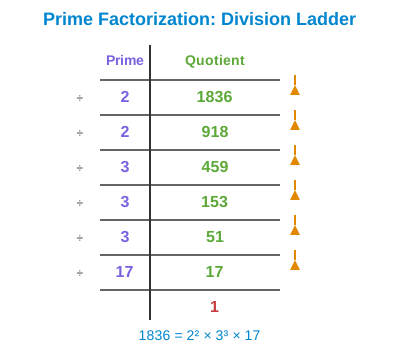
Vertical division ladder template: left column for primes (2,2,3,3,3,17), right column for quotients (1836,918,459,153,51,17,1), with arrows showing division flow downward

Here's the method, step by step, for 18361836.

Start with the smallest primeYour starting point for any factorisation, (start here)22The smallest prime number:

  • 1836÷2=9181836 \div 2 = 918 (even, so 22 works)
  • 918÷2=459918 \div 2 = 459 (even, so 22 works again)
✍️ Yes/No
Yes or No?
We've divided 18361836 by 22 twice and got 459459. Can we divide 459459 by 22 again?
  • 459459 is odd — 22 no longer works. Move to the next primeAfter 2 comes 3, then 5, then 7: 33new primeFollowing the sequence of primes.

Now try 3:

  • 459÷3=153459 \div 3 = 153 (digit sumAdd up all the digits of a number: 4+5+9=184 + 5 + 9 = 18, divisible by 3 ✓If sum divides by 3, so does the number)
  • 153÷3=51153 \div 3 = 51 (digit sum: 1+5+3=91 + 5 + 3 = 9, divisible by 3 ✓)
  • 51÷3=1751 \div 3 = 17 (digit sum: 5+1=65 + 1 = 6, divisible by 3 ✓)
✍️ MCQ
Choose one
How many times did we divide by 33 in the steps above?
  • 1717 is not divisible by 33. Move to 55 — not divisible. Move to 7717÷717 \div 7 is not exact.
  • But here's the key: (key test)17<72=4917 < 7^2 = 49Check primes up to the square root. If no prime up to its square root divides it, the number must be prime.No primes up to square root divide it means it's prime
  • 1717 is prime. Stop here!done!No need to check any further
✍️ MCQ
Choose one
Why did we stop the division process at 1717?

The prime factors are: 2,2,3,3,3,172, 2, 3, 3, 3, 17.

So 1836=2×2×3×3×3×171836 = 2 \times 2 \times 3 \times 3 \times 3 \times 17This is the prime factorisation.

✍️ MCQ
Choose one
How can we write 2×2×3×3×3×172 \times 2 \times 3 \times 3 \times 3 \times 17 in exponential form?

Key habitsHow to approach any prime factorisation problem:

  • Always start with the smallest primeBegin with the smallest prime (22)
  • Move up only when the current prime no longer divides evenlyOnly change primes when current one stops working
  • Stop when the quotient itself is primedone!You're done when quotient is prime
✍️ T/F
True or False?
When doing repeated division, you should move to the next prime as soon as you've divided once by the current prime. True or False?

2. Converting to exponential form

You can extract the prime factors. But the raw list like 2,2,3,3,3,172, 2, 3, 3, 3, 17 is not the format that HCF and LCM computation needs.

There's a specific notation — exponential form — that makes everything downstream work.

📋 Given Info

Exponential form means grouping repeated primes and writing them with exponents.

Example: 2×2×3×3×3×17=22×33×172 \times 2 \times 3 \times 3 \times 3 \times 17 = 2^2 \times 3^3 \times 17

This is read as: "two factors of 2, three factors of 3, and one factor of 17."

✍️ Question

Your turn! ✏️

Write the prime factorisation of 504 in exponential form.

  1. Show the repeated-division steps first
  2. Then group into exponential form

Let's factorise 504 step by step.

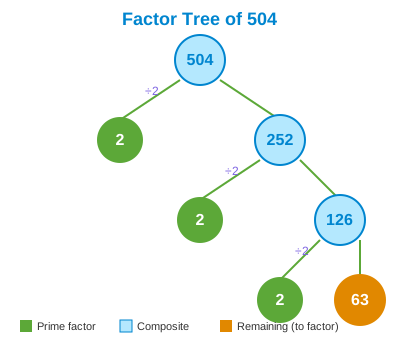
Divide by 2: 504÷2=252504 \div 2 = 252The method — divide by one prime repeatedly. Again: 252÷2=126252 \div 2 = 126Second division by 2. Again: 126÷2=63126 \div 2 = 63Third division — then we hit odd. Now 63 is odd63 is odd so 2 stops working — done with 2. We used 2 three timescountThe count becomes the exponent.

Factor tree starting with 504, showing division by 2 three times: 504->252->126->63, with 2 branching off at each step

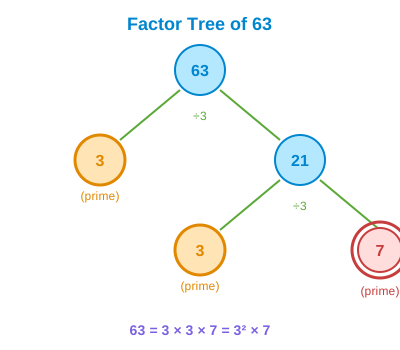
Divide by 3: 63÷3=2163 \div 3 = 21Now we repeat the process with 3. Again: 21÷3=721 \div 3 = 7Second division by 3. Now 7 is not divisible by 37 isn't divisible by 3 so we stop. We used 3 twicecountTwo times gives us the exponent 2.

7 is primeReaching a prime signals completion, so we stop.

Factor tree continuing from 63, showing division by 3 twice: 63->21->7, with 3 branching off at each step, 7 circled as prime
✍️ MCQ
Choose one
How many times did we divide by 2 in the factorisation of 504?

Expanded form: 504=2×2×2×3×3×7504 = 2 \times 2 \times 2 \times 3 \times 3 \times 7Writing out repeated primes the long way

Exponential formA shorter way to write repeated primes: 504=23×32×7504 = 2^3 \times 3^2 \times 7finalThe exponent shows how many times the prime appeared

✍️ MCQ
Choose one
What is the prime factorisation of 504504 in exponential form?

Now convert to exponential formA cleaner way to write repeated primes — group identical primes:

  • Three 2s become 232^3Instead of 2 times 2 times 2
  • Two 3s become 323^2
  • One 7 stays as 77 (or 717^1)

Exponential form:The final answer in exponential form 504=23×32×7504 = 2^3 \times 3^2 \times 7Each prime once with its power showing the count

✍️ FIB
Fill in the blank
If a number's prime factorisation is 24×522^4 \times 5^2, how many times does the prime 22 appear as a factor?
44

This notation is not just tidier — it's essential.

When you later compare two numbers for HCF, you'll look at "the power of 2 in this number vs the power of 2 in that number."Compare powers of each prime one by one

That comparison only makes sense if the factorisation is in exponential formWrite final answer in exponential form with powers explicitly writtenPowers must be explicitly shown.

3. Efficiency tricks: skipping primes and knowing when to stop

You have the basic procedure and the notation. Now let's make you faster. ⚡

Two simple observations can cut your factorisation time significantly — and speed matters when factorisation is a sub-step inside a bigger problem.

📋 Given Info

Consider factorising 3375. You could start testing divisibility by 22, then 33, then 55, and so on. But some of those tests are unnecessary.

Also consider factorising 2310 — at some point, the quotient you're working with becomes small enough that you can stop testing.

✍️ Question

Your Task 📝

Factorise 3375 into exponential form.

  1. Explain why you do NOT need to test the prime 22 at all.
  2. Then explain the general rule for when you can stop testing primes during factorisation.

Two speed tricks that save real time:

Trick 1 — Skip primes that obviously don't divide.

3375 ends in 5, so it's oddOdd numbers are never divisible by 2. No need to test 2 at all. Similarly, if a number doesn't end in 0 or 5, skip 5Only numbers ending in 0 or 5 are divisible by 5. These quick checks (even/odd, last digit)A quick glance at the last digit saves time eliminate unnecessary division.

✍️ MCQ
Choose one
A number ends in 7. Which primes can you immediately skip testing?

Let's factorise 3375:

  • Skip 2Checking odd first saves time on 2 (it's oddLook at the last digit first)
  • Try 3Exhaust one prime completely: 3375÷3=11253375 \div 3 = 1125
  • Again: 1125÷3=3751125 \div 3 = 375
  • Again: 375÷3=125375 \div 3 = 125Keep dividing until it stops working
  • Done with 3.Then move to the next prime
✍️ MCQ
Choose one
After dividing by 33 repeatedly, we have 125125. What is the next prime we should try?
  • Try 5: 125÷5=25125 \div 5 = 25
  • Again: 25÷5=525 \div 5 = 5
  • And 5prime!When quotient is prime, you're done is primeThe key stopping rule. Stop.No need to test anything further

3375=3×3×3×5×5×5=33×533375 = 3 \times 3 \times 3 \times 5 \times 5 \times 5 = 3^3 \times 5^3
(Count times each prime appeared, write as power)

✍️ MCQ
Choose one
Why did we skip testing the prime 22 when factorising 33753375?

Trick 2 — Know when to stop.

If your remaining quotientCompare quotient to square of next prime is less than the square of the next primeThe square of the next prime is your threshold you'd test, the quotient is primedone!You can stop testing here.

Example: If after dividing by 7The prime you just tested your quotient is 11This is your remaining quotient, you'd next test 11. Is 11<11211 < 11^2Compare quotient to square of next prime (121)? Yes(Yes, so 11 must be prime). So 11 is prime — stopdoneNo more testing needed.

✍️ MCQ
Choose one
You're factorising 23102310. After dividing by 22, 33, 55, and 77, your quotient is 1111. What should you do next?

Simpler version: Once the quotient is a recognisable primePrimes you can spot immediately (2,3,5,7,11,13,17,19,23,292, 3, 5, 7, 11, 13, 17, 19, 23, 29Common primes to memorise...), you can stop immediatelydone!No need to keep testing.

You don't need to 'divide it by itselfThis step is unnecessary' — just record it as the final prime factorThis is your last factor.

These tricks don't change the answer, but they cut the time.

In an exam, factorisation is usually step 1It's the first step of a bigger problem of a 3-step problem — spending three minutes hereDon't waste time on this part means running out of time laterYou'll run out of time for what follows.

4. Factorisation with verification

You can factorise efficiently and write in exponential form. The final habit to build is verification — a five-second check that catches errors before they cascade through an entire problem.

📋 Given Info

Verification means multiplying the exponential form back to check it gives the original number.

For example, if you claim 504=23×32×7504 = 2^3 \times 3^2 \times 7, you check:

8×9×7=72×7=5048 \times 9 \times 7 = 72 \times 7 = 504

Match confirmed. ✓verified

✍️ Question

Your Turn 🧮

Factorise 1980 into exponential form, then verify by multiplying back.

Show the multiplication clearly.
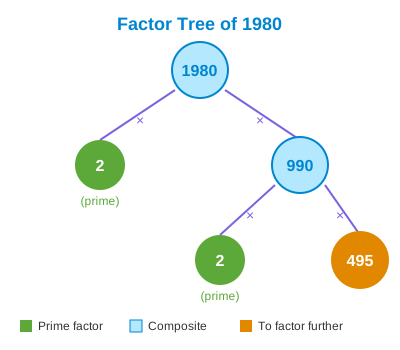
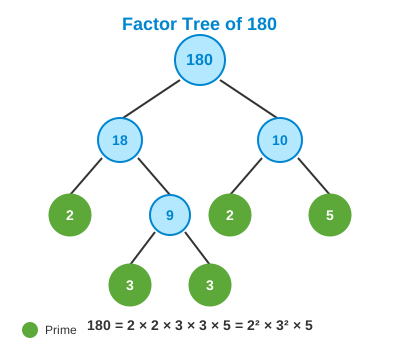
Factor tree starting with 1980 at top, branching to 2 and 990, then 990 branching to 2 and 495

Let's factorise 1980 step by step.

Divide by 2: 1980÷2=9901980 \div 2 = 990. Again: 990÷2=495990 \div 2 = 495. Now 495 is oddoddWe stop using 2 when the result is odd — done with 2.

✍️ MCQ
Choose one
How many times did we divide 1980 by 2?
Complete factor tree: 55 branches to 5 and 11, with prime factors 2,2,3,3,5,11 circled at leaves

Divide by 3: 495÷3=165495 \div 3 = 165 (digit sumAdd the digits to check divisibility by 3: 4+9+5=184 + 9 + 5 = 18, divisible by 3If the digit sum divides by 3, so does the number). 165÷3=55165 \div 3 = 55 (digit sum: 1+6+5=121 + 6 + 5 = 12, divisible by 3). 55÷355 \div 3? No — 5+5=105 + 5 = 10, not divisible by 3. Done with 3.

Divide by 5: 55÷5=1155 \div 5 = 11. Done with 5.

11 is primeprime!(Reaching a prime means factorisation is complete). StopA prime signals we're done.

✍️ MCQ
Choose one
What is the prime factorisation of 1980 in exponential form?

Expanded formWriting out every prime factor separately: 2×2×3×3×5×112 \times 2 \times 3 \times 3 \times 5 \times 11

Exponential formCount how many times each prime appears and write as a power: 22×32×5×112^2 \times 3^2 \times 5 \times 11This is the standard exam format

✍️ MCQ
Choose one
What is 22×322^2 \times 3^2?

Now verifyCheck your work by multiplying back — multiply the exponential form back:

22=42^2 = 4

32=93^2 = 9

4×9=364 \times 9 = 36

36×5=18036 \times 5 = 180

180×11=1980180 \times 11 = 1980

Match!Matching confirms your factorisation is correct The factorisation is correctProduct equals original number.

✍️ MCQ
Choose one
If you made an error and wrote 232^3 instead of 222^2 in the factorisation of 1980, what would the verification product be?

This five-second check is a habit worth building.

In a multi-step problem, an error in factorisation cascadesOne wrong factor cascades through everything — wrong factors lead to wrong HCF, which leads to wrong LCM, which leads to a wrong final answer.

Catching it here costs five seconds.Five seconds now saves your whole solution Catching it at the end (if you catch it at all) costs the entire problem.Missing it means losing the entire problem