Notebook
00:04
12 Apr 2026

LCM from Prime Factorisations: The Highest-Power Rule

Welcome! Today we're tackling LCM from Prime Factorisations: The Highest-Power Rule — the perfect companion to what you just learned about HCF.

You just learned that HCF uses the intersection of primes at minimum powers.

LCM is the other side of the coin — it uses the union of primes at maximum powers.

⚠️ Getting these two mixed up is the single most common error in this topic — and it costs full marks.

RulePrimesPowers
HCFIntersection (common only)Minimum
LCMUnion (all primes)Maximum

By the end of this section, you'll be able to:

  • Compute LCM confidently using prime factorisations
  • Contrast the HCF and LCM rules cleanly
  • Use a verification method that catches swap errors

1. LCM includes ALL primes, not just common ones

🔍 Quick Check

You just learned that HCF uses the intersection of primes at minimum powers.

Now let's see if you can figure out how LCM works — it's the other side of the coin.

The biggest conceptual difference between HCF and LCM is which primes get included.

  • HCF only uses shared primesHCF
  • But what about LCM?
📋 Given Info

Here's what we know:

504=23×32×7504 = 2^3 \times 3^2 \times 7

990=2×32×5×11990 = 2 \times 3^2 \times 5 \times 11

You already computed HCF = 18 using only the shared primes (2 and 3).

Now you need to compute LCM.

✍️ Question

For LCM(504, 990), which primes should be included?

  • Should you include 7only in 504, even though it only appears in 504?
  • Should you include 5 and 11only in 990, even though they only appear in 990?

Explain why.

LCMThe smallest number both can divide into means the Least Common MultipleThe smallest number that both numbers divide into perfectly — the smallest numberBoth numbers divide into it evenly that both 504 and 990 divide into evenly.

In other words, LCM is the smallest number that has both 504 and 990 as factors.

If a number is divisible by both 504 and 990, it must be a multiple of their LCM.

✍️ MCQ
Choose one
If a number NN is divisible by both 504504 and 990990, what can we say about NN?

For 504 to divide into the LCM, the LCM must contain at least all the prime factors of 504Every prime factor must be present. Since 504=23×32×7504 = 2^3 \times 3^2 \times 7, the LCM needs at least 232^3minRequired from 504's factorisation, at least 323^2minRequired from 504's factorisation, and at least 717^1minRequired from 504's factorisation.

✍️ Yes/No
Yes or No?
If the LCM did NOT contain the factor 77, could 504504 divide into it evenly?

For 990 to divide into the LCMApply the same reasoning to 990, the LCM must contain at least all the prime factors of 990All prime factors must be included. Since 990=21×32×51×111990 = 2^1 \times 3^2 \times 5^1 \times 11^1, the LCM needs at least 212^1, at least 323^2, at least 515^1minUnique to 990, still required, and at least 11111^1minUnique to 990, still required.

✍️ Yes/No
Yes or No?
The prime 55 only appears in 990990, not in 504504. Should 55 be included in the LCM?

Putting these together: the LCM needs 2, 3, 5, 7, and 11every prime from either numberTake every prime that shows up in either factorisation.

The LCM Rule: Include ALL primesYou need all of them, not a subset that appear in EITHER factorisation — not just the shared onesLCM is the opposite of HCF.

✍️ Yes/No
Yes or No?
For LCM(504,990)\text{LCM}(504, 990), should you include 77 even though it only appears in 504504?
✍️ MCQ
Choose one
Which primes must be included in LCM(504,990)\text{LCM}(504, 990)?

This is the key contrast with HCF:

  • HCF = intersectionOnly take primes appearing in both numbers (only primes in BOTHMust be present in both to count). For dividing both numbers, you can only use what they share.
  • LCM = unionYou need every prime from either number (all primes from EITHERLCM must be divisible by both originals). For being a multiple of both, you need everything either number hasNeeds everything from both numbers.
✍️ T/F
True or False?
HCF uses the intersection of primes (only shared primes), while LCM uses the union of primes (all primes from either number). True or False?

2. Taking the HIGHEST power of each prime for LCM

You know to include all primes when finding the LCM. Now — what power of each prime should you use?

Primes to includePower to use
HCFIntersection (shared primes only)Minimum power
LCMUnion (all primes from either)Maximum power

Let's see why the maximum power rule makes sense.

📋 Given Info

Here's the situation:

For LCM(504,990)\text{LCM}(504, 990), you need to include the prime 22.

  • 504504 has 232^3 (that's 22 cubed)
  • 990990 has 212^1 (that's just 22 to the 11)

The LCM must be divisible by both 504504 and 990990.

✍️ Question

Think about this 🤔

Should the LCM include 232^3 or 212^1?

And — what goes wrong if you pick the smaller power?

The LCM must be a multiple of both 504 and 990. Let's see what that demands for the prime 2.

504=23×32×7504 = 2^3 \times 3^2 \times 7

For 504 to divide the LCM, the LCM needs at least 232^3504 requires three factors of 2 (three factors of 2)3 twosThree 2s needed for 504.

990=21×32×5×11990 = 2^1 \times 3^2 \times 5 \times 11(990 requires just one factor of 2)

For 990 to divide the LCM, the LCM needs at least 212^1Only one 2 required here (one factor of 2).

✍️ MCQ
Choose one
If we pick 212^1 for the LCM instead of 232^3, which number will NOT divide evenly into the LCM?

The stricter requirementWhichever number needs more of a prime, that's what goes in the LCM is 232^3 (from 504).

If you only used 212^1, the LCM would have too few 2s for 504 to divide it. 504÷(something with only 21)504 \div (\text{something with only } 2^1) would leave a remainder.

So you take the maximumThis guarantees both numbers divide the LCM cleanly: max(3,1)=3\max(3, 1) = 3.

Use 232^3.

✍️ MCQ
Choose one
For LCM(504, 990), both numbers have 323^2 in their prime factorisation. What power of 3 should the LCM include?

The same logic applies to every prime: the number with the bigger powerSets the stricter requirement the LCM must meet sets the requirement, and the LCM must meet that requirement.

The maximum power is always sufficientSufficient means it works, necessary means anything less fails and always necessaryThat's why you always pick the highest power.

3. Full LCM computation with HCF contrast

You understand both principles:

  • All primes (from either number)
  • Highest powers (the maximum exponent for each prime)

Let's compute the full LCM and make the contrast with HCF crystal clear — keeping these rules straight under pressure is what earns marks.

📋 Given Info

Given Information:

  • 504=23×32×7504 = 2^3 \times 3^2 \times 7
  • 990=2×32×5×11990 = 2 \times 3^2 \times 5 \times 11

You already computed: HCF=21×32=18\text{HCF} = 2^1 \times 3^2 = 18

✍️ Question

Your Task 📝

Compute LCM(504,990)\text{LCM}(504, 990).

Then:

  1. State the one-line contrast between the HCF rule and the LCM rule.
  2. Apply a sanity check to your answer.

Let's compute LCM(504, 990) step by step.

First, list all primes from either factorisation: 2, 3, 5, 7, 11Every prime from either number must appear.

Remember:

  • 504=23×32×7504 = 2^3 \times 3^2 \times 7Primes from the first number
  • 990=2×32×5×11990 = 2 \times 3^2 \times 5 \times 11Primes from the second number
✍️ MCQ
Choose one
For the prime 2, what power should we use in the LCM? (504=23×504 = 2^3 \times \ldots, 990=21×990 = 2^1 \times \ldots)

Take the highest powerCompare powers from both numbers and pick the bigger one of each prime:

  • 2: max(3, 1) = 3 → 23=82^3 = 8
  • 3: max(2, 2) = 2 → 32=93^2 = 9
  • 5: appears only in 990You still include it in the LCM51=55^1 = 5
  • 7: appears only in 504(You still include it in the LCM)71=77^1 = 7
  • 11: appears only in 990You still include it in the LCM111=1111^1 = 11
✍️ Yes/No
Yes or No?
When a prime appears in only ONE of the two numbers, do we include it in the LCM?

LCMMust divide evenly into both starting numbers = 23×32×5×7×112^3 \times 3^2 \times 5 \times 7 \times 11 = 8×9×5×7×118 \times 9 \times 5 \times 7 \times 11

== 7272 ×5×7×11\times 5 \times 7 \times 11

== 360360 ×7×11\times 7 \times 11

✍️ FIB
Fill in the blank
We have 2520×112520 \times 11. What is the final value of the LCM?
2772027720

=2520×11= 2520 \times 11

== 27,720\mathbf{27,720}LCM

✍️ FIB
Fill in the blank
For HCF we use the minimum power of common primes. For LCM we use the ___ power of all primes.
maximummaximum
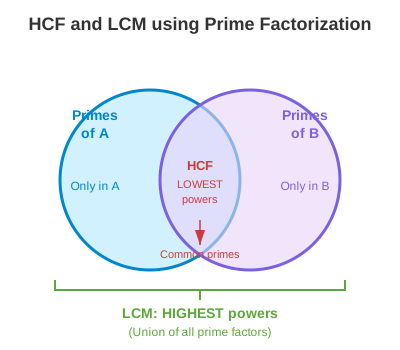
Venn diagram showing two overlapping circles labeled 'Primes of A' and 'Primes of B'. Intersection region labeled 'HCF: LOWEST powers'. Union of both circles labeled 'LCM: HIGHEST powers'

The clean contrast:

  • HCF(Only take what both numbers share) = intersectionCommon primes only (common primes only) at LOWESTMinimum powers of common primes powers → gives the largest divisor of bothmax divisorThe biggest number that goes into both
  • LCMTake all primes from both numbers = unionAll primes from both (all primes) at HIGHESTMaximum powers of all primes powers → gives the smallest multiple of bothmin multipleThe smallest number both go into
✍️ FIB
Fill in the blank
If you're computing HCF, you take the ______ power of each common prime. If you're computing LCM, you take the ______ power of each prime from either number.
lowest, highestlowest,~highest

Sanity checksThese checks catch silly mistakes:

  • HCF ≤ smallest numberHCF cannot exceed the smaller number: 1850418 \leq 504. ✓ Good.Quick check confirms you're right
  • LCM ≥ largest numberLCM cannot be smaller than the larger number: 27,72099027,720 \geq 990. ✓ Good.Takes two seconds, saves marks

If your HCF came out bigger than the smaller numberSignals you made a swap error, or your LCM came out smaller than the bigger numberSignals you made a swap error, you swapped the rulesThe most common error to catch.

✍️ MCQ
Choose one
If you calculated LCM(504, 990) and got 450, what does the sanity check tell you?

4. The product property: HCF times LCM equals a times b

You've seen how HCF uses the intersection of primes at minimum powers. Now let's look at the other side of the coin.

There's a beautiful relationship that connects:

  • HCF
  • LCM
  • The original numbers

It serves as both a verification tool and a shortcut for finding missing values.

📋 Given Info

The Product Property states:

For any two positive integers aa and bb:

HCF(a,b)×LCM(a,b)=a×b\text{HCF}(a, b) \times \text{LCM}(a, b) = a \times b

📋 Given Info

Given Information:

For the numbers 504 and 990:

PropertyValue
HCF18
LCM27,720
✍️ Question

Your Task 🧮

Verify the product property for 504 and 990.

Then explain in one or two sentences WHY this works — what happens to the exponents of each prime when you multiply HCF and LCM?

Let's verify: 18×27720=49896018 \times 27720 = 498960. And 504×990=498960504 \times 990 = 498960. They match! ✓verified

✍️ MCQ
Choose one
What is 21×232^1 \times 2^3?

But why does this ALWAYS work? Look at what happens prime by prime.

For each prime pp, if its powers in aa and bb are pmp^m and pnp^n:

  • HCF takes pmin(m,n)p^{\min(m,n)}H C F uses the smaller exponent
  • LCM takes pmax(m,n)p^{\max(m,n)}L C M uses the larger exponent

When you multiply: pmin(m,n)×pmax(m,n)=pm+np^{\min(m,n)} \times p^{\max(m,n)} = p^{m+n}Adding min and max gives the total of both powers

And that's exactly pm×pnp^m \times p^n — the contribution from a×ba \times bkey resultThis identity works for any two numbers!

Take prime 2. In 504 it has exponent 3. In 990 it has exponent 1.

  • HCFHCF uses the minimum power takes min(3,1)=1\min(3, 1) = 1
  • LCMLCM uses the maximum power takes max(3,1)=3\max(3, 1) = 3maxAlways take the max for LCM
  • HCF × LCM contributes 21+3=242^{1+3} = 2^4Min plus max gives the total
  • Product 504×990504 \times 990 contributes 23+1=242^{3+1} = 2^4The products match prime by prime

Same thing!This works for every prime

✍️ MCQ
Choose one
For prime 3, both 504 and 990 have exponent 2. What is min(2,2)+max(2,2)\min(2,2) + \max(2,2)?

For any prime, min(a,b)+max(a,b)=a+b\min(a, b) + \max(a, b) = a + bThis identity is why the product property works universally. This is a basic algebra fact.

Think about it: if you have two numbers, the smaller one plus the larger one is just... their sum! No matter which is which.

So for every prime, the exponent in HCF × LCM equals the exponent in a×ba \times b.

Since all exponents match for every prime, the products must be equal.

HCF(a,b)×LCM(a,b)=a×b\text{HCF}(a, b) \times \text{LCM}(a, b) = a \times b
Key Result
(Use this when you know two values and need the third)

✍️ MCQ
Choose one
Why does the product property HCF(a,b)×LCM(a,b)=a×b\text{HCF}(a,b) \times \text{LCM}(a,b) = a \times b always work?

This property is incredibly useful:

  • To verify:Your verification check after computing compute both sides and check they match.
  • To find a missing value:(Know three values, solve for the fourth) if you know HCF, LCM, and one number, compute the other as HCF×LCMknown number\frac{\text{HCF} \times \text{LCM}}{\text{known number}}The formula for finding the missing number.
✍️ MCQ
Choose one
If HCF(a,b)=12\text{HCF}(a, b) = 12, LCM(a,b)=180\text{LCM}(a, b) = 180, and a=36a = 36, what is bb?

⚠️ One critical warningThis is the key warning to remember: this property works ONLY for exactly two numbersNot three, not four, just two.

For three or more numbersThis is where students lose marks, HCF × LCM does NOTWRONG!The formula stops working here equal the product.

Always use prime factorisations directlyThat method always works when dealing with three or more numbers.

✍️ T/F
True or False?
The product property HCF(a,b,c)×LCM(a,b,c)=a×b×c\text{HCF}(a, b, c) \times \text{LCM}(a, b, c) = a \times b \times c holds for three numbers. True or false?