The Formal Statement of Euclid's Division Lemma
Welcome! Today we're looking at The Formal Statement of Euclid's Division Lemma — the precise mathematical language behind something you've been doing all along.
You have been writing division as an equation and applying the remainder constraint.
Now it is time to give this result its proper mathematical name and state it with the precision that mathematics demands.
Euclid's Division Lemma is over two thousand years old, yet every word in its statement earns its place:
| If you... | Then... |
|---|---|
| Drop 'uniquecritical' | The statement becomes trivially true for infinitely many pairs |
| Change a single inequality sign | It breaks for exact divisions |
Precision in mathematical language is not pedantry — it is the difference between a statement that proves things and one that proves nothing.
Mastering this precise statement is essential because it is the foundation for:
- The division algorithm that finds HCF
- Case-analysis proofs about the forms integers can take
1. Complete formal statement of EDL
We've been working with division and writing it as an equation. Now it's time to give this result its proper mathematical name and state it with the precision that mathematics demands.
We are trying to capture everything we know about division:
- The equation
- The constraint
- The uniqueness of the pair
...all in one precise mathematical statementgoal.
The challenge is to include every necessary word without leaving any gaps that would weaken the result.
Here's what you've learned so far:
- For any division of by , the equation holds
- The constraint must be satisfied
- Exactly one pair satisfies this
This fact has a formal name: Euclid's Division Lemma.
Your turn ✍️
State Euclid's Division Lemma in full.
Make sure you include every necessary part:
- What kind of numbers are involved?
- What is guaranteed to exist?
- What conditions must hold?
Here is the precise statement:
Euclid's Division Lemma: For any two given positive integers and , there exist unique whole numbers and such that , where .
Let's break down the key parts:
- Input: Two positive integers and
- Guarantee: There exist unique values (quotient) and (remainder)
- Equation:
- Constraint: key constraint (remainder is non-negative and strictly less than divisor)
In simpler words: When you divide any positive integer by another, you always get exactly one quotient and one remainder — and the remainder is always between 0 and one less than the divisor.
Every word earns its place:
-
'positive integers and ' — the lemma applies to all positive integers, no exceptions. Whether is 7 or 7 million, whether is 2 or 2 billion — the lemma works.
-
'there exist' — for any and , such and can always be found. This is a guarantee — you will never fail to find them.
-
'unique' — there is exactly one pair key that works. This is the power of the statement. Without 'unique', we'd just be saying some and exist, but infinitely many pairs could satisfy if we removed the constraint.
-
'whole numbers and ' — and are non-negative integers (0, 1, 2, 3, ...).
-
'' — the division equation. This is the relationship that ties everything together.
-
'' — the constraint. The lower bound allows (exact division is perfectly valid — like ). The upper bound is strict — cannot equal , because if it did, we could increase by 1 and reduce by .
2. Spotting errors in imprecise EDL statements
Now that we have the complete statement of Euclid's Division Lemma, we need to understand why every word matters.
The way to test that understanding is to look at imprecise versions and figure out exactly which piece is broken and what damage it causes.
Here are two statements a student might write:
(A) For positive integers and , where .
(B) For positive integers and , where .
Both of these have problems. 🔍
Identify what is wrong with each one, and for each error, give a concrete example showing why it matters.
Let's look at each statement carefully.
Statement (A): 'For positive integers a and b, a = bq + r where 0 < r < b.'
Problem 1: The constraint says error, meaning must be strictly positive. But the remainder can be 0 — when one number divides the other exactly.
For instance, . The remainder is 0, and that's a perfectly valid division. This statement would say it's invalid, which is wrong.
Problem 2: No mention of 'unique'. The statement just says some and exist with , but infinitely many do.
For example, , but also , or . The whole point of the lemma is that exactly one pair works when we require .
Statement (B): 'For positive integers a and b, a = bq + r where .'
Problem 1: The constraint allows . But if the remainder equals the divisor, you can form one more group.
Take — the remainder is 12, same as the divisor. That means the quotient should really be 7: .
Problem 2: Again, no 'unique'.
Just like Statement (A), this statement is missing the word 'unique' — without it, we haven't captured what makes Euclid's Division Lemma special.
The correct version: 'For any two given positive integers and , there exist unique whole numbers and such that , where .'
Every word matters.
3. Why it's called a 'lemma'
We have established the statement of Euclid's Division Lemma and tested it for precision.
The next piece we need is context: where does this result sit in the landscape of mathematics?
Understanding its role — as a stepping stone, not a destination — reveals what it is used to build.
In mathematics, results can be called theorems, lemmas, or corollaries.
- A theorem is a major result proved for its own sake
- A lemma is a result proved mainly because it helps prove something bigger
Question 🤔
Why is Euclid's Division Lemma called a 'lemma' rather than a 'theorem'?
Name two specific things in this topic that it enables.
A lemma is a proven mathematical statement that serves as a stepping stone for bigger results.
A theorem is the main result itself.
Euclid's Division Lemma isn't the final destination — it's the tool that makes other things possible.
Think of EDL as a screwdriver: you don't display it, but you can't build anything without it.
EDL enables two major things:
1. Euclid's Division Algorithm for finding HCF — you apply the lemma repeatedly (divide, swap, repeat) until the remainder hits 0. Each step uses EDL once.
Look at the flowchart on the board — this shows exactly how the algorithm works. You divide by , get the remainder , and if is not zero, you swap: becomes , and becomes . Then repeat until .
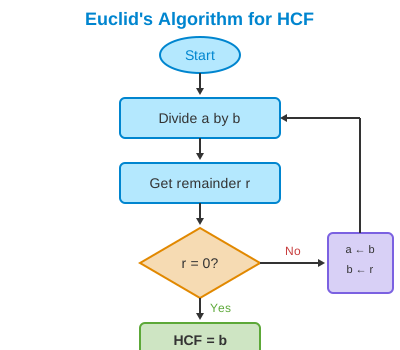
1. Euclid's Division Algorithm for finding HCF — you apply the lemma repeatedly (divide, swap, repeat) until the remainder hits 0. Each step uses EDL once.
Look at the flowchart on the board — this shows exactly how the algorithm works. You divide by , get the remainder , and if is not zero, you swap: becomes , and becomes . Then repeat until .
2. Case-analysis proofs about forms of integers — when you divide any integer by 3, EDL guarantees the remainder is 0, 1, or 2. So every integer is of the form , , or . This technique is used to prove results like "the square of any odd number is of the form ".
4. Using EDL as a four-way relationship
The formal statement is now well understood. What remains is to see the division equation not as a formula that goes in one direction, but as a four-way relationship — given any three of the four quantities, we should be able to find the missing one and verify that the constraint still holds.
The equation connects four numbers:
- dividend (dividend)
- divisor (divisor)
- quotient (quotient)
- remainder (remainder)
If you know any three, you can find the fourth.
Example: If , , and , then:
Your Turn 🧮
A division gives:
- Quotient = 23
- Remainder = 19
- Divisor = 31
What is the dividend?
Show your working and verify that the remainder constraint () is satisfied.
The equation is a four-way relationship. If you know any three of the four values, you can find the missing one.
Finding each variable:
- Know , , → find :
- Know , , → find :
- Know , , → find :
- Know , , → find :
Here, we're given , , . So we use the formula to find :
Let's compute step by step:
- So sum
Then .
The dividend is 732.answer
Verification: Is the remainder constraint satisfied?
We need , i.e.,
✓ Yes! is non-negative and less than .
Always verify the remainder constraint: Is ? Yes! This confirms the division equation is valid — the quotient wasn't too small or too large.