Divisibility Patterns in Consecutive Integers
Welcome! Today we're exploring Divisibility Patterns in Consecutive Integers — one of those satisfying topics where a pattern you've always noticed finally gets a proper proof.
Here's a pattern you've probably noticed but never proved:
Pick any three consecutive numbers — say 7, 8, 9example — and exactly one of them is divisible by 3.
Always. No matter which three you pick.
We're going to prove this rigorously using the division lemma — no hand-waving, just solid reasoning.
Then we'll use it to crack a beautiful result:
| Expression | Property |
|---|---|
| Always divisible by 6key |
For any positive integer . Always.
1. Checking divisibility for all three numbers in one case
Here's a pattern you've probably noticed but never proved:
Pick any three consecutive numbers — say 7, 8, 9 — and exactly one of them is divisible by 3.
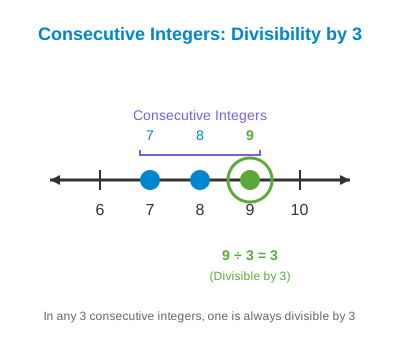
Always. No matter which three you pick.
We're going to prove this rigorously.
The division lemma with divisor 3 gives us three cases for any integer :
Key discipline: In each case, you must check all three numbers — not just find the one that works.
Let's start with the first case: , which means .
Our three consecutive integers are:
Your turn 🧮
When , state the values of , , and .
For each one, say whether it is divisible by 3 or not — and if not, state what remainder it leaves.
How many of the three are divisible by 3?
When , let's check each of the three consecutive integers:
— Is this divisible by 3? Yes — it's 3 times . Remainder: 0.
— Is this divisible by 3? No — when you divide by 3, you get quotient and remainder 1leftover. The prevents exact division.
— Divisible by 3? No — remainder is 2leftover.
So exactly one () is divisible by 3, and the other two are not.
Why do we need to check all three?
Because the claim isn't just "at least one is divisible by 3" — it's "exactly one."
This is a crucial distinction! "At least one" would be satisfied even if two or all three were divisible. But we're proving something stronger.
If we only showed is divisible, someone could argue that maybe or is also divisible.
By checking each one's remainder, we rule that out.
- → remainder 0divisible → divisible ✓
- → remainder 1 → not divisible ✗
- → remainder 2 → not divisible ✗
2. The r = 1 and r = 2 cases — where the divisible number shifts
In the r = 0 case, it was itself that was divisible by 3.
In the other two cases, the divisible number shifts:
- Sometimes it's
- Sometimes it's
You need to track which one it is in each case.
You've already shown that when r = 0 (), exactly is divisible by 3.
Now complete the proof for the other two cases.
Tip: Expressions like can be simplified to show divisibility — factor out the 3!
For r = 1 () and r = 2 (), check all three numbers , , in each case.
Which number is divisible by 3 in each case? Show why by simplifying the expression.
Let's work through both cases carefully.
Case r = 1 (n = 3q + 1):
- . Remainder when divided by 3: 1r=1. Not divisible.
- . Remainder: 2r=2. Not divisible.
- . Now, . This IS divisible by 3 — it's 3 times .
So n + 2winner! is the one divisible by 3.
Case r = 2 (n = 3q + 2):
- . Remainder: 2≠0. Not divisible.
- . Divisible by 3.
- . Now, 4 divided by 3 gives quotient 1 remainder 1. So . Remainder: 1. Not divisible.
So n + 1 is the one divisible by 3.
Notice the pattern: as increases from 0 to 2, the divisible number shifts from to to .
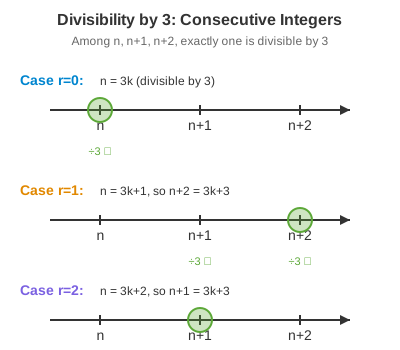
In every case, exactly one of the three consecutive integers is divisible by 3.
The 'exactly one'key is confirmed by checking all three — the non-divisible ones always have remainder 1 or 2.
3. Factoring before case analysis
You've proved the consecutive integer result — that among any three consecutive integers, exactly one is divisible by 3. 🎯
Now we're going to use it. But first, there's a strategic move that makes the proof much cleaner.
Instead of cubing and doing messy algebra, you factor the expression first.
Consider the expression .
Before doing any division lemma case analysis, there's an algebraic step that transforms this into something much easier to work with.
Factor completely.
What do you notice about the factors?
Why is this factored form useful for proving divisibility?
Let's work through the factoring step by step. Start by factoring out :
Now, is a difference of squares:
So we get:
Notice something beautiful here — these are three consecutive integers: , , and consecutive!
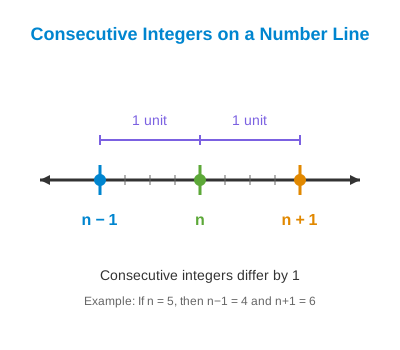
Look at these three factors: , , . They're three consecutive integers.
If , you get .
If , you get .
Why does this help?
Because you've already proved that among any three consecutive integers, exactly one is divisible by 3.
So the product must contain a factor of 3.
This means proven! is always divisible by 3, no matter what integer you choose!
This is the 'factor before case analysis' strategy: instead of cubing for each and wading through ugly algebra, you factor first and reduce the problem to a result you've already proved.
Much cleaner.
The key insight: — a product of three consecutive integerskey!. And we've already shown that any product of three consecutive integers is divisible by 3!
4. Proving divisibility by 6 — combining two arguments
You've factored into three consecutive integers and connected it to divisibility by 3.
But the claim is divisibility by 6, not just 3.
You need a second argument for divisibility by 2, and then a way to combine both.
What you've established so far:
You've shown that:
This is the product of three consecutive integers.
You know this product is divisible by 3 because among any three consecutive integers, one is a multiple of 3.
Now prove that is also divisible by 2.
Then explain why being divisible by both 2 and 3 means it's divisible by 6.
Divisibility by 2: Look at any two consecutive integers, like and . One is even and one is odd — they alternatepattern.
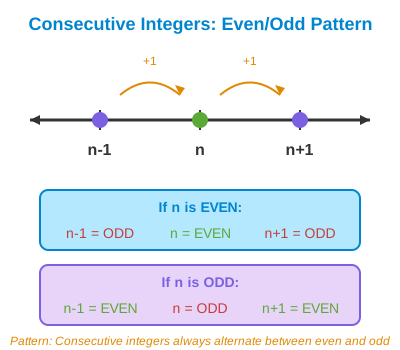
If is even, then is odd.
If is odd, then is even.
So among and , one is always even.
So the product always contains at least one even factor, which means the whole product is divisible by 2.
Divisibility by 3: You already proved that among three consecutive integers, exactly one is divisible by 3. So the product product contains a factor of 3.
Combining them: The product is divisible by 2 AND by 3. Can we conclude it's divisible by 6?
Yes — but only because 2 and 3 are coprime (their GCD is 1, they share no common factors).
When two coprime numbers both divide a value, their product also divides it.
So coprime divides the product .
Important: This reasoning wouldn't work for, say, 4 and 6.
A number can be divisible by both 4 and 6 without being divisible by 24.
Example: 12our counterexample is divisible by 4 ✓ and divisible by 6 ✓
But 12 is NOT divisible by 24 ✗fails!
The 'coprime' condition is essential.
Since 2 and 3 share no common factors (they're coprime), divisibility by both guarantees divisibility by their product 62×3.
5. A different application — n squared minus 1 divisible by 8 for odd n
You've seen how factoring and consecutive integer reasoning prove divisibility by 6.
Here's a different application of the same toolkit — this time targeting divisibility by 8, which requires a clever choice of divisor.
Consider the claim:
If is an odd positive integer, then is divisible by 8.
You know from earlier work that every positive odd integer is of the form:
- , or
Using these two cases ( and ), compute for each and show that both results are divisible by 8.
Let's expand both cases step by step.
Case :
Factor out 8:
This is clearly divisible by 8 — it's 8 times somethingkey!.
Case :
Factoring out 8:
, ,
So: 8 is factor
✓ Divisible by 8
Why divisor 4 instead of divisor 2?
Notice why we used divisor 4 (giving forms and for odd integers) rather than divisor 2 (giving ).
This is a crucial strategic choice — the divisor you pick determines what factors naturally appear in your algebra.
What happens with divisor 2:
With divisor 2, you'd get:
This only shows divisibility by 4not 8!, not by 8.
See the problem? The factor of 8 just doesn't appear naturally.
What happens with divisor 4:
The larger divisor gives terms involving and , which are both divisible by 8.
Key insight: Choosing the right divisor is what makes the target factor appear naturally.
When you want to prove divisibility by 8, using divisor 4 gives you coefficients like 16 and 8÷8 — both multiples of 8. The factor of 8 just falls out of the algebra without any extra cleverness needed.