Euclid's Division Algorithm — Chaining Divisions to Find HCF
Welcome! Today we're exploring Euclid's Division Algorithm — a method for chaining divisions together to find the HCF of any two numbers.
You can now perform a single division step confidently — bracketing, verifying, self-correcting.
The question is: how do you chain these steps together to actually find the HCF of two numbers?
Euclid's Division Algorithm is the answer.
| Fact | Detail |
|---|---|
| Age | Over 2300 years old |
| Status | Still the most efficient method for computing HCF by hand |
The beauty of this algorithm:
- No factorisation required
- Just divide, swap, and repeat
- The HCF appears automatically at the end
By the end of this section, you'll understand:
- Why this algorithm works — not just how
- What HCF really means at a deeper level
- Preparation for the back-substitution technique (expressing HCF as a linear combination)
1. The three-step algorithm
We are trying to describe a mechanical procedure — a recipe — that takes any two positive integers and produces their HCF.
The challenge is to be precise about what happens at each stage:
- What you divide
- What you check
- What you swap
- When you stop
Euclid's Division Algorithm is a method for finding the HCF of two positive integers.
It uses the division equation repeatedlykey.
Describe the algorithm in steps. 🤔
Given two positive integers and (with ):
- What do you do first?
- What do you check?
- What do you do if the remainder is not 0?
- When do you stop, and what is the HCFgoal?
Euclid's Division Algorithm is three steps on repeat:
Step 1: Divide the larger number () by the smaller number (). Write: , where .
Step 2: Check the remainder. If stop!, you're done — the divisor is the HCF.
Step 3: If , swap the pair: the old divisor becomes the new dividend, and the old remainder becomes the new divisor. Now you have the pair . Go back to Step 1.
The swap is the crucial move.
After dividing by to get remainder , the NEXT division is divided by — not divided by .
This is where students often slip up. You don't keep dividing the original number . The divisor from the previous step becomes the dividend for the next step.
The old divisor moves up to become the new dividend.
| Step | Dividend | Divisor | Remainder |
|---|---|---|---|
| 1 | |||
| 2 | |||
| 3 |
Notice the pattern: each row's divisor becomes the next row's dividend!
This creates a chain — the numbers cascade down, getting smaller each time until the remainder hits zeroSTOP.
2. Why HCF(a, b) = HCF(b, r)
We now know the steps of Euclid's algorithm. But knowing the steps does not explain why they work.
The next piece we need is the mathematical reason behind the swap:
When we replace the pair with , we need to be sure the HCF has not changed.
This is the engine that powers the entire algorithm.
Here's what we know:
The algorithm replaces the pair with at each step.
For this to work, must equal whenever .
Your task 🎯
Explain why when .
Your explanation should cover both directions:
- Why every common divisor of is also a common divisor of
- Why every common divisor of is also a common divisor of
Here's why swapping the pair doesn't change the HCF. We need to show that and have exactly the same common divisors.
Think about it this way: if both pairs share the exact same set of common divisors, then their greatest common divisor must also be the same!
So our proof strategy is clear:
Direction 1: Show that every common divisor of is also a common divisor of .
Direction 2: Show that every common divisor of is also a common divisor of .
If we prove both directions, the two sets of common divisors are identical — and therefore Goal.
Forward direction: Take any number that divides both and . Does also divide ?
Yes: . Since divides and divides (and hence ), must divide . So divides both and proven!.
Reverse direction: Now let's go the other way. Take any number that divides both and . The question is — does also divide ?
Yes! Look at the original equation: . Since divides , it must divide . And divides by assumption. So divides , which is exactly . Therefore divides both and ✓.
Both directions together: Every common divisor of is a common divisor of , and every common divisor of is a common divisor of . The two pairs share exactly the same common divisors — so their greatest common divisor must be equal. That's why (Key Result).
Since every common divisor of one pair is a common divisor of the other, the two pairs share the exact same set of common divisors.
Therefore they share the same greatest common divisor:
This is the mathematical engine of the algorithm. Each step replaces the problem with an equivalent one — same HCF, but smaller numbers.
3. Executing EDA on a concrete example
We have established both the procedure and the reason it preserves HCF.
Now it is time to put it all together:
Execute the full algorithm on an actual pair of numbers, chaining division steps with correct pair-swaps until the remainder hits zerogoal.
Let's find HCF(867, 255).
Since , start by dividing by .
Find HCF(867, 255) by executing Euclid's Division Algorithm.
Show every step, including the pair swap at each stage.
What is the HCF?
Let's walk through HCF(867, 255) step by step.
Step 1: Divide 867 by 255.
(since ).
Remainder: .
Remainder is not 0, so we continue.
Swap: new pair is (255, 102)new pair.
Step 2: Divide 255 by 102.
(since ).
Remainder: .
Remainder is not 0, so we continue.
Swap: new pair is (102, 51)Repeat until remainder is zero.
Step 3: Divide 102 by 51.
exactly.
Remainder is 0STOP. Stop!
The HCF is the divisor at this final step: 51.
Notice the chain:
Each step replaces the pair with a smaller equivalent one.
At the end, 51 divides 102 exactly, so HCF.
This is the power of Euclid's Algorithm — we keep reducing until the remainder becomes zero!
4. Why the algorithm must terminate
We can execute Euclid's algorithm and we understand why each swap preserves the HCF.
But there's a lurking question:
How do we know the remainders will ever reach zero? Could the algorithm run forever?
We need a mathematical guarantee that it must stop.
Here's what we know:
At each step of the algorithm, the pair is replaced by where .
So the sequence of remainders forms a decreasing chain:
decreasing
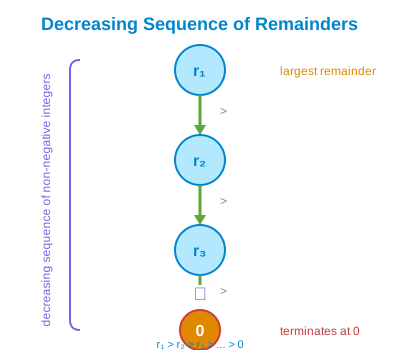
Think about this 🤔
Why must the algorithm eventually stop?
What mathematical property guarantees that you won't keep dividing forever?
The key is the constraint from each division step.
At every step, the remainder is strictly less than the divisor: .
This isn't just a small detail — it's the mathematical guarantee that makes the whole algorithm work!
When we swap the pair, becomes the new divisor. So the divisors at successive steps form a strictly decreasing chain:
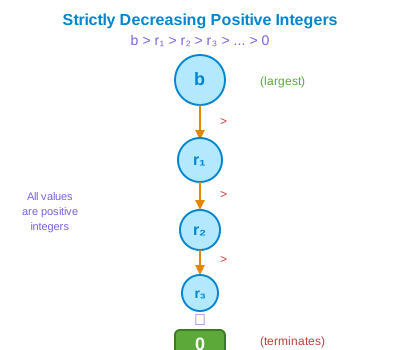
Look at the diagram on the board — each remainder is smaller than the one before, and they're all non-negative integers.
Here's the mathematical property: a strictly decreasing sequence of non-negative integers must terminate.
Why? There are only finitely many non-negative integers less than . You can't keep going down forever — eventually you must hit 0.
And when the remainder is 0, the algorithm stops!
Every value in this chain is a non-negative integer (remainders are always ). Now here's the mathematical fact: a strictly decreasing sequence of non-negative integers cannot go on forever.
Why? Because there are only finitely many non-negative integers below . If , the remainders can be at most and they must eventually reach stops here.
So the algorithm is guaranteed to terminate. You will never get stuck in an infinite loop of divisions.
This is the Well-Ordering Principle at work — every non-empty set of non-negative integers has a smallest element. Since our remainders form a strictly decreasing sequence of non-negative integers, we MUST reach 0key in finitely many steps.
5. Reading off the HCF correctly
The algorithm's logic and termination are now understood. The final detail — seemingly simple but a frequent source of lost marks — is reading the answer correctly from the last equation.
Three numbers appear on the right side of the final step, and only one of them is the HCF.
Here is the final step of an EDA computation:
The remainder is 0, so the algorithm stops here.
In the equation , there are three numbers on the right side: 8, 6, and 0.
Which one is the HCF, and why are the other two not the answer?
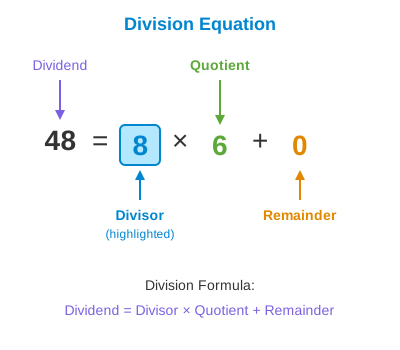
At the terminating step , three numbers appear on the right: 8 (the divisor), 6 (the quotient), and 0 (the remainder). Students sometimes grab the wrong one.
The HCF is 8 — the divisor.
Why not 6? The quotient tells us how many times the divisor fits — it's just a count, not a common factor.
Why not 0? The remainder being 0 is the signalsignal that we've found the HCF — it's not the HCF itself. Zero can't be the greatest common divisor of anything!
Why not 0? The remainder of 0 is the signal that tells you to stop. It means the division was exact. But 0 is not itself the HCF — it's the 'stop sign', not the destination.
Why not 6? That's the quotient — it tells you how many times 8 fits into 48. It has nothing to do with the HCF of the original pair.
The rule: The HCF is always the divisor at the step where the remainder first becomes 0.
In the equation , the divisor is 8HCF. That's the number that divides the previous remainder exactly, and by the chain of HCF-preserving swaps, it's the HCF of the original pair too.