HCF or LCM? Reading the Problem for the Right Operation
Welcome! Today we're tackling a crucial skill: HCF or LCM? Reading the Problem for the Right Operation.
This is where computation meets comprehension.
You can compute HCF and LCM flawlessly from prime factorisations. But in a word problem, the question never says 'find the HCF' — it says:
- 'Find the greatest length of each plank'
- 'After how many seconds will they beep together again?'
The real skill is translating the English into the right mathematical operation.
Choose wrong, and your entire answer is worthless.
By the end of this section, you'll recognise the patterns:
| Pattern | Operation |
|---|---|
| Breaking into equal parts | HCF |
| Aligning cycles or repetitions | LCM |
And you'll understand the reasoning well enough to handle any variant.
1. The core distinction: breaking down vs building up
Every HCF-or-LCM decision comes down to one fundamental question. Getting this principle clear saves you from memorising signal words — you'll understand the logic behind them instead.
Here's what we know:
- HCF is the largest number that divides all given numbers exactly
- LCM is the smallest number that all given numbers divide into
In word problems, these translate to two very different real-world actions.
Your turn 🤔
In your own words, describe the type of real-world situation that calls for HCF and the type that calls for LCM.
Give one example scenario for each (not the specific numbers, just the scenario type).
The core distinction:
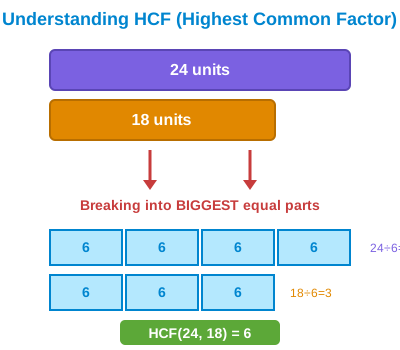
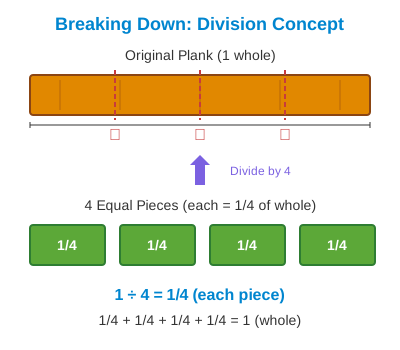
HCF = breaking DOWN into the biggest equal pieces.
The answer divides all the given numbers. You're chopping things up.
Look at the diagram on the left — see how we're taking a large bar and breaking it down into equal smaller pieces? That's HCF in action.
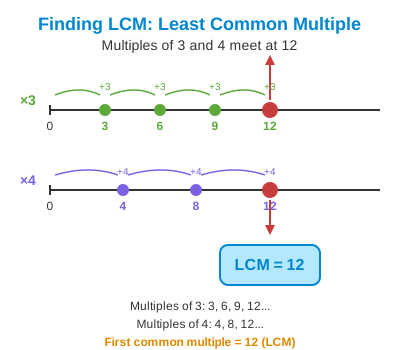
LCM = building UP to the smallest common landing point.
The answer is a multiple of all the given numbers. You're looking for when things line up.
Now look at the diagram on the right — see the number lines with steps of 3 and steps of 4? They first meet at 12. That's LCM — building up until everything aligns.
HCF Examples:
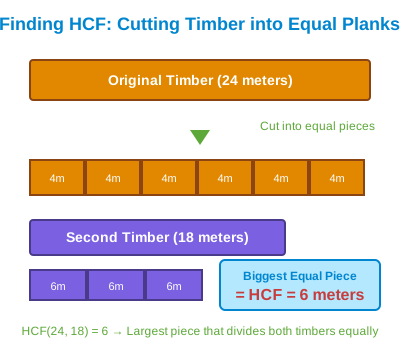
- Cutting timber into equal planks → biggest plank length
- Dividing students into equal groups → biggest group size
- Filling containers from different-sized tanks → biggest container that measures each exactly
LCM Examples:
- Two bells tolling at different intervals → when do they toll together?
- Finding the shortest length of cloth measurable by rods of different lengths
- Finding the least number divisible by all given divisors — again, you need the smallest multiple that all your numbers divide into evenly
The key test: Does the answer DIVIDE the given numbers (HCF), or do the given numbers DIVIDE the answer (LCM)?
- Plank length divides timber length → HCF
- Bell intervals divide the coincidence time → LCM
2. Reading signal words from a cutting/grouping problem
You understand the core distinction between HCF and LCM.
Now let's apply it to a specific problem and trace the reasoning from the English words to the mathematical operation.
Here's a problem:
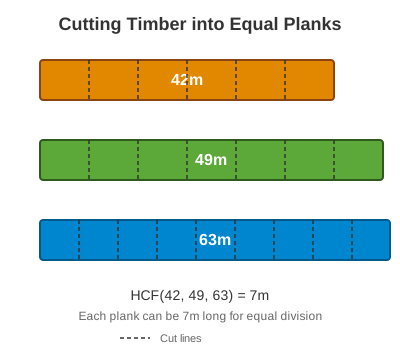
"Three pieces of timber are 42 m, 49 m, and 63 m long. They must be cut into planks of the same length. What is the greatest possible length of each plank?"
Is this an HCF or LCM problem?
Identify the specific signal words in the problem that tell you, and explain why those words point to HCFgoal.
Let's trace the reasoning for this timber problem.
The situation: three pieces of timber (42 m, 49 m, 63 m) are being CUT into planks of the SAME length, and we want the GREATEST possible plank length.
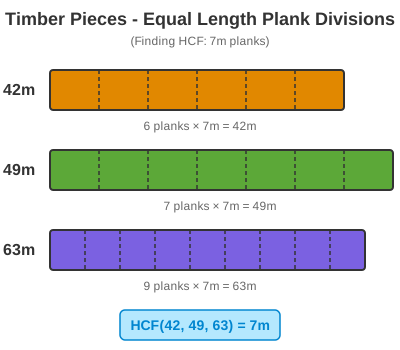
Signal word 1: 'cut into planks' — we're breaking the timber DOWN into smaller pieces. This is a dividing action.
Signal word 2: 'same length' — the plank length must work for all three timber pieces. It must divide 42, 49, and 63 exactly (no leftover timberkey constraint).
Signal word 3: 'greatest possible' — among all the lengths that divide all three, we want the biggest one.
Putting it together: we need the largest number that divides 42, 49, and 63. That's HCF(42, 49, 63).
⚠️ A common trap: students see 'greatest' and think LCM (because LCM gives a bigger number).
This is one of the most frequent errors in these problems!
But 'greatest' here modifies 'plank length,' which is a DIVISOR of the timber lengths.
The plank must divide evenly into 42 m, 49 m, and 63 m — no leftover timber!
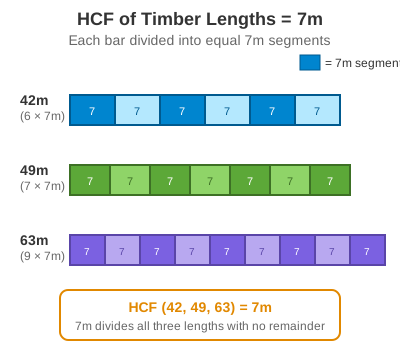
The greatest divisor = HCF
3. Reading signal words from a periodic-event problem
You can handle the 'cutting' context. Now let's look at the other type — periodic events — where the signal words and reasoning are completely different.
Here's a problem:
'An electronic device beeps every 54 seconds. Another beeps every 72 seconds. They beeped together just now. After how many seconds will they beep together again?'
Is this HCF or LCM?
Explain your reasoning in terms of what the answer represents — why must it be a multiple of both 54 and 72?
Let's understand this situation clearly. Two devices are beeping at different intervals — Device 1 beeps every 54 seconds, Device 2 beeps every 72 seconds. We want to find the next time they beep simultaneously.
Device 1 beeps at times: 54, 108, 162, 216, 270, ...
Device 2 beeps at times: 72, 144, 216, 288, ...
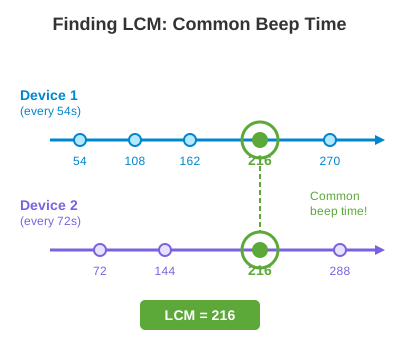
We need a time that appears in BOTH lists — a common multiple of 54 and 72. And since we want the earliest such time, we need the least common multiple.
This is LCM because:
- The answer (216) is divisible by 54 → beeps
- The answer (216) is divisible by 72 → beeps
The given numbers (54 and 72) divide INTO the answer — that's the LCM signal!
Why must the answer be a multiple of 54? Because Device 1 only beeps at multiples of 54. If the answer were, say, 200 seconds, Device 1 wouldn't beep at — so they couldn't beep together at that time.
Why must the answer be a multiple of 72? Same reason for Device 2 — it only beeps at multiples of 72.
So the answer must be a common multiple of both. The LEAST common multiple gives the NEXTearliest coincidence.
Let's compute :
Primes involved: 2 and 3.
For LCM, take the highest power of each prime:
- Highest power of 2: (from 72)
- Highest power of 3: (from 54)
seconds
seconds minutes seconds.
Answer: Both devices will beep together again at 216 seconds after they started.
Signal words to remember: When you see phrases like 'together again,' 'at the same time,' 'simultaneously,' or 'coincide' — these all point to LCMkey.
4. The trap: 'greatest' doesn't always mean LCM
You can handle both HCF and LCM computations. But there's a specific trap that catches many students — confusing the word 'greatest' in the problem with 'the operation that gives the bigger number.'
⚠️ The Trap: Seeing "maximum" or "greatest" and automatically choosing LCM because it gives bigger answers.
Let me show you a scenario where this trap appears.
Here's the situation:
A student sees this problem:
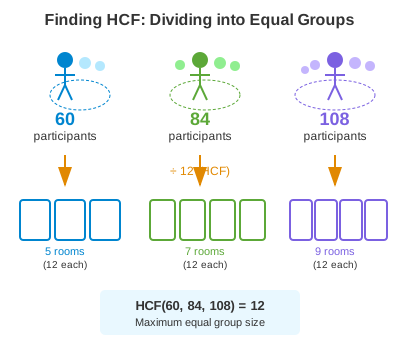
'Find the maximum number of participants per room if 60, 84, and 108 participants from three subjects are to be seated in rooms with equal numbers, all from the same subject.'
The student says:
'Maximum means biggest, so I should use LCMwrong! to get the biggest answer.'
Your task 🔍
What is wrong with the student's reasoning? Which operation is correct, and why? Compute the answer.
The student's mistake: they heard ʼmaximumʼ and reached for LCM because LCM gives a bigger number. But 'maximum' here modifies 'maximum' here modifies 'room size,' which is a DIVISOR of the participant counts.
Think about it physically: you have 60 Hindi students, 84 English students, 108 Maths students. Each room holds the same number, all from one subject. The room size must divide 60 (so Hindi students fill rooms exactly), divide 84, and divide 108.
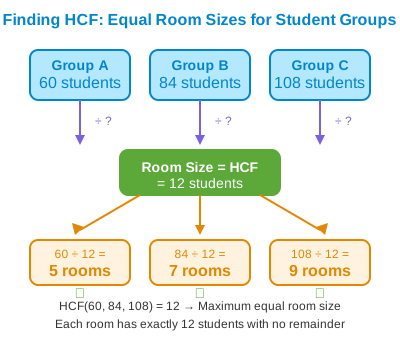
Room size = a common factor of 60, 84, 108. We want the maximum = HCFAnswer.
Let's compute:
Common primes: 2 (min power 2)min and 3 (min power 1)min. Note: 5 is missing from 84 and 108, 7 is only in 84.
HCF answer
Answer: The maximum number of participants per room is 12.
Sanity check: 12 divides 60 (gives 5 rooms), 84 (gives 7 rooms), 108 (gives 9 rooms). Total rooms = 21. Makes sense ✓
What if you'd used LCM? absurd. A room with 3780 seats? There aren't even that many students total . Nonsensical.
The lesson: 'Maximum' or 'greatest' in a dividing context points to HCF, not LCM.
Don't let signal words like 'maximum,' 'greatest,' or 'largest' automatically trigger LCM. Ask yourself: Is this answer supposed to DIVIDE the given numbers? If yes → HCF. Always.
Remember — context beats signal words. Always check what the answer actually DOES in the problem.