The Proof-by-Cases Template Using Division
Welcome! Today we're exploring The Proof-by-Cases Template Using Division — a powerful technique that will make a whole family of proofs feel almost automatic.
You already know that dividing by 2 splits all integers into even and odd.
What if you divide by 3, or by 5, or by any number?
You get a complete set of cases — and that's the engine behind a whole family of proofs.
| Divide by | Number of cases |
|---|---|
| 2 | 2 (even, odd) |
| 3 | 3 (remainder 0, 1, 2) |
| n | n cases |
By the end of this section, you'll be able to:
- Take any 'show that every integer is of the form ...' question
- Write the proof from a clean four-step template
1. How dividing by b produces exactly b cases
We're starting at the very foundation of proof-by-cases.
Before writing any proof, you need to see:
- Why dividing all integers by a fixed number creates a complete, gap-free partition into cases
- How many cases you get
This partition is the engine behind a whole family of proofs.
Here's what you already know:
When you divide any positive integer by 2, the remainder is either 0 or 1 — giving two forms:
- (even)
- (odd)
Every integer is exactly one of these.
Now let's think about dividing by a larger numberkey...
Your turn 🤔
If you divide every positive integer by 5, how many different forms do you get?
List all of them.
Then explain: Why is there no form ?
When you divide any positive integer by , the division lemma says there's a unique remainder satisfying .
The possible remainders are — that's exactly values in total.
For , the remainders are .
So every positive integer takes one of these five forms:
- (remainder 0)
- (remainder 1)
- (remainder 2)
- (remainder 3)
- (remainder 4)
Now, why no ? Because the constraint says , and is not less than .
But there's a deeper reason: . That's just a multiple of 5 — the casesame! with a different quotient.
The 'extra' remainder wraps around and gets absorbed into the next quotient. This is exactly why the constraint exists — it prevents double-counting.
2. The four-step proof template
Now that you see how division creates a complete partition, let's turn that into a proof method.
There's a clean four-step structure that every proof of the form 'show that every integer is of the form ...' follows.
Here's the template for proving that every positive integer falls into certain forms:
Step 1: Choose a divisor .
Step 2: Write with , and list all possible remainders.
Step 3: For each remainder, write out the corresponding form of .
Step 4: Conclude which forms are valid.
You've seen this done for divisor 2b=2 (even/odd) and divisor 3b=3 (three forms).
Your turn! 📝
Using this template, prove that every positive integer is of the form , , , or .
Write out the full proof, making sure you:
- State which divisor you're using
- Explain why there are exactly four caseswhy 4?
- Show what each case gives you
Let's walk through the template with divisor 4.
Step 1: Choose divisor b. (The question mentions , so the divisor is 4.)
Step 2: By Euclid's Division Lemma, for any positive integer , there exist unique and such that , where .
So can be 0, 1, 2, or 3 — giving us exactly four casescases to consider.
Step 3: Write out each case:
- : — this is a multiple of 4
- : — one more than a multiple of 4
- : — two more than a multiple of 4
- : — three more than a multiple of 4
Notice something? Every positive integer lands in exactly one of these four buckets. No overlaps, no gaps!key insight
Step 4: Since the division lemma guarantees every positive integer has a unique remainder when divided by 4, and the only possible remainders are 0, 1, 2, 3, every positive integer falls into exactly one of these four forms:
- (remainder 0)
- (remainder 1)
- (remainder 2)
- (remainder 3)
This completes the proof.
The key point: The proof works because the division lemma gives you a complete, non-overlapping partition.
- Complete:no gaps Every integer is covered (no gaps)
- Non-overlapping:no duplicates Each integer belongs to exactly one form (no duplicates)
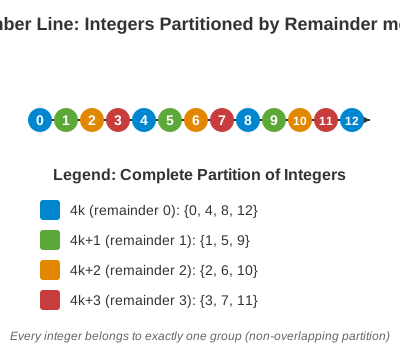
Look at the number line on the board — notice how every integer from 0 to 12 is colored exactly once? Blue for multiples of 4, green for 4k+1, orange for 4k+2, red for 4k+3. No number is left out, and no number has two colors.
You don't need to check specific numbers — the lemma handles all integers at once.
3. Why uniqueness makes the proof valid
You've seen the template and used it to list cases.
But there's a subtlety people often miss — the proof only works because of one specific property of the division lemma.
Without it, listing cases wouldn't prove anything.
Suppose someone writes:
'Every integer is of the form , , or .'
They list the three forms and say 'done.'
A mathematician says:
'Your proof has two gaps — you haven't shown that every integer falls into at least one of these forms, and you haven't shown that no integer falls into more than one.'
Think about this 🤔
How does the division lemma fill both of these gaps?
Specifically:
- Which word in the lemma's statement guarantees no overlaps?
- Which part guarantees no gaps?
The division lemma says: for any positive integers and , there EXIST UNIQUE whole numbers and such that with .
Two words do all the heavy lifting here: 'Exist' and 'Unique'.
- 'Exist' guarantees no gapsexist — every integer DOES fall into at least one of the forms .
- 'Unique' guarantees no overlapsunique — no integer falls into more than one form.
'Exist' — this means for every integer , at least one pair works. So every integer lands in at least one of the cases. No integer is left out. This fills the 'no gaps'key requirement.
'Unique' — this means for each , exactly one pair works. So no integer can land in two different cases simultaneously.
The number 10 can't be both and , because only one of these has a valid remainder.
This fills the 'no overlaps' requirement.
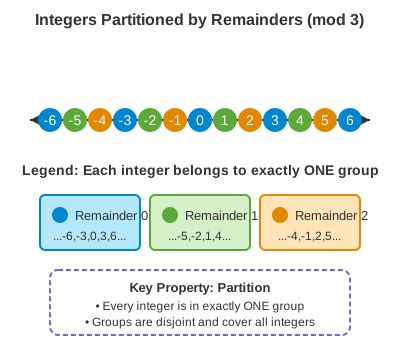
Together, existence and uniqueness give you a partition: every integer belongs to exactly one case.
Look at the diagram on the board — see how every integer lands in exactly one colored group? No integer is left floating outside, and no integer appears in two colors at once. That's a partition.
That's what makes proof by exhaustive cases logically airtight — you check every case, knowing nothing slips through and nothing gets counted twice.
So when someone says "every integer is of the form , , or " — the division lemma with guarantees this is a valid partition. Exist means no gaps. Unique means no overlaps.
4. Even/odd proof as a two-case instance of the template
We've established the proof-by-cases template and understood why it works mathematically.
Now let's make sure you can execute it on the simplest possible example — the one that splits all integers into just two groups.
Consider the statement:
"Every positive integer is either even or odd."
Recall:
- An even number is a multiple of 2
- An odd number is one more than a multiple of 2
Your Task ✍️
Write a proof of this statement using the division lemma.
Your proof should make clear why there are exactly two cases and no third possibility.
Here's the even/odd proof using the division lemma template:
Choose divisor . By the division lemma, for any positive integer , there exist unique and with:
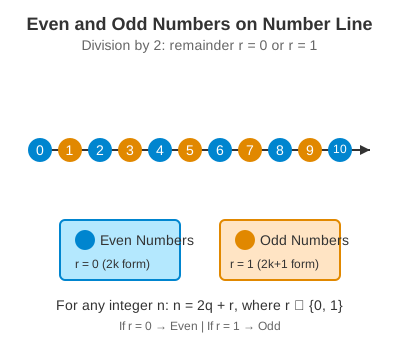
Since must be a whole number that's at least 0 and strictly less than 2, the only possibilities are:
- → → is even
- → → is odd
Just two cases. The division lemma guarantees there's no third possibilitykey!!
Case : . This is divisible by 2, so it's even.
Case : . This is one more than a multiple of 2, so it's odd.
The division lemma guarantees there's no third option. The remainder when dividing by 2 can only be 0 or 1 — those are the only whole numbers in the range .
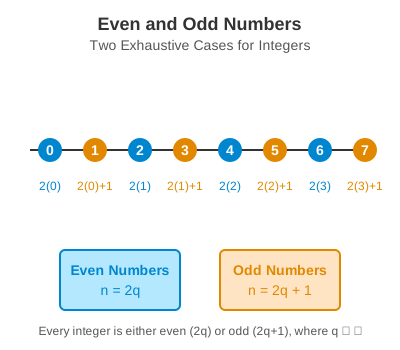
So every positive integer is either or , and never both.
This is the simplest instance of the template: two caseskey, no elimination needed, and the conclusion follows directly.
5. Applying the template to a new divisor
You've seen the template with divisors 2 and 4.
Now let's test whether you can apply it independently to a divisor you haven't worked with before — and handle the complete write-up on your own.
Consider the claim:
'Every positive integer is of the form , , , , , , or .'
How many cases does this proof have, and why?
Also, a classmate says there should be an eighth form, .
In one sentence, explain why that doesn't add a new case.
When you divide by 7, the division lemma says: with .
The possible remainders are 0, 1, 2, 3, 4, 5, 6 — that's seven valueskey!, so seven cases.
Now, what about ? Let's do the algebra:
This is a multiple of 7 — it's the form where . In other words, it's just the casesame! with a different quotient. It's not a new form.
This happens every time someone suggests as an extra case.
The division lemma's constraint catches this: if the remainder equals the divisor, you can absorb it into the quotient.
That's the whole point of requiring key constraint — it prevents this kind of double-counting.
General pattern: Dividing by always gives exactly cases, with remainders through . Never more.
This is the proof-by-cases template: choose your divisor , and the division lemma automatically partitions all positive integers into exactly exhaustive, non-overlapping cases.