Building Numbers from LCM: Remainder, N-Digit, and Constant-Deficit Problems
Welcome! Today we're tackling Building Numbers from LCM — where the LCM isn't the final answer, but just the starting point.
You've been computing HCF and LCM as endpoints.
Now the LCM becomes a stepping stone — the answer to the actual question is built FROM the LCM.
We'll see three ways to build the final answer:
| Construction Type | Final Step |
|---|---|
| Remainder problems | Add the remainder |
| Overshoot problems | Subtract the overshoot |
| Constant-deficit problems | Subtract the deficit |
These construction problems are some of the trickiest in the chapter.
The difference between adding and subtractingkey in the final step is where most marks are lost.
By the end of this section, you'll:
- Handle all three types confidently
- Know exactly when to add and when to subtract
1. Least number with a given remainder: why you ADD
Building Numbers from LCM 🔧
You've been computing HCF and LCM as endpoints. Now let's see how the LCM becomes a stepping stone — the answer to the actual question is built FROM the LCM.
The first construction type asks for the smallest number that leaves a specific remainder when divided by several divisors.
The LCM gives you the clean multiple — and the answer is a step beyond itkey.
Key Insight 💡
If a number leaves remainder 7 when divided by 35, then:
is exactly divisible by 35
Similarly for the other divisors:
- is exactly divisible by 56
- is exactly divisible by 91
So must be a common multiple of all the divisors.
Your Challenge 🎯
Find the least number which when divided by 35, 56, and 91 leaves remainder 7 in each case.
Show why you ADD the remainder to the LCM rather than subtracting it.
(Work through the factorisation, find the LCMkey, and explain your reasoning for the final step)
Think about what the question says: the number leaves remainder 7 when divided by 35, 56, and 91.
This means:
Rearranging: is divisible by 35, 56, and 91. So is a common multiple of all three.
For the LEAST such number, we want the smallest common multiple: key formula.
Computing the LCM:
Let's find the prime factorisation of each divisor:
All primes involved: .
Notice that 7 appears in ALL three numbers.
For LCM, we take the highest power of each prime:
- Highest power of :
- Highest power of :
- Highest power of :
- Highest power of :
So the LCM is 3640.answer
So , meaning answer.
Why ADD? Because the number is the LCM plus the leftover. The LCM is the last 'clean' multiple before the number. The number sits 7 units beyond+7 it.
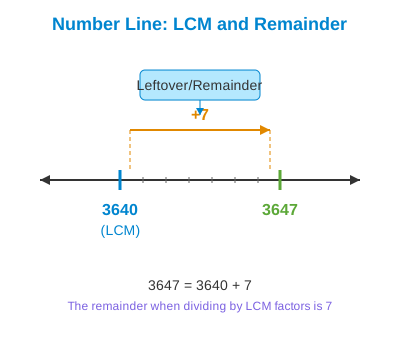
Verify:
remainder ✓
remainder ✓
remainder ✓
All three divisions give remainder 7 — our answer is correct!
2. Greatest N-digit multiple: why you SUBTRACT
New Challenge: Going Down Instead of Up 📉
In the previous problem, we built UP from 0 by adding a remainder to a multiple of the LCM.
Now we reverse direction:
- Instead of building up from 0, you start from the largest N-digit number
- Come down to the nearest multiple
This time you subtract.
Given Information:
- The greatest 4-digit number is 9999
- You need the largest multiple of that does not exceed 9999
- If 9999 is not itself a multiple, you go DOWN to the nearest one
Problem 🧮
Find the greatest 4-digit number exactly divisible by 15, 24, and 36.
Show:
- The LCM computation (using prime factorization)
- The division of 9999 by the LCM
- Explain why you subtract the remainder from 9999
Step 1 — Find LCM(15, 24, 36)
First, we break each number into prime factors:
All primes involved: 2, 3, 5. Take the highest power of each:
LCM =
Step 2 — Divide 9999 by 360
with remainder 279.
This means: , and .
Step 3 — Subtract the remainder
9999 is 279 units PAST the last multiple of 360. Think of it as standing at 9999 and walking backward to the nearest multiple. You walk back 279 steps.
Why SUBTRACT (not add)? Adding 279 would give — a 5-digit number, which overshoots. We want the greatest 4-digit number, so we go DOWN to 9720.
Verify: , , . All exact. ✓
So 9720Answer! is the greatest 4-digit number exactly divisible by 15, 24, and 36.
⚠️ Common mistake: Adding the remainder instead of subtracting.
| ❌ Wrong approach | ✅ Correct approach |
|---|---|
| Goes above 9999 (5 digits!) | Stays within 4 digits ✓ |
Remember — you're going DOWN from 9999, not up.
When finding the greatest number in a range, we need the largest multiple that does not exceed the limit. Subtracting the remainder takes us back to the nearest multiple below.
3. Constant-deficit problems: recognising equal gaps
The Trickiest Variant 🔍
The trickiest variant looks like it has different remainders — but a hidden pattern turns it into a clean subtraction problem.
The secret is in the gaps between the divisors and their remainders.
Here's the problem:
Find the smallest number which when divided by 28 gives remainder 8, and when divided by 32 gives remainder 12.
Notice that the remainders are different (8 and 12), so this doesn't look like the earlier 'same remainder' type we've seen.
Your Task ✏️
Compute (divisor − remainder) for each condition:
What do you notice?
Use this observation to find the answer. Explain what 'constant deficit' means and why the answer is LCM minus this deficit.
At first glance, the remainders are 8 and 12 — different. But compute the 'gap' between each divisor and its remainder:
Equal! This is the signal for a constant-deficit problem.
The "deficit" or "gap" is the same (20) for both conditions — this tells us the number falls short of a multiple of each divisor by exactly 20.
What does this mean? The number is 20 SHORT of the next multiple of each divisor.
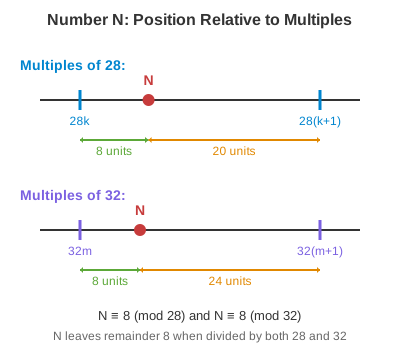
- Divided by 28: remainder 8 means the number is 8 past a multiple, but also 20 short of the NEXT multiple ().
- Divided by 32: remainder 12 means the number is 12 past a multiple, but also 20 short of the NEXT multiple ().
In both cases, the number falls short by exactly 20.
So (number + 20) is a multiple of both 28 and 32. The smallest such value is LCM(28, 32).
So our answer will be LCM minus 20.
Let's find the LCM:
Therefore: number + 20 = 224, so number = 224 - 20 = 204.
Verify:
- remainder ✓
- remainder ✓
Both correct!
Recognition trick: Whenever you see different remainders, compute (divisor - remainder) for each. If they're all equal, it's a constant-deficit problem.
4. Distinguishing the three construction types
You've now seen all three types of LCM construction problems.
The critical skill is telling them apart — because each type has a different final step, and mixing them up gives a completely wrong answer.
| Type | Final Operation |
|---|---|
| Remainder problem | LCM + remainder |
| N-digit problem | Limit − overshoot |
| Constant-deficit | LCM − deficit |
Let's see if you can classify problems correctly.
Classification Challenge 🎯
For each problem below, state which type it is and what the final operation is (add or subtract, and what). Do NOT solve — just classify.
(A) Find the least number which when divided by 12 and 18 leaves remainder 4 in each case.
(B) Find the greatest 3-digit number exactly divisible by 8, 12, and 15.
(C) Find the smallest number which when divided by 36 and 45 leaves remainders 11 and 20 respectively.
Let's classify each one.
(A) 'Least number... leaves remainder 4 in each case.'
Same remainder for all divisors. This is Type 1.
Setup: (number - 4) = LCM(12, 18). Answer = LCM + 4.
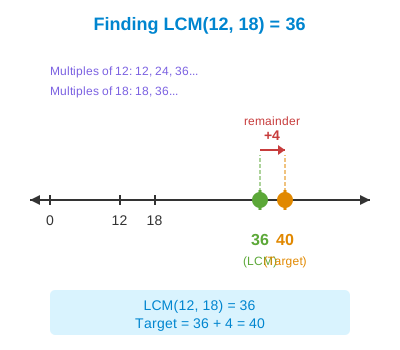
The number sits ABOVE the LCM by the remainder amount. ADD.key
(B) 'Greatest 3-digit number exactly divisible by 8, 12, and 15.'
Greatest N-digit exact multiple. This is Type 2.
Setup: Find LCM(8, 12, 15), then find the largest multiple of LCM that fits in 3 digits.
Divide 999 by LCM, get remainder, subtract remainder from 999.
The number sits BELOW 999. SUBTRACT the overshoot.
(See the number line diagram — 999 overshoots the target, so we walk backward.)
(C) 'Divided by 36 leaves remainder 11, divided by 45 leaves remainder 20.'
Different remainders — check deficits: , . Equal! This is Type 3.
Setup: (number + 25) = LCM(36, 45). Answer = LCM - 25.
The number sits BELOW the LCM by the deficit amount. SUBTRACT.Key!
Quick summary:
- Type 1 (same remainder given): ANSWER = LCM + remainder
- Type 2 (greatest N-digit): ANSWER = limit - overshoot
- Type 3 (equal deficits): ANSWER = LCM - deficit
Types 2 and 3 both subtract. Type 1 adds. The common error is adding when you should subtract, or vice versa.