Notebook
00:08
12 Apr 2026

HCF from Prime Factorisations: The Lowest-Power Rule

Welcome! Today we're learning HCF from Prime Factorisations: The Lowest-Power Rule — a clean, systematic method that replaces guesswork with logic.

You've learned to factorise numbers into their unique prime fingerprints.

Now we put that fingerprint to work.

Finding the Highest Common Factor used to mean trial and error — but with prime factorisations in hand, it becomes a simple comparison:

  • Which primes do both numbers share?
  • How many of each?

By the end of this section, you'll be able to:

GoalWhat you'll do
ComputeFind HCF from any pair of factorisations
UnderstandKnow WHY the lowest-power rule works
VerifyUse a sanity check that catches the most common swap error

1. Identifying common primes between two factorisations

Finding HCF from Prime Factorisations 🔍

You've learned to factorise numbers into their unique prime fingerprints. Now we put that fingerprint to work!

Before you can apply any power rule to find the HCF, you need to see which primes the two numbers actually share.

This is the first step — and missing a prime or including a non-shared one changes the answer completely.

📋 Given Info

Let's look at two numbers and their prime factorisations:
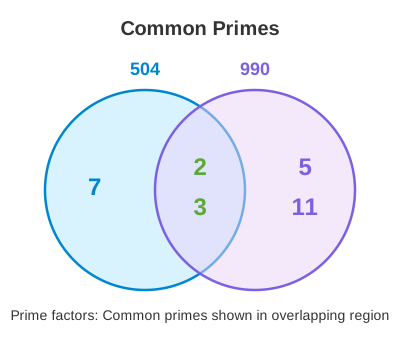
504=23×32×7504 = 2^3 \times 3^2 \times 7

990=2×32×5×11990 = 2 \times 3^2 \times 5 \times 11

Venn diagram with two overlapping circles. Left circle labeled '504' contains 7 in the non-overlapping part. Right circle labeled '990' contains 5 and 11 in the non-overlapping part. The overlapping region contains 2 and 3. Title: Common Primes

Primes appearing in 504: {2,3,7}\{2, 3, 7\}

Primes appearing in 990: {\{ 2,32, 3 ,5,11}, 5, 11\}

✍️ Question

Your turn 🤔

  1. Which primes are common to both 504 and 990?

  2. Which primes appear in only one of them?

  3. Explain why the non-common primes cannot be part of the HCF.

To find common primes, look at both factorisations side by sideHow you spot which primes they share:

504=23×32×7504 = 2^3 \times 3^2 \times 7One of the two factorisations to compare

990=2×32×5×11990 = 2 \times 3^2 \times 5 \times 11The other factorisation to compare

Primes in 504: 2, 3, 7

Primes in 990: 2, 3, 5, 11
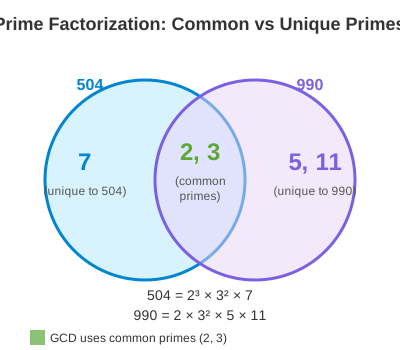
Venn diagram with two overlapping circles labeled 504 and 990. Left only: 7. Overlap: 2, 3. Right only: 5, 11. Shows common vs unique primes.

Common to both: 2 and 3commonThe only ones that appear in both numbers — these appear in BOTHOnly these can be part of the HCF lists.

Only in 504: 7

Only in 990: 5 and 11

✍️ MCQ
Choose one
Why can't the prime 77 be part of the HCF of 504504 and 990990?

The HCF can only include primes that divide BOTHIf it doesn't divide both, it can't be in the HCF numbers. A prime that appears in only one factorisationIt's automatically excluded from the HCF cannot be part of any common factor — because it simply doesn't divide the other number!

A Venn diagram is the perfect way to visualise which prime factors the two numbers share and which belong to only one of them. The overlap region reveals exactly which primes can contribute to the HCF.
-20-15-10-551015205-5018025260018025260057Prime Factors of 180, 252, and 600180 = 2² × 3² × 5252 = 2² × 3² × 7600 = 2³ × 3 × 5²2, 32 and 3 are in ALL threeAB50499072, 35, 11
✍️ MCQ
Choose one
Which primes are common to both 504=23×32×7504 = 2^3 \times 3^2 \times 7 and 990=2×32×5×11990 = 2 \times 3^2 \times 5 \times 11?

Why can't the HCF include 7If a prime isn't in both, it can't be in HCF?

Because HCF must divide bothCommon means it must be in both numbers numbers. If HCF contained a factor of 7, then HCF would need to divide 990.

But 990=2×32×5×11990 = 2 \times 3^2 \times 5 \times 11No 7 anywhere in this factorisation — there's no 7no 7!990 cannot be divided by 7 in its factorisation.

A number without 7 in its prime factorisation is not divisible by 7 (by FTA uniquenessThere's no other way to factor it). So including 7 in the HCF would make it fail to divide 990.

✍️ MCQ
Choose one
If we tried to include 5 in the HCF of 504 and 990, which number would the HCF fail to divide?

Same logic for 5 and 11 — they're not in 504's factorisation, so they can't be in any number that divides 504.

Key insight:The key principle for finding HCF Only primes that appear in both factorisationsMust be in both to be in the HCF can be part of the HCF.

The Rule for Finding HCF from Prime Factorisations:

HCF includes only primes that appear in ALLEvery single number must share the prime — no exceptions the given factorisations.

✍️ Yes/No
Yes or No?
If we're finding the HCF of three numbers and a prime appears in only two of them, can it be part of the HCF?

Why does this rule work?

The HCF must divide both numbers exactlyIt can't be part of their common factor. If a prime appears in only one factorisation, it cannot divide the other number — so it cannot be part of the HCF.

For 504 and 990:

  • Primes in 504: {2,3,7}\{2, 3, 7\}
  • Primes in 990: {2,3,5,11}\{2, 3, 5, 11\}
  • Common primes: {2,3}\{2, 3\}These are the primes shared by both numbers ✓ These go into the HCF
  • Non-common primes: 7 (only in 504), 5 and 11 (only in 990) ✗ These are excludedPrimes not shared by both are excluded from HCF
✍️ MCQ
Choose one
For 504=23×32×7504 = 2^3 \times 3^2 \times 7 and 990=2×32×5×11990 = 2 \times 3^2 \times 5 \times 11, which primes will appear in the HCF?

2. Why the LOWEST power of each common prime

You know which primes to include in the HCF — the ones that appear in both factorisations.

Now you need to decide how many of each — and the answer is always the smaller power.

Understanding why is what prevents the swap error that costs full marks.
📋 Given Info
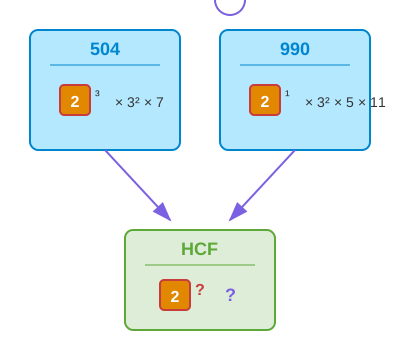
Two prime factorisation boxes side by side: left box labeled '504' showing 2^3 with the 2 highlighted, right box labeled '990' showing 2^1 with the 2 highlighted. Arrow pointing down to a question mark box labeled 'HCF' with '2^?' inside

Here's the situation:

  • 504 has 232^3 in its factorisation
  • 990 has 212^1 in its factorisation

Both numbers have the prime 2, but with different powers.

The HCF needs to include some power of 2.

✍️ Question

Should the HCF include 232^3 or 212^1?

Explain your choice by considering what happens if you pick the wrong one.

Think about what HCF means: the LARGEST number that divides BOTHHCF must work for both numbers at once given numbers. The key constraint is 'divides both'.

504 has 23=82^3 = 8504 can handle the higher power in its factorisation. So 504 is divisible by 8.

990 has 21=22^1 = 2990 is limited to the lower power in its factorisation. So 990 is divisible by 2, but NOTThe smaller power limits what divides both by 4 or 8.

✍️ Yes/No
Yes or No?
If we include 232^3 in the HCF, would the HCF divide 990?

If the HCF included 23=82^3 = 8, it would need to divide 990. But 990÷8=123.75990 \div 8 = 123.75not exactDivision gives a decimal, not whole. So 8 does not divide 990failsOnce it fails one number, it's out, and any number containing a factor of 8 cannot divide 990 eitherFactors of 8 can't divide 990 either.

The largest power of 2 that divides BOTH numbers is 212^1The smaller power is your limit. That's the bottleneckThe bottleneck determines the HCF990 limits how many 2s the HCF can have.

✍️ MCQ
Choose one
When finding the HCF, if one number has 343^4 and another has 323^2, which power of 3 goes into the HCF?
The Venn diagram shows which primes are shared, but now we need to see WHY we take the smaller power. The annotation reveals the 'bottleneck' — 990 limits how many 2s the HCF can have.
-20-15-10-551015205-5018025260018025260057Prime Factors of 180, 252, and 600180 = 2² × 3² × 5252 = 2² × 3² × 7600 = 2³ × 3 × 5²2, 32 and 3 are in ALL threeAB50499072, 35, 11For 2: min(2³, 2¹) = 2¹bottleneck: 990 only has 2¹

This is why the rule is: take the MINIMUM powerNot maximum, not average — minimum of each common prime. The number with fewer copies of that prime sets the limitIt limits how many times that prime can appear in the HCF.

If one number has 323^2Only has three squared and the other has 343^4Even though it has three to the fourth, the HCF can only use 323^2winnerThe smaller power always wins — because the first number won't be divisible by anything with more than two 3s.

✍️ MCQ
Choose one
For 504 and 990, both have the prime 3. We have 504=23×32×7504 = 2^3 \times 3^2 \times 7 and 990=2×32×5×11990 = 2 \times 3^2 \times 5 \times 11. What power of 3 should the HCF include?

3. Computing HCF from factorisations — full procedure

You understand which primes to include and why you take the lowest power.

Now let's put it all together and compute a complete HCF, with the sanity check that catches errors.

📋 Given Info

Here's what we're working with:

  • 504=23×32×7504 = 2^3 \times 3^2 \times 7
  • 990=2×32×5×11990 = 2 \times 3^2 \times 5 \times 11
✍️ Question

Your Task 📝

Compute HCF(504,990)\text{HCF}(504, 990).

Show:

  1. Which primes you include
  2. Which power you take for each
  3. The final computed value
  4. The sanity check you should apply to verify your answer makes sense

Let's go through it methodically.

Step 1 — List the factorisations side by side:

504=23×32×7504 = 2^3 \times 3^2 \times 7

990=21×32×5×11990 = 2^1 \times 3^2 \times 5 \times 11

✍️ MCQ
Choose one
Looking at these two factorisations, which primes are common to both 504504 and 990990?

Step 2 — Find common primes: 2 and 3Primes must be in both numbers to count appear in both. The primes 5, 7, 11Single-number primes are excluded from HCF each appear in only one — exclude themWe exclude primes not shared by both.

✍️ MCQ
Choose one
Why can't the prime 55 be included in HCF(504,990)\text{HCF}(504, 990)?

Step 3 — Take the minimum powerThis rule determines how HCF is calculated of each common prime:

  • Prime 2: powers are 3 and 1. Minimum = 1The smaller power is what both can share. Use 212^12 to the power 1 is the shared overlap.
  • Prime 3: powers are 2 and 2. Minimum = 2. Use 323^2.

See how we always pick the smaller power? That's the key.The smaller power represents the overlap

✍️ FIB
Fill in the blank
If one number has 252^5 and another has 232^3 in their prime factorisations, what power of 22 goes into the HCF?
33
Now let's annotate the case where both numbers have the same power — when both have 3², the minimum is simply 3². No bottleneck here.
-20-15-10-55101520105-5018025260018025260057Prime Factors of 180, 252, and 600180 = 2² × 3² × 5252 = 2² × 3² × 7600 = 2³ × 3 × 5²2, 32 and 3 are in ALL threeAB50499072, 35, 11For 2: min(2³, 2¹) = 2¹bottleneck: 990 only has 2¹For 3: min(3², 3²) = 3²same power in both

Step 4 — Multiply: HCF =21×32=2×9== 2^1 \times 3^2 = 2 \times 9 = 1818.

✍️ Yes/No
Yes or No?
If you had computed HCF =23×32=72= 2^3 \times 3^2 = 72 instead, would that be correct?

Step 5 — Sanity check: HCF must be \leq the smallest given number. Smallest is 504. Is 1850418 \leq 504? Yes. ✓

If your HCF had come out larger than 504, you'd know something went wrong — probably swapped the min/max ruleA common mistake to watch for.

Step 6 — Verify (optional but recommended): 504÷18=504 \div 18 = 2828No remainder means we got it right (exact). 990÷18=990 \div 18 = 5555(Clean division confirms our answer) (exact). Both divide cleanly. HCF confirmed. ✓

✍️ Subjective
Your turn
What are the two sanity checks you should apply after computing an HCF?

4. HCF of three numbers

-25-20-15-10-5510152025105-5018025260018025260057Prime Factors of 180, 252, and 600180 = 2² × 3² × 5252 = 2² × 3² × 7600 = 2³ × 3 × 5²

You can handle two numbers confidently. With three numbers, the procedure is identical — but there's one extra thing to watch:

A prime that's common to two of the three numbers but missing from the third gets excluded entirely.

📋 Given Info

Here are the three numbers and their prime factorisations:

  • 180=22×32×5180 = 2^2 \times 3^2 \times 5
  • 252=22×32×7252 = 2^2 \times 3^2 \times 7
  • 600=23×3×52600 = 2^3 \times 3 \times 5^2
✍️ Question

Compute HCF(180, 252, 600).

Be careful about which primes are common to ALL three numbers.

State your answer and verify it divides each of the three numbers.

The procedure for three numbers is the same as for twoThe approach is identical to two numbers — just check ALL three factorisationsA prime must appear in every single factorisation.

Our three numbers and their prime factorisations:

180=22×32×5180 = 2^2 \times 3^2 \times 5

252=22×32×7252 = 2^2 \times 3^2 \times 7

600=23×31×52600 = 2^3 \times 3^1 \times 5^2

✍️ MCQ
Choose one
Which primes are common to ALL three factorisations of 180180, 252252, and 600600?

Common primes — a prime must appear in ALL THREEMust be in every single number factorisations:

  • Prime 2: in 180 (power 2), in 252 (power 2), in 600 (power 3). ✅ Present in all three.
  • Prime 3: in 180 (power 2), in 252 (power 2), in 600 (power 1). ✅ Present in all three.
  • Prime 5:Present in 180 and 600, but not 252 in 180 (power 1), NOT in 252Missing from one number disqualifies it, in 600 (power 2). ❌ Missing from 252 — exclude.OUTTwo out of three isn't good enough
  • Prime 7: NOT in 180, in 252 (power 1), NOT in 600. ❌ Missing from two — exclude.
✍️ MCQ
Choose one
Why can't prime 5 be included in the HCF of 180, 252, and 600?
Let's mark the center of our Venn diagram to show which primes survived the test — appearing in all three numbers, not just two.
-25-20-15-10-5510152025105-5018025260018025260057Prime Factors of 180, 252, and 600180 = 2² × 3² × 5252 = 2² × 3² × 7600 = 2³ × 3 × 5²2, 32 and 3 are in ALL three

Take the minimum powerThe rule that determines your HCF limit across ALL THREE for each common prime:

  • Prime 2: min(2,2,3)=2\min(2, 2, 3) = 2. Use 22=42^2 = 4.
  • Prime 3: min(2,2,1)=1\min(2, 2, 1) = 1. Use 31=33^1 = 3.
✍️ MCQ
Choose one
Why do we use 313^1 instead of 323^2 in the HCF?

HCF = 22×31=4×3=122^2 \times 3^1 = 4 \times 3 = 12The largest number that divides all three evenly

✍️ FIB
Fill in the blank
What is HCF(180,252,600)\text{HCF}(180, 252, 600)?
1212

Sanity check: 1218012 \leq 180 (the smallest number)HCF must be smaller than or equal to smallest input. Good.

Verify:Final check to confirm your answer 180÷12=15180 \div 12 = 15(Each division should give a whole number), 252÷12=21252 \div 12 = 21, 600÷12=50600 \div 12 = 50. All exact.No remainder means correct answer confirmedAnswer confirmed correct

✍️ MCQ
Choose one
If the HCF of three numbers came out to be 250250, but the smallest of the three numbers is 180180, what can you conclude?

⚠️ The common trapA prime in two of three numbers tricks you with three numbers: including a prime that appears in two of the threeCommon means ALL three, not just most (like 5 here).

It must appear in ALLIf even one number is missing that prime, it's out of them, or it's out.

PrimeIn 180?In 252?In 600?Common to ALL?
2✅ Yes
3✅ Yes
5missing!252 has no factor of 5❌ NoMissing from one means out entirely
7❌ No
✍️ MCQ
Choose one
If a student included the prime 55 in their HCF calculation for 180180, 252252, and 600600, their answer would be: