The Unique Prime Fingerprint of Every Number
Welcome! Today we're exploring The Unique Prime Fingerprint of Every Number — a concept that's way more powerful than it sounds.
Think about the number 60. You can split it as:
| Factorisation | Result |
|---|---|
| 60 | |
| 60 | |
| 60 |
Different starting points, but they all end at the same collection of primes.
Why does that always happen? And why should you care?
Because this single fact — that every number has a unique prime fingerprint — is the engine behind:
- HCF and LCM
- Decimal classification
- Irrationality proofs
By the end of this section, you'll be able to:
- State the Fundamental Theorem of Arithmetic precisely
- Use its uniqueness guarantee to make definitive claims about what can and cannot divide a number
1. The two parts of FTA: existence and uniqueness
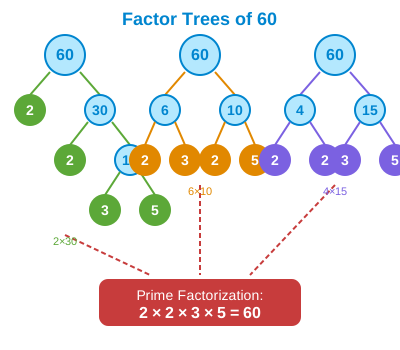
Think about the number 60. You can split it as:
Different starting points, but they all end at the same collection of primes. Why does that always happen?
We're starting with the statement itself. Before you can use the Fundamental Theorem of Arithmetic, you need to know exactly what it claims — and it claims two things, not onekey!.
Given Information:
The Fundamental Theorem of Arithmetic (FTA) is a statement about how positive integers relate to prime numbers.
It applies specifically to composite numbers — numbers greater than 1 that are not themselves prime.
State the Fundamental Theorem of Arithmetic. Make sure your statement has two distinct parts.
Then answer:
- Does FTA apply to the number 1??
- Does it apply to the number 7??
The Fundamental Theorem of Arithmetic makes two claims about composite numbers:
Part 1 — Existence: Every composite number CAN be written as a product of primes.
This is the less surprising part. Take any composite number, split it into factors, split those factors, keep going — since the pieces get smaller and are all at least 2, the process must stop with all primes.
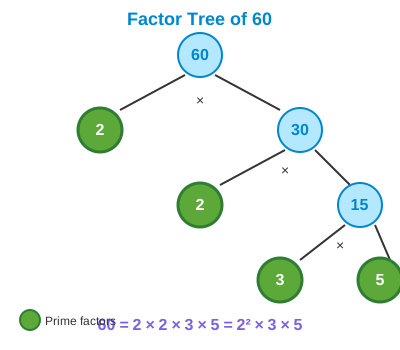
Part 2 — Uniqueness: There is only ONE waykey! to write a composite number as a product of primes (ignoring the order of the primes).
You cannot find a different set of primes that multiplies to the same number.
In short: Every composite number has a unique prime factorisation.
- Existence = you CAN always find a prime factorisation
- Uniqueness = there is only ONE such factorisation
The qualifier 'composite' matters. FTA applies to composite numbers — those with factors beyond 1 and themselves. What about the edge cases?
The number 1special has no prime factorisation at all. It is the 'empty product' — neither prime nor composite.
A prime number like prime has a trivial factorisation: just itself. It is already a product of one prime. FTA is usually stated for composites, but primes fit naturally if you allow single-prime products.
When stating FTA, always include both parts — existence AND uniqueness — and always say 'composite number,' not just 'number.'
2. Recognising a valid prime factorisation vs a non-prime factorisation
Think about the number 60. You can split it as:
Different starting points, but they all end at the same collection of primes. Why does that always happen?
You know what FTA claims. Now let's make sure you can tell the difference between a genuine prime factorisation and something that merely looks like one.
This distinction trips up students constantly.
Here's a scenario: 🤔
A student says:
"I found two different factorisations of 180: one is , and the other is . So FTA is wrong — there are two factorisations!"
Explain the student's error.
The key word in FTA is prime.'
FTA says the prime factorisation is unique — not that every factorisation into any factors is unique.
So and are both valid factorisations, but only the second one uses only prime factors.
Look at 180. You can write it many ways:
All of these are true factorisations of 180.
But only the last one is a PRIME factorisation — every factor in it is prime.
The others contain composite factors (4, 9, 20, 45)composite, so they are not prime factorisations.
When you break fully into primes, you get:
That's the same prime factorisation as the student's other expression. So there really is only one prime factorisation — the student just hadn't finished breaking down the first one!
The test for whether something is a prime factorisation: Is every factor in it a prime number?
If any factor is composite, you're not done — keep splitting.
3. Using FTA uniqueness to rule out a prime factor
Think about the number 60. You can split it as:
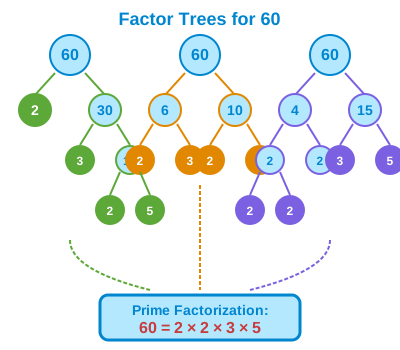
— different starting points, but they all end at the same collection of primes.
Why does that always happen?Key Q
Now we get to the real power of the Fundamental Theorem of Arithmetic.
- Existence tells you primes are there
- Uniqueness tells you which primes are NOT there
And that's what makes definitive arguments possible.
Once you know the prime factorisation of a number, FTA uniqueness tells you that no other prime factorisation exists.
If a prime does not appear in the factorisation, it truly cannot divide the number — there is no hidden alternative factorisation where it might appear.
The prime factorisation of is (since ).
Using FTA, explain why the number 5 can never divide not a factor, no matter how large is.
Why would checking examples like not be enough?
Here's the argument, step by step.
Start with the factorisation: , so .
Now, is already fully factorised into primes — the only prime present is 2only prime. No 3, no 5, no 7, nothing else.
Could 5 somehow divide this number through some other route? This is where FTA uniqueness does its work.
FTA says the prime factorisation is the ONLY one. There is no secret alternative factorisation of that sneaks in a factor of 5.
If 5 divided the numbernot possible, 5 would have to appear in the prime factorisation — but the only prime there is 2.
Why can't you just check examples?
Because , , — none divisible by 5.
But you've only checked three values of . What about ? Or ?
You can't check them all.
The FTA argument covers every at once:
The prime factorisation of is always — it has only 2skey, for any value of , period.
Since 5 never appears in the factorisation, and FTA says this factorisation is unique, 5 can never divide .
This is the real muscle of uniqueness — it lets you make statements about ALL values, not just the ones you've checked.
Without FTA, you'd be stuck saying "I checked a few cases and 5 didn't divide any of them." With FTA, you can confidently say "5 will never divide for any value of " — and you've proven it mathematicallykey, not just guessed it from examples.
4. The prime fingerprint idea and why it matters going forward
Think about the number 60.
You can split it as:
— different starting points, but they all end at the same collection of primes.
Why does that always happen?
You can now state FTA, spot fake factorisations, and use uniqueness to rule out prime factors. The last piece is seeing how this all connects — why a unique factorisation turns every number into a kind of identity card.
Every composite number has a unique prime factorisation.
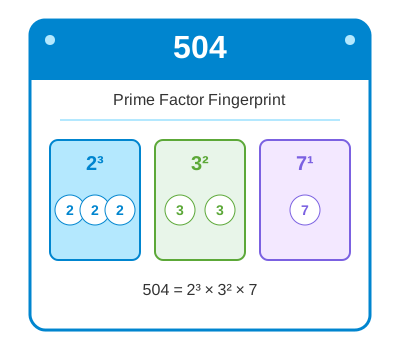
Think of it as a fingerprint: the number 504example is uniquely identified by , and no other number shares that exact combination of prime powers.
Your turn to think 🤔
Explain in your own words why the 'prime fingerprint' makes it possible to compute HCF and LCM mechanically by comparing prime powers.
What would go wrong if FTA were false — if a number could have two different prime factorisations?
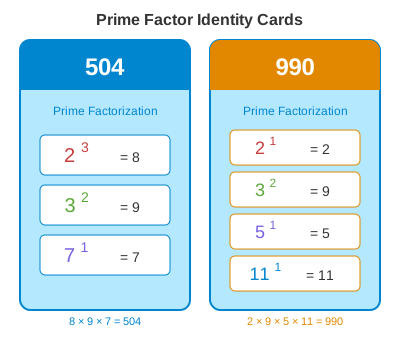
Think of every number as having an identity card listing its prime factors and their powers:
Just like your Aadhaar card uniquely identifies you, this prime fingerprint uniquely identifies the number.
FTA guarantees each number has exactly one such card. That's what makes comparison possible.
If two numbers share a prime on their cards, we can directly compare the powers. If a prime is missing from a card, we know it's not a factor — no guessing neededkey!.
For HCF, we take the minimum power of each common prime — because HCF must divide both numbers.
For LCM, we take the maximum power of each prime — because LCM must be divisible by both.
The fingerprint makes this completely mechanical — just compare the cards!
For HCF (the largest number dividing both), you look at each prime that appears on BOTH cards and take the smaller power.
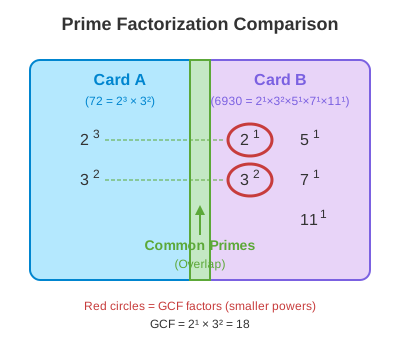
- Prime 2:
- Prime 3:
- Primes 5, 7, 11 are not on both cards — skip them.
For LCM (the smallest multiple of both), take the larger power of every prime on either card.
- Prime 2:
- Prime 3:
- Primes 5, 7, 11: take whatever power exists (1 each).
Now imagine FTA were false — suppose 504 could also be factorised as . Then "the power of 2 in 504" wouldn't be a single number — it could be 3 or 1 depending on which factorisation you looked at.
The min/max comparison would give different answers depending on your choice. The whole method collapses.
Uniqueness is what pins down a single power for each prime, making the comparison deterministic.