Translating Verbal Conditions About Zeros
Welcome! Today we're working on Translating Verbal Conditions About Zeros — a skill that turns word problems into solvable equations.
Many problems describe a relationship between zeros using words instead of numbers.
"One zero is twice the other" "The zeros differ by 3" "The product of zeros is equal to their sum"
The essential skill is translation:
| What you see | What you do |
|---|---|
| Verbal condition | Convert to equation |
| Words about zeros | Sum or product formula |
Once translated, the coefficient formulas solve the equation instantlykey benefit.
- No guessing
- No trial and error
- Just direct calculation
1. Translating reciprocal and negative conditions
📝 Translating Verbal Conditions About Zeros
The two most common verbal conditions — reciprocal zeros and negatives of each other — each have a single-line translation.
Mastering these translations makes many problems trivial.
Key Facts:
- Reciprocal zeros: product α·β
- Negatives of each other: sum α+β
Your Turn ✍️
For each condition, state the algebraic translation:
(a) The zeros of a quadratic are reciprocals of each other.
(b) The zeros of a quadratic are negatives of each other.
For each, state what equals what, and connect it to the coefficients of the quadratic .
Translation dictionary:
Reciprocal zeros: zeros are and .
Product key
Coefficient equation:
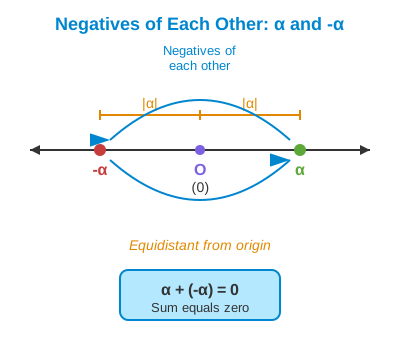
Negatives of each other: zeros are and .
Sum key!
Look at the number line on the board — see how and are mirror images across zero?
Coefficient equation: , which means answer
Summary: Zeros are negatives of each other
Notice: reciprocal is about the PRODUCT, while negatives is about the SUM. Do not confuse them.
2. Applying the reciprocal condition to find an unknown
The reciprocal condition becomes powerful when applied to polynomials with unknown coefficients.
When we know that product of zeros = 1 (the reciprocal condition), this translates to:
This gives us a direct equation for the unknown.
Given Information:
Consider the polynomial
We're told that one zero is the reciprocal of the other.
This means:
- If the zeros are and , then
- So their product: key!
Question:
If one zero of is the reciprocal of the other, find find.
Reciprocal zeros: product = 1.
When one zero is the reciprocal of the other, their product must equal 1.
If the zeros are and , then:
This is the key translation from the verbal condition to algebra.
For the polynomial :
- Leading coefficient (call it ) =
- Constant term (call it ) =
Product of zeros = = = key!
Solving for :
Cross-multiply:
Rearrange:
Recognise: this is
So answer.
The equation happened to be a perfect square — typical of well-designed problems. Clean answer, clean algebra.