Notebook
00:04
12 Apr 2026

Zeros in Arithmetic Progression and Cubic Symmetric Functions

Welcome! Today we're exploring Zeros in Arithmetic Progression and Cubic Symmetric Functions — a powerful pattern that shows up again and again in cubic problems.

A favourite pattern in cubic problems: the three zeros are in arithmetic progression (AP).

When zeros follow a pattern, the algebra becomes surprisingly clean.

The smart notation we'll use:

ZeroExpression
First(ad)(a - d)
Middleaa
Third(a+d)(a + d)

This choice makes the sum formula give 3a3akey result — immediately revealing the middle zero.

Then the sum of pairwise products gives you (find d)dd.

By the end, you will master this two-step technique:

  1. Use sum of zeros → find aa
  2. Use pairwise products → find dd

1. The AP zeros notation and sum simplification

Let's look at a clever trick for working with cubic polynomials!

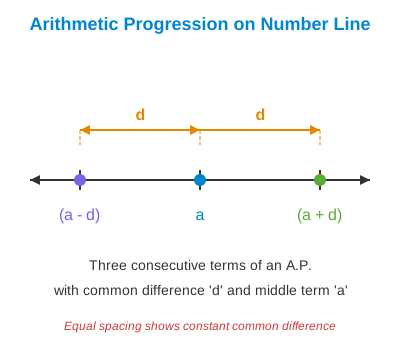
When three zeros of a cubic are in arithmetic progression (AP), we can write them as:
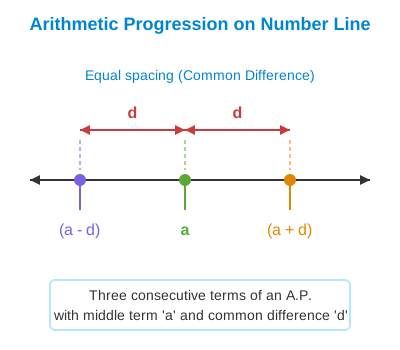
Number line showing three points labeled (a-d), a, and (a+d) equally spaced, with arrows indicating equal distance d between consecutive points

(ad),a,(a+d)(a-d), \quad a, \quad (a+d)

This notation creates a beautiful simplification: when you add them up, the dd-terms cancel out!

Sum=(ad)+a+(a+d)=3a\text{Sum} = (a-d) + a + (a+d) = 3a

This means the sum formula alone determines the middle zero aa.

✍️ Question

Your turn! 🤔

The zeros of a cubic polynomial are in AP: (ad)(a-d), aa, (a+d)(a+d).

If the sum of zeros is 6, what is aafind this?

The APNumbers are equally spaced, same gap between each pair notation for zeros:

When three zeros are in Arithmetic ProgressionSame gap between each pair of numbers, we write them as (ad)(a-d)Standard way to write three AP terms, aamiddleAutomatically builds in equal spacing from the middle, and (a+d)(a+d)Standard way to write three AP terms

Number line showing three equally spaced points labeled (a-d), a, and (a+d), with arrows showing distance d between consecutive points

Here:

  • aa is the middle valueEverything is measured from it
  • dd is the common differenceHow far apart each term is from the next
✍️ MCQ
Choose one
In the AP notation (ad)(a-d), aa, (a+d)(a+d), which term represents the middle zero?

Finding the sum:

Let's add these three zeros:

(ad)+a+(a+d)(a-d) + a + (a+d)

Expanding this:

(ad)+a+(a+d)=(a-d) + a + (a+d) = ad+a+a+da - d + a + a + d == 3a3asum(The sum simplifies to 3a, three times the middle term)

Notice what happened? The dd terms cancel out!The d terms cancel, leaving only the middle value So the sum of zeros depends only on aa, not on dd.

✍️ MCQ
Choose one
In our problem, the sum of zeros is 66. Using the result that the sum equals 3a3a, what is the value of aa?

Applying this to our problem:

If the sum of zeros =6= 6:

3a=63a = 6

a=2a = 2
answer
(Sum divided by 3 gives the middle value)

So a=2a = 2This is the middle zero we found is the middle zero. We don't need to know dd to find the middle value — the sum alone determines itNo need to find d or the other zeros.

✍️ MCQ
Choose one
If the sum of three AP zeros is 1515, what is the middle zero aa?

2. Using pairwise products to find d

📋 Given Info

Let's continue with our AP zeros problem.

With a now known, the sum of pairwise products gives us an equation in d (or b in our notation).

Key insight: When you expand the pairwise products for zeros (ab)(a-b), aa, (a+b)(a+b), the cross terms cancel beautifully, leaving:

3a2b23a^2 - b^2
key formula

✍️ Question

Your Turn 📝

The zeros of x33x2+x+1x^3 - 3x^2 + x + 1 are (ab)(a-b), aa, (a+b)(a+b).

Given that a=1a = 1 (from the sum), find bb using the sum of pairwise products relationship.

Hint: Remember that for a cubic x3+px2+qx+rx^3 + px^2 + qx + r, the sum of pairwise products of zeros equals qq.

For zeros (ab)(a-b), aa, (a+b)(a+b), let's expand the sum of pairwise productsMultiply every pair of zeros and add them up:

(ab)(a)+(a)(a+b)+(a+b)(ab)(a-b)(a) + (a)(a+b) + (a+b)(a-b)

Expanding each term:

=a2ab+a2+ab+a2b2= a^2 - ab + a^2 + ab + a^2 - b^2

== 3a23a^2The clean form we'll use in problems - b2b^2The clean form we'll use in problems

✍️ MCQ
Choose one
Why did the abab terms cancel in the expansion?

Notice how the abab terms cancelcancel!Cross terms always vanish due to symmetry — the AP structureCreates automatic cancellation of cross terms creates this simplification automatically!

This is exactly like what happened with the sum of zeros — the symmetric spacing around the middle valueZeros are evenly spaced around center makes cross terms vanishThey cancel because of symmetric spacing.

For x33x2+x+1x^3 - 3x^2 + x + 1: the sum of pairwise productsAlpha beta plus beta gamma plus gamma alpha equals cacoeff=\frac{c}{a_{coeff}} = 11=1\frac{1}{1} = 1So this sum equals 1.

So we have: 3a2b2=13a^2 - b^2 = 1(Connects our AP parameters to the polynomial)

Substituting a=1a = 1from sumFrom our earlier work: 3(1)2b2=13(1)^2 - b^2 = 1

✍️ MCQ
Choose one
We have 3(1)2b2=13(1)^2 - b^2 = 1. What is b2b^2?

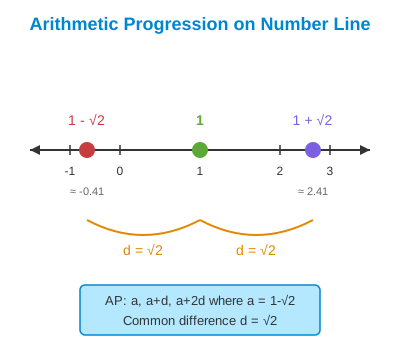
This gives us b2=2b^2 = 2The calculation gives us this value, so b=2b = \sqrt{2}That's our common difference.

So the three zeros are: (12)(1 - \sqrt{2})First zero in the progression, 11centerThe middle value, and (1+2)(1 + \sqrt{2})Last zero in the progression.

The three zeros are: 121 - \sqrt{2}First zero, symmetric with the third, 11The center of the arithmetic progression, 1+21 + \sqrt{2}Third zero, symmetric with the first.

Number line showing three points at 1-sqrt(2), 1, and 1+sqrt(2), with equal spacing marked to show arithmetic progression

Note that both values b=2b = \sqrt{2}One value of b and b=2b = -\sqrt{2}The other value of b give the same three zerosSymmetric zeros mean the set doesn't change — just in different order.

✍️ MCQ
Choose one
If the zeros of a cubic are in AP as (ad)(a-d), aa, (a+d)(a+d), and the sum of zeros is 99, what is the middle zero aa?