Notebook
00:08
12 Apr 2026

Verifying Zeros at Surd Values

Welcome! Today we're tackling Verifying Zeros at Surd Values — a skill that trips up many students but doesn't have to trip up you.

You have evaluated polynomials at integers, negatives, and fractions.

But many polynomials have zeros that are surds — irrational numbers like 2\sqrt{2} or 232\sqrt{3}surd.

These appear frequently in problems, and the arithmetic is different from what you are used to.

In this lesson, you will learn:

WhatWhy it matters
Techniques for evaluating at surd valuesHandle irrational zeros confidently
The shortcut (ab)2=a2b(a\sqrt{b})^2 = a^2 \cdot bSimplify calculations quickly
Degree-based zero countBuilt-in error check

1. Squaring a simple surd

You've evaluated polynomials at integers, negatives, and fractions. But many polynomials have zeros that are surds — irrational numbers like 2\sqrt{2} or 232\sqrt{3}. These appear frequently in problems.

Surd verification begins with one fundamental fact:

(a)2=a(\sqrt{a})^2 = a
key identity

This is the definition of square root, and it turns what looks like complicated arithmetic into a clean integer computation.

Examples:

  • (2)2=2(\sqrt{2})^2 = 2
  • (5)2=5(\sqrt{5})^2 = 5
  • (13)2=13(\sqrt{13})^2 = 13
📋 Given Info

The fundamental fact:

  • (2)2=2(\sqrt{2})^2 = 2
  • (5)2=5(\sqrt{5})^2 = 5
  • (13)2=13(\sqrt{13})^2 = 13

This makes evaluating polynomials at surds much simpler than it first appears.

✍️ Question

Your turn ✏️

Verify that 5\sqrt{5} is a zero of p(x)=x25p(x) = x^2 - 5.

Show complete working.

The key fact for surd evaluation: (a)2=a(\sqrt{a})^2 = aYour go-to tool for evaluating surds in polynomials

This is the definition of square root — the very reason we call it a square root in the first place.

So (5)2=5(\sqrt{5})^2 = 5. Not 25\sqrt{25}, not something complicated — just 5answer.

✍️ MCQ
Choose one
Using the rule (a)2=a(\sqrt{a})^2 = a, what is (13)2(\sqrt{13})^2?

Verify: Is 5\sqrt{5} a zero of p(x)=x25p(x) = x^2 - 5?

Method: Substitute x=5x = \sqrt{5} into p(x)p(x)Substitute and check for zero — that's verification

✍️ MCQ
Choose one
When we substitute x=5x = \sqrt{5} into p(x)=x25p(x) = x^2 - 5, what expression do we get?

p(5)=(5)25p(\sqrt{5}) = (\sqrt{5})^2 - 5
substitution

Using the key factRoot a squared equals a — remember this rule (a)2=a(\sqrt{a})^2 = a:

(5)2=5(\sqrt{5})^2 = 5
(This rule makes surd calculations simple)

So: p(5)=55=p(\sqrt{5}) = 5 - 5 = 00

✍️ Yes/No
Yes or No?
We got p(5)=0p(\sqrt{5}) = 0. Does this confirm that 5\sqrt{5} is a zero of p(x)p(x)?

Conclusion: Since p(5)=0p(\sqrt{5}) = 0, we confirm that 5\sqrt{5} is a zero of p(x)=x25p(x) = x^2 - 5.

The pattern: substitute, apply surd rule, check for zero

Note: (5)2(-\sqrt{5})^2 is also 5, because squaring removes the negative signWhy both roots give the same squared result.

So 5-\sqrt{5}The negative surd is also a zero of the polynomial is also a zero:

p(5)=(5)25=55=0p(-\sqrt{5}) = (-\sqrt{5})^2 - 5 = 5 - 5 = 0
verified!
(A common pattern with surd zeros)

✍️ MCQ
Choose one
The polynomial p(x)=x25p(x) = x^2 - 5 has how many zeros?

2. Squaring a compound surd like 2sqrt(3)

You've been evaluating polynomials at integers, negatives, and fractions. But many polynomials have zeros that are surds — irrational numbers like 2\sqrt{2} or 232\sqrt{3}. These appear frequently in problems.

Simple surds like 5\sqrt{5} are straightforward.

The harder case: Compound surds like 232\sqrt{3}, where both the integer part and the surd part need to be squared.

There's a shortcut that makes this clean.

📋 Given Info

The squaring shortcut:

(ab)2=a2b(a\sqrt{b})^2 = a^2 \cdot b

So:

  • (23)2=4×3=12(2\sqrt{3})^2 = 4 \times 3 = 12
  • (32)2=9×2=18(3\sqrt{2})^2 = 9 \times 2 = 18
  • (57)2=25×7=175(5\sqrt{7})^2 = 25 \times 7 = 175

The square and the square root cancel out — you just square the coefficient and multiply by what's under the root.

✍️ Question

Your turn 🧮

Compute (23)2(2\sqrt{3})^2.

Then use it to evaluate the first term of 3x2\sqrt{3}x^2 at x=23x = 2\sqrt{3}.

Show your steps, not just the final answer.

Here is the shortcut for squaring compound surdsA shortcut you'll use constantly when verifying zeros:

(ab)2=a2(b)2=a2b(a \cdot \sqrt{b})^2 = a^2 \cdot (\sqrt{b})^2 = a^2 \cdot b
(Leaving you with just the number inside)

The aa gets squaredFirst step — square the number in front, and the b\sqrt{b} squared just gives bbThe square root goes away when squared. Multiply the two results.Final step — multiply the results together

Example: (23)2=223=43=12(2\sqrt{3})^2 = 2^2 \cdot 3 = 4 \cdot 3 = 12answerThe whole method in action

✍️ MCQ
Choose one
If x=23x = 2\sqrt{3}, what is the value of 3x2\sqrt{3} \cdot x^2?

Let's see this in action:

(23)2=22×3=4×3=12(2\sqrt{3})^2 = 2^2 \times 3 = 4 \times 3 = 12
(Square the coefficient, the square root disappears)

More examples:

  • (32)2=32×2=9×2=18(3\sqrt{2})^2 = 3^2 \times 2 = 9 \times 2 = 18Square outside, multiply by inside the root
  • (57)2=52×7=25×7=175(5\sqrt{7})^2 = 5^2 \times 7 = 25 \times 7 = 175Same technique works for any numbers
✍️ MCQ
Choose one
What is (45)2(4\sqrt{5})^2?

Now for the first term of 3x2\sqrt{3}x^2 at x=23x = 2\sqrt{3}:

3(23)2=\sqrt{3} \cdot (2\sqrt{3})^2 = 312\sqrt{3} \cdot 12 == 12312\sqrt{3}result

✍️ MCQ
Choose one
What is 2(32)2\sqrt{2} \cdot (3\sqrt{2})^2?

Notice: the squared surd became a clean integer (12)Squaring a surd gives you a clean integer, and then multiplying by 3\sqrt{3} gave a term with 3\sqrt{3} as a common factorMultiplying brings the surd back into play. This is the typical pattern in surd verification — terms often share a common surd factorThis common factor is what lets everything cancel that cancels or combinesEverything cancels out at the end.

3. Complete surd verification with multiple terms

You've evaluated polynomials at integers, negatives, and fractions. Now let's tackle something more interesting — surd zeros.

Many polynomials have zeros that are irrational numbers like 2\sqrt{2} or 232\sqrt{3}. These appear frequently in problems, and verifying them requires a specific technique.

📋 Given Info

Here's the key insight: when evaluating a polynomial at a surd value, each term will often have the surd as a common factor.

For example, when evaluating 3x28x+43\sqrt{3}x^2 - 8x + 4\sqrt{3} at x=23x = 2\sqrt{3}:

  • Each term will have 3\sqrt{3}common as a factor
  • This lets you combine the integer multipliers:

(1216+4)3(12 - 16 + 4)\sqrt{3}

Factor out the common surd, then do simple integer arithmetic.

✍️ Question

Your Turn ✏️

Verify that x=23x = 2\sqrt{3} is a zero of f(x)=3x28x+43f(x) = \sqrt{3}x^2 - 8x + 4\sqrt{3}.

Show every step.

Let's go through this step by step.

f(x)=3x28x+43f(x) = \sqrt{3}x^2 - 8x + 4\sqrt{3}

We need to evaluate at x=23x = 2\sqrt{3}.

This means we'll substitute 232\sqrt{3} everywhere we see xxWe plug in the value to test if it's a zero in the polynomial.

Term 1: 3(23)2\sqrt{3} \cdot (2\sqrt{3})^2

First: (23)2(2\sqrt{3})^2Square the number part and multiply by what's under the root = 4×34 \times 3That's how the surd disappears = 12resultThe surd disappears and you get a clean number

Then: 3×12\sqrt{3} \times 12 = 12312\sqrt{3}

✍️ MCQ
Choose one
If we had (32)2(3\sqrt{2})^2 instead, what would it simplify to?

Term 2: 8(23)=-8 \cdot (2\sqrt{3}) = 163-16\sqrt{3}

This one is straightforward multiplicationno squaring involved!

Term 3: 434\sqrt{3}

This term has no xx in itconstantSubstitution doesn't change it — it's a constantJust a fixed number, no variable! No calculation needed, it stays exactly as 434\sqrt{3}Goes straight to your final answer.

✍️ MCQ
Choose one
We have three terms: 12312\sqrt{3}, 163-16\sqrt{3}, and 434\sqrt{3}. What do we get when we add them together?

Now all three terms have 3\sqrt{3}Factor it out like a variable as a common factor. Factor it out:

123163+43=(1216+4)312\sqrt{3} - 16\sqrt{3} + 4\sqrt{3} = (12 - 16 + 4) \cdot \sqrt{3}
(Common irrational factor simplification)

✍️ MCQ
Choose one
What is 1216+412 - 16 + 4?

(1216+4)3=03=0(12 - 16 + 4) \cdot \sqrt{3} = 0 \cdot \sqrt{3} = 0

✓ Since f(23)=0f(2\sqrt{3}) = 0This confirms it's a zero, we have verified that x=23x = 2\sqrt{3}verified!Value that makes polynomial equal zero is indeed a zero of the polynomialA value that makes the polynomial zero.

The strategy for surd verification:

Simplify each term to have a common surd factorThis makes the arithmetic manageable, then combine the integer multipliers.

If they add to 0Basic integer addition to check, the value is confirmed as a zero.

✍️ MCQ
Choose one
Why do we want all terms to have a common surd factor when verifying zeros?

Applying the strategy to our problem:

For f(x)=3x28x+43f(x) = \sqrt{3}x^2 - 8x + 4\sqrt{3} at x=23x = 2\sqrt{3}:

  • Each term simplifies to have 3\sqrt{3} as a factorHappens because we substitute a value involving root 3
  • Combine: (1216+4)(12 - 16 + 4)The real check is whether this gives zero3=\sqrt{3} = (zero!)03=00 \cdot \sqrt{3} = 0If yes, you've confirmed the zero
✍️ MCQ
Choose one
If the integer multipliers had summed to 55 instead of 00, what would f(23)f(2\sqrt{3}) equal?

4. Using the degree-zero count as an error check

-550f(x) = x² - 2y=-2.00V(0.00, -2.00)AB√2-√2g(x) = x² + 1y=1.00V(0.00, 1.00)No x-intercepts: g(x) > 0 for all xf(x) = x² - 2y=-2.00V(0.00, -2.00)AB√2-√2g(x) = x² + 1y=1.00V(0.00, 1.00)No x-intercepts: g(x) > 0 for all x

With surd verification complete, let's return to the at-most-n-zeros rule as a consistency check.

After finding zeros (including surd zeros), comparing the count with the degree confirms that everything is consistent — or catches an error before it goes unnoticed.

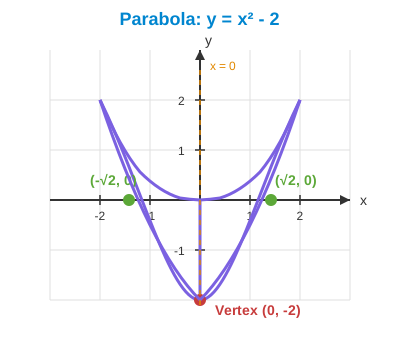
Look at the graph:

PolynomialDegreeZeros Found
f(x)=x22f(x) = x^2 - 222\sqrt{2} and 2-\sqrt{2}
g(x)=x2+1g(x) = x^2 + 12?

Comparing zero count with degree is your error-catching tool.

✍️ Question

Question 🤔

f(x)=x22f(x) = x^2 - 2 has zeros 2\sqrt{2} and 2-\sqrt{2}.

  1. Is this consistent with the degree?

  2. For g(x)=x2+1g(x) = x^2 + 1, how many real zeros are there, and why?

The degree sets the ceiling for real zeros, not the floor.The ceiling, not the floor

Parabola y = x^2 - 2 opening upward, vertex at (0,-2), crossing x-axis at x = -sqrt(2) and x = sqrt(2), both points labeled

For f(x)=x22f(x) = x^2 - 2The function we're analyzing (degree 2): We found 2\sqrt{2}The two real zeros we found and 2-\sqrt{2} as zeros. That's 2 zerosMatches the degree perfectly for a degree-2 polynomial. Since 222 \leq 2, this is consistent.

Look at the first diagram — see how the parabola crosses the x-axis at exactly two pointsWhat we expect with two real zeros?

✍️ FIB
Fill in the blank
A degree-3 polynomial can have at most how many real zeros?
33

For g(x)=x2+1g(x) = x^2 + 1The interesting case (degree 2): For any real xx, we have x20x^2 \geq 0Always non-negative. So x2+11x^2 + 1 \geq 1Adding 1 to something non-negative. The polynomial is always at least 1, and never equals 0That's why no real zeros exist. Zero real zeros.But still consistent with degree 2

The second diagram shows this — the parabola sits entirely above the x-axisNever touches or crosses it!

✍️ Yes/No
Yes or No?
The polynomial h(x)=x2+4h(x) = x^2 + 4 has degree 2 but zero real zeros. Is this consistent with the degree rule?

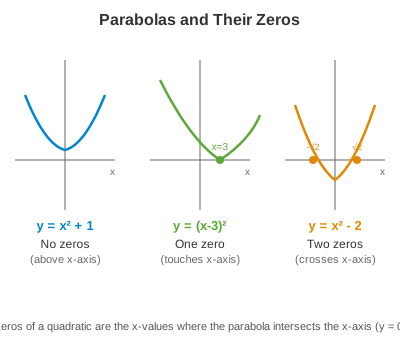
So a degree-2 polynomial can have 0, 1, or 2 real zerosAll three possibilities exist for quadratics:

  • 0 real zeros:Parabola stays above or below the x-axis x2+1x^2 + 1
  • 1 distinct real zero:Parabola just grazes the x-axis (x3)2=x26x+9(x - 3)^2 = x^2 - 6x + 9
  • 2 distinct real zeros:Parabola passes through the x-axis twice x22x^2 - 2
Three parabolas side by side: x^2+1 (above x-axis, no zeros), (x-3)^2 (touching x-axis at x=3, one zero), x^2-2 (crossing x-axis at two points, two zeros). Label each with its equation and number of zeros.
✍️ Yes/No
Yes or No?
A polynomial has degree 4. It has exactly 3 real zeros. Is this consistent with the degree rule?

This is your error-detection alarmA fast way to verify your work: After finding zeros, compare the count with the degreeMatch your zero count to the degree. If the count exceeds the degreeFinding too many zeros signals an error, recheck your work.

For example, if you're working with x22x^2 - 2 and you somehow find 3 zeros — stop! A degree-2 polynomial can have at most 2 real zeros. Something went wrong in your calculation.

✍️ MCQ
Choose one
A student claims that g(x)=x2+1g(x) = x^2 + 1 has zeros at x=1x = 1 and x=1x = -1. Without computing, can you spot a problem with this claim?