Notebook
00:03
12 Apr 2026

Quadratic Division and Polynomial Remainders

Welcome! Today we're tackling Quadratic Division and Polynomial Remainders — taking your division skills to the next level.

Dividing by a quadratic is the same cycle as before:

Divide → Multiply → Subtract → Check

But each multiplication step is more involved because you are multiplying by a three-term expression.

The remainder can now be a linear expression like 2x+32x + 3example, not just a single number.

Division TypeRemainder Form
By linearConstant (e.g., 5)
By quadraticLinear (e.g., 2x+32x + 3)

This skill is essential for the final cluster, where you divide quartics by quadratic factors to find all zeros.

1. Multi-term multiplication in quadratic division

Let's look at dividing by a quadratic.

When dividing by a quadratic, each multiplication step involves multiplying a single term by a trinomial, producing three terms.

This is more arithmetic per step than linear division.
📋 Given Info
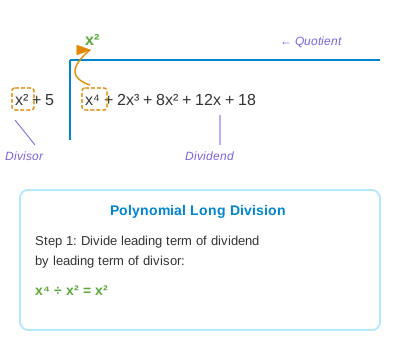
Polynomial long division setup with dividend x^4 + 2x^3 + 8x^2 + 12x + 18 under the division bracket and divisor x^2 + 5 outside, with x^2 written above as first quotient term

Here's our problem:

We're dividing x4+2x3+8x2+12x+18x^4 + 2x^3 + 8x^2 + 12x + 18 by (x2+5)(x^2 + 5).

Finding the first quotient term:

Divide the leading terms: x4x2=x2\frac{x^4}{x^2} = x^2

So the first quotient term is x2x^21st term.

✍️ Question

Your turn ✏️

In dividing x4+2x3+8x2+12x+18x^4 + 2x^3 + 8x^2 + 12x + 18 by (x2+5)(x^2 + 5), the first quotient term is x2x^2.

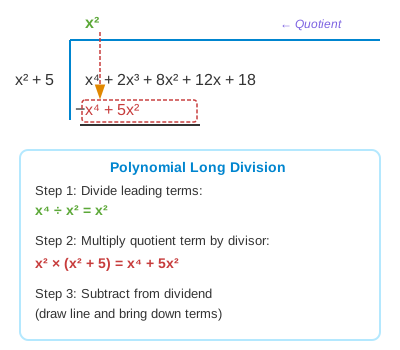
Same division setup with x^2 times (x^2 + 5) = x^4 + 5x^2 written below dividend, subtraction line drawn, showing the multiplication step to perform

Multiply x2x^2 by the divisor and subtract from the dividend. What remains?

When multiplying x2x^2 by (x2+0x+5)(x^2 + 0x + 5), include ALL termsInclude all terms when multiplying — even the ones with zero coefficientsDon't skip zero coefficients or columns won't align!

  • x2×x2=x4x^2 \times x^2 = x^4
  • x2×0x=0x3x^2 \times 0x = 0x^3
  • x2×5=5x2x^2 \times 5 = 5x^2
✍️ MCQ
Choose one
Why do we include the 0x30x^3 term even though it equals zero?

Result: x4+0x3+5x2x^4 + 0x^3 + 5x^2

This is what we subtractThis is where mistakes happen from the dividend x4+2x3+8x2+12x+18x^4 + 2x^3 + 8x^2 + 12x + 18.

Now subtractWhere the actual division happens from the dividend:

(x4+2x3+8x2+12x+18)(x^4 + 2x^3 + 8x^2 + 12x + 18) - (x4+0x3+5x2)(x^4 + 0x^3 + 5x^2)

Column by column:

  • x4x4=0x^4 - x^4 = 0
  • 2x30x3=2x32x^3 - 0x^3 = 2x^3
  • 8x25x2=3x28x^2 - 5x^2 = 3x^2
  • 12x12x staysThey just come down unchanged (nothing to subtract)
  • 1818 staysNothing to subtract from these terms (nothing to subtract)
✍️ MCQ
Choose one
When we subtracted 8x25x28x^2 - 5x^2, we got 3x23x^2. What coefficient did we get for the x3x^3 term after subtraction?

Result: 2x3+3x2+12x+182x^3 + 3x^2 + 12x + 18remainderThis is what we divide in the next round

This is our new dividendThat reduction shows you're making progress for the next step of the division.

2. Completing quadratic division and reading the polynomial remainder

The division continues until the remainder's degree drops below 2. The remainder is then a linear expression (or constant), which some problems ask you to express as px+qpx + q.


We've already completed cycle 1 of dividing x4+2x3+8x2+12x+18x^4 + 2x^3 + 8x^2 + 12x + 18 by (x2+5)(x^2 + 5).

After cycle 1, the remainder is: 2x3+3x2+12x+182x^3 + 3x^2 + 12x + 18

✍️ Question

Complete the division 📝

Divide x4+2x3+8x2+12x+18x^4 + 2x^3 + 8x^2 + 12x + 18 by (x2+5)(x^2 + 5).

State the quotient and remainder.

(Remember: After cycle 1, you have 2x3+3x2+12x+182x^3 + 3x^2 + 12x + 18from cycle 1 remaining. Continue from there.)

Cycle 2:

Continuing from 2x3+3x2+12x+182x^3 + 3x^2 + 12x + 18:

  • DivideLook at leading terms only: 2x3x2=\frac{2x^3}{x^2} = 2x2xquotient(What you get from dividing leading terms)
✍️ MCQ
Choose one
When we multiply 2x2x by (x2+0x+5)(x^2 + 0x + 5), what do we get for the last term? 2x×5= ?2x \times 5 = \ ?
  • Multiply: 2x(x2+0x+5)=2x3+0x2+10x2x(x^2 + 0x + 5) = 2x^3 + 0x^2 + 10xMust include every term, not just the first
  • SubtractThe highest power term disappears completely: (2x3+3x2+12x+18)(2x3+0x2+10x)=(2x^3 + 3x^2 + 12x + 18) - (2x^3 + 0x^2 + 10x) = 3x2+2x+183x^2 + 2x + 18resultDegree decreases with each cycle
✍️ Yes/No
Yes or No?
After Cycle 2, our remainder is 3x2+2x+183x^2 + 2x + 18. Can we continue dividing this by x2+5x^2 + 5?

Cycle 3:

  • Divide: 3x2x2=\frac{3x^2}{x^2} = 33quotient
  • Multiply: 3(x2+0x+5)=3(x^2 + 0x + 5) = 3x2+0x+153x^2 + 0x + 15
✍️ MCQ
Choose one
When we subtract (3x2+0x+15)(3x^2 + 0x + 15) from (3x2+2x+18)(3x^2 + 2x + 18), what do we get for the xx term?
  • Subtract: (3x2+2x+18)(3x2+0x+15)=2x+3(3x^2 + 2x + 18) - (3x^2 + 0x + 15) = 2x + 3

Since the degree of 2x+32x + 3 (which is 1)When remainder degree is lower, we stop is less than the degree of the divisor x2+5x^2 + 5 (which is 2)The divisor's degree determines when to stop, we stop hereThis is the stopping condition.

This means 2x+32x + 3 is our remainderWhat remains after you can't divide anymore.

✍️ T/F
True or False?
We stop the division when the degree of the remainder is less than the degree of the divisor. True or False?

Stopping ConditionTells you when to put down your pen:

degree(2x+3)=1<degree(x2+5)=2\text{degree}(2x + 3) = 1 < \text{degree}(x^2 + 5) = 2. STOPCannot divide when degree drops below divisor.

We cannot continue dividing because the remaining polynomial has a lower degreeWhat's left becomes your remainder than the divisor.

Final Answer:

  • Quotient: x2+2x+3x^2 + 2x + 3
  • Remainder(It's a linear expression, not just a number): 2x+32x + 3 (a linear expression, not just a numberWhen dividing by quadratic, remainder can be degree 0 or 1)

Sanity check: The quotient has degree 42=24 - 2 = 2. ✓ Correct.

✍️ MCQ
Choose one
If we divided a degree 5 polynomial by a degree 2 polynomial, what would be the degree of the quotient?