Notebook
00:06
12 Apr 2026

From Factors to Zeros: Sign-Correct Conversion

Welcome! Today we're tackling From Factors to Zeros: Sign-Correct Conversion — the step that trips up even students who factorise perfectly.

You have factored the polynomial. Now comes the step where many students lose marks on a correct factorisation: converting each factor into a zero.

The pattern (ax+b)=0(ax + b) = 0 gives x=bax = -\frac{b}{a}, and the sign flip trips people up consistently.

The minus sign is where the marks disappear.

In this lesson, you will:

GoalWhat you'll learn
HabitSolve the equation rather than reading off the number
SkillHandle surd and fraction factors
ConceptUnderstand repeated zeros

1. Solving each factor equation correctly

From Factors to Zeros 🎯

You've factored the polynomial — great work! But here's where many students lose marks even on a correct factorisation: converting each factor into a zero.

The conversion from factor to zero requires solving a linear equation, not just reading off a number.

Key insight: The sign always flips between what appears in the factor and the actual zero value.

📋 Given Info

The Pattern:

From a factor (ax+b)(ax + b), the zero is found by setting ax+b=0ax + b = 0 and solving:

x=bax = \frac{-b}{a}

Notice the sign flip:

  • Factor (x+4)(x + 4) gives x=4x = -4sign flipped
  • Factor (2x3)(2x - 3) gives x=32x = \frac{3}{2}minus → plus
✍️ Question

Your Turn ✏️

From the factored form (2x+5)(x3)=0(2x + 5)(x - 3) = 0, find all zeros.

Show the solving step for each factor.

Always SOLVE the equation.The key rule to remember Never just read off the number.Why students lose marks

This is where students lose marksCommon mistake on exams! If you see (2x+5)(2x + 5), don't just say "the zero is 5" — that's wrongwrong!This is incorrect. You MUST set the factor equal to zero and solve properlySolve properly each time.

For (2x+5)=0(2x + 5) = 0:

  • 2x=52x = -5Moving terms changes the sign (move +5+5 to the other side, it becomes 5-5flippedSign changed when we moved it)
  • x=52x = -\frac{5}{2}

See that? The +5+5 in the factor became 5-5 when we moved it. The sign flipped!Watch for this pattern every time

✍️ MCQ
Choose one
In the factor (2x+5)(2x + 5), the constant is +5+5. But the zero we got is x=52x = -\frac{5}{2}. Why did the sign change?

For (x3)=0(x - 3) = 0:

  • x=3x = 3(Opposite sign in the answer)

This one's simpler — just move 3-3 to the other side, and it becomes +3+3flippedSign flipped from factor to zero.

✍️ MCQ
Choose one
The zeros of (2x+5)(x3)=0(2x + 5)(x - 3) = 0 are:

Quick check:Your safety net for catching sign mistakes Let's verify our zeros by substituting back into the original factors.

Substitute x=52x = -\frac{5}{2} into (2x+5)(2x + 5):

2(52)+5=5+5=02\left(-\frac{5}{2}\right) + 5 = -5 + 5 = 0 \checkmark
verified!
(If you get zero, you're correct)

Substitute x=3x = 3 into (x3)(x - 3):

33=03 - 3 = 0 \checkmark
verified!
(This is why we call them zeros)

Both zeros check out!Takes ten seconds and can save you marks When we substitute each zero into its corresponding factor, we get exactly zero.

✍️ Yes/No
Yes or No?
If you substitute a zero into the wrong factor (like putting x=3x = 3 into (2x+5)(2x + 5)), will you still get zero?

The common error: Seeing +5+5This is the trap — don't copy this sign in (2x+5)(2x + 5) and writing x=52x = \frac{5}{2}wrong!You must flip the sign, not copy it.

But check: 2(52)+5=5+5=102\left(\frac{5}{2}\right) + 5 = 5 + 5 = 10, notWe got 10 when we substituted, not zero 00.

This proves x=52x = \frac{5}{2}We proved this value is wrong by substitution is wrongVerification catches the sign error immediately — it doesn't make the factor zero!

✍️ MCQ
Choose one
If a student claims x=3x = 3 is a zero of (x+3)(x + 3), what would substitution give?

The sign must flipThe sign must flip when moving across equals when you move a term to the other side of the equation.

(2x+5)=02x=(2x + 5) = 0 \Rightarrow 2x = 5-5flipped!Plus 5 becomes negative 5 on the right x=\Rightarrow x = 52-\frac{5}{2}(That's why the zero is negative 5 over 2)

2. Handling surd factors

Handling Surd Factors 🔢

When factors involve surds, the solving process is the same:

  • Set the factor equal to zero
  • Solve for xx

But the arithmetic needs more care.

Specifically, you may need to divide by a surd coefficient and then rationalise the denominator.

📋 Given Info

Quick example:

For a factor (3x2)(\sqrt{3}x - 2):

  1. Set 3x2=0\sqrt{3}x - 2 = 0
  2. Get 3x=2\sqrt{3}x = 2
  3. So x=23x = \frac{2}{\sqrt{3}}
  4. Rationalise: x=233x = \frac{2\sqrt{3}}{3}final answer
✍️ Question

Your turn! ✏️

From the factored form:

(x23)(3x2)=0(x - 2\sqrt{3})(\sqrt{3}x - 2) = 0

Find both zeros. Rationalise any surd denominators.

Surd factors are solved the same way as regular factors — just with surd arithmetic. Don't let the 3\sqrt{3}The root 3 is just a number, nothing special about the method intimidate you!

Factor (x23)=0(x - 2\sqrt{3}) = 0:

This gives us x=23x = 2\sqrt{3}.

Straightforward — no rationalisation neededWhen there's no surd in the denominator, you're done here because there's no surd in the denominatorNo extra rationalisation step needed.

✍️ FIB
Fill in the blank
For the factor (3x2)=0(\sqrt{3}x - 2) = 0, the rationalised zero is x=x = ___
23/32√3/3

Factor (3x2)=0(\sqrt{3}x - 2) = 0:

3x=2\sqrt{3}x = 2

x=23x = \frac{2}{\sqrt{3}}
(Not done yet — need to rationalise the denominator)

✍️ MCQ
Choose one
To rationalise 23\frac{2}{\sqrt{3}}, what should we multiply the numerator and denominator by?

To rationalise: multiply numerator and denominator by 3\sqrt{3}Use the same surd from the denominator:

x=23×33=233x = \frac{2}{\sqrt{3}} \times \frac{\sqrt{3}}{\sqrt{3}} = \frac{2\sqrt{3}}{3}

232\sqrt{3} on numerator, 33bottomThe surd cancels itself out on denominator.

Final answer: 233\frac{2\sqrt{3}}{3}

Both forms (23\frac{2}{\sqrt{3}} and 233\frac{2\sqrt{3}}{3}) are mathematically correctThey represent the same value, but the rationalised formAlways rationalise before your final answer is cleaner and expected in most contexts.

✍️ MCQ
Choose one
From (x23)(3x2)=0(x - 2\sqrt{3})(\sqrt{3}x - 2) = 0, the two zeros are:

3. Repeated factors and multiplicity

Sometimes the factored form is a perfect square like (2x1)2(2x - 1)^2, meaning the same factor appears twice.

This gives only one distinct zero with multiplicity 2×2, which is consistent with the degree.

The degree of the polynomial = total count of zeros (counting multiplicity)

📋 Given Info

Here's the information:

4x24x+1=4x^2 - 4x + 1 = (2x1)2(2x - 1)^2

The factor (2x1)(2x - 1) appears twice.

✍️ Question

Factor 4x24x+14x^2 - 4x + 1 and find its zeros.

Why does this degree-2 polynomial have only one distinct zerokey twist?

Let's factor 4x24x+14x^2 - 4x + 1.

ac=4×1=4a \cdot c = 4 \times 1 = 4. We need a pair with product = 4Product equals positive 4 and sum = -4Sum equals negative 4. The pair is -2 and -2This pair satisfies both conditions.

✍️ MCQ
Choose one
When we found the pair 2-2 and 2-2 for factoring, why did we need both numbers to be negative?

Split the middle termThe technique for breaking apart a quadratic:

4x22x2x+1=2x(2x1)1(2x1)=(2x1)(2x1)=(2x1)24x^2 - 2x - 2x + 1 = 2x(2x - 1) - 1(2x - 1) = (2x - 1)(2x - 1) = (2x - 1)^2
(Group terms and find common factors in each)

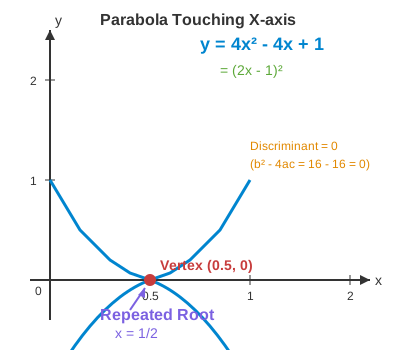
Parabola y = 4x^2 - 4x + 1 touching x-axis at single point x = 1/2, vertex at (0.5, 0), opening upward, labeled 'repeated root'

Both factors are the same!(When factors match, you get a repeated root) Setting (2x1)=0(2x - 1) = 0: x=12x = \frac{1}{2}zeroOnly one distinct zero from the repeated factor.

This is called a repeated rootThe factor appears twice but gives one zero or (factor appears twice, one distinct zero)root with multiplicity 2Multiplicity 2 means factor appears twice. The parabola just touches the x-axisGraphically recognizing a repeated root at this point instead of crossing it.

✍️ MCQ
Choose one
If a quadratic has factors (x3)(x3)(x - 3)(x - 3), how many distinct zeros does it have?

Only one distinct zero. But the polynomial has degree 2Degree tells you how many zeros to expect — should it have 2 zerosShould have 2 zeros, not just 1?

Yes, it does — if you count with multiplicityWhen a factor repeats, its zero gets counted multiple times. The factor (2x1)(2x - 1)appears twiceThis factor appears twice in the polynomial appears twice, so x=12x = \frac{1}{2} is counted twiceCounts as 2 zeros since factor appears twice. We say x=12x = \frac{1}{2} has multiplicity 2The term for when a zero is counted multiple times.

✍️ FIB
Fill in the blank
If a polynomial factors as (x5)3(x - 5)^3, what is the multiplicity of the zero x=5x = 5?
33

Recognition tip: A perfect square trinomialYour shortcut detector for spotting repeated zeros (like a22ab+b2=(ab)2a^2 - 2ab + b^2 = (a - b)^2) always gives a repeated zeroOnly one distinct root when you see that squared binomial.

If your factoring produces the same root twiceGetting the same root twice confirms your pattern (like x=12x = \frac{1}{2} and x=12x = \frac{1}{2}), you know you have a perfect square trinomialConfirms you started with a perfect square trinomial.

This is why 4x24x+14x^2 - 4x + 1 = (2x1)2(2x - 1)^2 has only one distinct zeroUse whichever direction helps you in the problem!