Notebook
00:05
12 Apr 2026

Understanding Zeros of a Polynomial

Welcome! Today we're exploring Understanding Zeros of a Polynomial — one of the most important ideas in the entire polynomials chapter.

When you evaluated q(x)=6x27x3q(x) = 6x^2 - 7x - 3 at x=32x = \frac{3}{2} and got 0key result, that was not a coincidence — it tells you something fundamental about the polynomial.

Certain special inputs 'zero out' a polynomial, and these inputs are the key to:

  • Factoring polynomials
  • The relationship between zeros and coefficients
  • The entire division-based approach for finding all roots

In this lesson, you will learn:

ConceptWhat you'll be able to do
What a zero isDefine it precisely
How to verify a zeroCheck if a given value is a zero
A powerful ruleKnow how many zeros a polynomial can have

1. Definition of a zero

We are about to define the most important concept in the chapter.

A zero is not the polynomial being zero everywhere — it is a specific input value that produces output zero.

Getting this definition precise is essential because every technique in the chapter revolves around it.

Remember when we evaluated q(x)=6x27x3q(x) = 6x^2 - 7x - 3 at x=32x = \frac{3}{2}, and the result was 0?

This makes x=32x = \frac{3}{2}special value special — it 'zeroes out' the polynomial.

✍️ Question

Question 🤔

What does it mean for a number to be a 'zero' of a polynomial p(x)p(x)?

Is 3check this a zero of p(x)=x25x+6p(x) = x^2 - 5x + 6?

Show your verification.

A zero of a polynomialThe input that makes the whole thing equal zero is a specific input value — a number you plug in for xx — that produces output zero.

Formally: a real number aa is called a zero of the polynomial p(x)p(x) if p(a)=0p(a) = 0key conditionSubstitute the value, if result is zero, you've found a zero.

In simpler words: if you substitute aa into the polynomial and get 00, then aa is a zero of that polynomial.

✍️ MCQ
Choose one
If p(5)=0p(5) = 0 for some polynomial p(x)p(x), what can we conclude about the number 55?

Important distinction:Zeros refer to particular input values the zero is not the polynomial itself being zero. The polynomial p(x)=x25x+6p(x) = x^2 - 5x + 6 is 'aliveThe polynomial outputs vary by input' at most values of xx. It just happens to equal zero at certain special inputsZero output only at special inputs.

The word 'zero' refers to the input that makes the output zero — it 'zeroes out' the polynomial.

✍️ MCQ
Choose one
If p(x)=x25x+6p(x) = x^2 - 5x + 6, and we plug in x=2x = 2, we get p(2)=410+6=0p(2) = 4 - 10 + 6 = 0. What can we conclude?

To verify: substitute and computePlug in the value and calculate.

p(3)=(3)25(3)+6=915+6=0p(3) = (3)^2 - 5(3) + 6 = 9 - 15 + 6 = 0Result of zero confirms it's a zero

Since the result is 00zero!, x=3x = 3 IS a zero of p(x)p(x).

✍️ Yes/No
Yes or No?
Can a polynomial have more than one zero?

Let's check another value:

p(1)=(1)25(1)+6=15+6=2p(1) = (1)^2 - 5(1) + 6 = 1 - 5 + 6 = 2

Since the result is not 00not zeroThe result was 2, which is not zero, x=1x = 1 is NOT a zero of p(x)p(x)So x equals 1 fails the test.

✍️ MCQ
Choose one
What is p(4)=(4)25(4)+6p(4) = (4)^2 - 5(4) + 6?
A graph shows exactly what it means to be a zero — it's where the curve touches the x-axis. Let's plot the parabola and see the difference between a zero and a non-zero point.
-15-10-551015-50x-axisy = x² + 1No intersection with x-axis = No Real ZerosNo real zeros (never crosses x-axis)y = (x-2)²x=7.92x=8.08Only 1 zero at x = 2Graph is tangent to x-axisy = (x-3)²x=2.92x=3.08x = 3 has multiplicity 2 (1 distinct zero)Graph is tangent to x-axisf(x) = x² - 5x + 6x=1.99x=3.01y=6.00V(2.50, -0.25)x-axisx=3x = 3 is a zero (output = 0)(1, 2)x = 1 is NOT a zero (output = 2)
✍️ FIB
Fill in the blank
Looking at the graph, can you spot another point where the parabola crosses the x-axis? What xx-value is it?
22

2. Verifying zeros by substitution

Now that we know the definition of a zero, we need to be able to verify whether a given value is or is not a zero.

This requires careful substitution — exactly the evaluation skill from the previous section — with the specific goal of checking whether the result equals 00target.

📋 Given Info

To check if a value is a zero, substitute it and see if the result is exactly 0.

For p(x)=x22x3p(x) = x^2 - 2x - 3:

InputCalculationResultConclusion
x=3x = 3p(3)=963p(3) = 9 - 6 - 300zero!3 is a zero
x=0x = 0p(0)=003p(0) = 0 - 0 - 33-3not zero0 is not a zero
✍️ Question

Your turn! ✏️

Is 1-1 a zero of p(x)=x22x3p(x) = x^2 - 2x - 3?

Is 22 a zero of p(x)=x22x3p(x) = x^2 - 2x - 3?

Show complete working for both.

Let's verify carefully.

For x = -1:

p(1)=(1)22(1)3p(-1) = (-1)^2 - 2(-1) - 3

(1)2=(1)(1)=+1(-1)^2 = (-1)(-1) = +1(Even powers make negatives positive) (even power, positiveSquaring negative one gives positive one).

2(1)=+2-2(-1) = +2Two negatives multiply to positive (negative times negative = positiveSign rule for multiplication).

✍️ MCQ
Choose one
We have p(1)=1+23p(-1) = 1 + 2 - 3. What is this equal to?

So p(1)=1+23=0p(-1) = 1 + 2 - 3 = 0Substituting gives zero result. The result is 0key!Output equals zero, so -1 IS a zeroConfirms it's a zero of the polynomial.

For x = 2:

p(2)=(2)22(2)3=443=3p(2) = (2)^2 - 2(2) - 3 = 4 - 4 - 3 = -3

The result is 3-3We got negative 3, not the zero we need, which is notNot a zero because output wasn't zero 00. So 2 is NOT a zeroA zero must give exactly zero as output of p(x)=x22x3p(x) = x^2 - 2x - 3.

✍️ Yes/No
Yes or No?
Is 44 a zero of p(x)=x22x3p(x) = x^2 - 2x - 3?

The Verification SequenceThe essential takeaways to remember

Every time you check whether a value is a zero, follow these four stepsMemorize this method for any polynomial:

  1. Write p(value)p(\text{value})
  2. Compute each term separately
  3. Add them up
  4. CheckThis final check is what matters most if the result equals 00goalZero means zero, not close to zero
✍️ MCQ
Choose one
What is the first step when checking if a value is a zero of a polynomial?

This four-step process is what you do every single time — whether checking p(3)p(3), p(1)p(-1), or any other value.

3. The at-most-n-zeros rule

We've seen how to verify individual zeros — plug in a value, check if the output is 00.

But here's an interesting question:

How many zeros can a polynomial have?

There's actually a rule that connects the degree of a polynomial to the maximum number of real zeros it can have.

This rule is incredibly useful — it acts as a built-in error detector for your work.

📋 Given Info

Consider the polynomial p(x)=x22x3p(x) = x^2 - 2x - 3.

This is a degree 2 polynomial (a quadratic).

We found that it has two zeros:
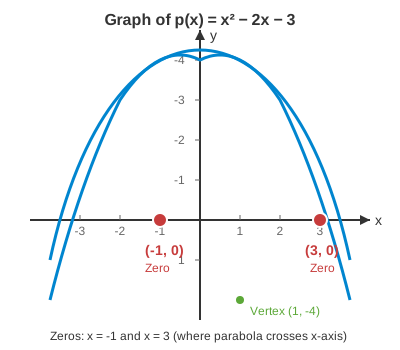
  • x=3x = 3
  • x=1x = -1
Parabola of p(x) = x squared minus 2x minus 3, opening upward, crossing x-axis at x = -1 and x = 3, with both zeros marked as points and labeled
✍️ Question

Think about this: 🤔

A polynomial of degree nn has at most how many real zeros?

And here's a scenario:

If a student claims to have found 3 zeros for a quadratic polynomial, what should they conclude?

Here is the rule: A polynomial of degree nn has at most nn real zeros.Could have fewer or no real zeros, but never exceed n

This is a fundamental constraintNever more than the degree allows — no exceptions!

✍️ Yes/No
Yes or No?
Our polynomial p(x)=x22x3p(x) = x^2 - 2x - 3 has degree 2. We found zeros at x=3x = 3 and x=1x = -1. According to the rule, could there be a third zero?
Polynomial TypeDegreeMaximum Real Zeros
Linear11
Quadratic22
Cubic33
Biquadratic44

The degree tells you the ceiling — the maximum possible real zeros.

So if a student claims to have found 3 zeros for a quadratic polynomial — that's impossible!The rule tells you something went wrong They must have made a calculation errorDon't waste time, just redo the calculation somewhere.

✍️ MCQ
Choose one
A student says they found 44 real zeros for a cubic polynomial. What should they conclude?

Why 'at most'Maximum possible, not guaranteed and not 'exactly'Would mean guaranteed count? Because some polynomials have fewer real zeros than their degree allows.

This is a crucial distinction — the degree gives you the ceilingThe ceiling, not a promise, not a guarantee.

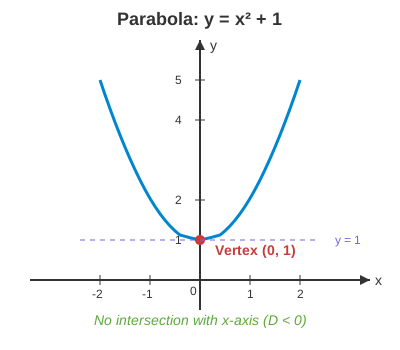
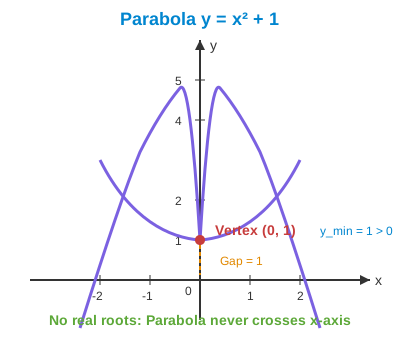
Example 1: p(x)=x2+1p(x) = x^2 + 1 has degree 2 but zero real zerosNo real solutions exist.

Why? Because x20x^2 \geq 0 for all real xx, so x2+11x^2 + 1 \geq 1Always positive means no x-axis crossing. The polynomial is always at least 1 — it never touches the x-axisNo crossing means no solution.

Parabola y = x^2 + 1 opening upward with vertex at (0,1), x-axis shown, parabola entirely above x-axis, no intersection points
✍️ MCQ
Choose one
The polynomial p(x)=x2+4p(x) = x^2 + 4 has degree 2. How many real zeros does it have?

Example 2: p(x)=(x2)2p(x) = (x - 2)^2 has degree 2 but only one distinct real zero — namely x=2x = 2.

We say this zero has multiplicity 2How many times the factor repeats because the factor (x2)(x - 2)This factor appears twice appears twice.

✍️ T/F
True or False?
A polynomial of degree 4 could have exactly 2 real zeros. True or false?
These two parabolas show why 'at most' is the key phrase — a polynomial's degree sets the maximum number of zeros, but some polynomials have fewer or even none.
-15-10-551015-50x-axisy = x² + 1No intersection with x-axis = No Real ZerosNo real zeros (never crosses x-axis)y = (x-2)²x=7.92x=8.08Only 1 zero at x = 2Graph is tangent to x-axis
✍️ MCQ
Choose one
The parabola y=(x2)2y = (x-2)^2 just touches the x-axis at one point. How many real zeros does this polynomial have?

The Degree Rule as an Error Detector

The rule is your error detectorUse it to catch mistakes before finalizing: if you find more zeros than the degree allowsStop immediately if this happens, you have made a mistakeSomething went wrong in your working.

Using the Check

This check catches errors before they go unnoticed.

For example, if you're working with the quadratic polynomial p(x)=x22x3p(x) = x^2 - 2x - 3 (degree 2Maximum is 2 real zeros) and you claim to have found 3 zerosThe rule tells you there's definitely an error, something has gone wrong in your calculation!

We verified that this polynomial has exactly 2 zerosThe maximum for any quadratic: x=3x = 3 and x=1x = -1. That's the maximum allowed for a quadratic.

✍️ MCQ
Choose one
A student claims that the polynomial p(x)=x22x3p(x) = x^2 - 2x - 3 has three zeros: x=3x = 3, x=1x = -1, and x=0x = 0. What should they conclude?

4. Fewer zeros than degree allows

The at-most-n rule sets a ceiling, not a floor.

Understanding when a polynomial has fewer zeros than its degree allows — and why — deepens your understanding and prepares you for cases like:

  • Repeated zeros
  • Polynomials with no real zeros at all
📋 Given Info

Consider these two quadratics:

  • x2+1x^2 + 1 has degree 2
  • x26x+9=(x3)2x^2 - 6x + 9 = (x - 3)^2 has degree 2

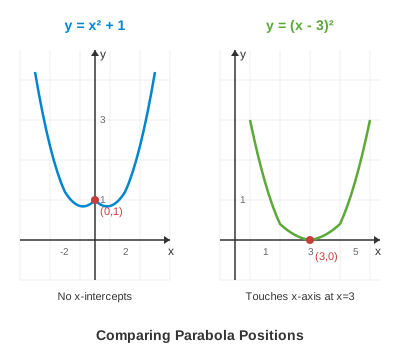
Both are quadratics, but they have different numbers of distinct real zeros.
Two coordinate planes side by side. Left: parabola y = x^2 + 1 opening upward with vertex at (0,1), not crossing x-axis. Right: parabola y = (x-3)^2 opening upward with vertex touching x-axis at (3,0). Both with labeled axes and grid lines.

Take a look at the graphs on the board — y=x2+1y = x^2 + 1 on the left and y=(x3)2y = (x-3)^2 on the right.

✍️ Question

Question 🤔

How many distinct real zeros does x2+1x^2 + 1 have?

How many does (x3)2(x - 3)^2 have?

Explain why each has fewer than 2 distinct zeros.

The degree sets the ceiling for the number of real zeros, but a polynomial can have fewer.

This is exactly why we say "at most" — the degree tells you the maximum possible, not a guarantee.

Let's see two important cases where this happens — and both are sitting right in front of us with x2+1x^2 + 1 and (x3)2(x - 3)^2.

Case 1: No real zeros at all.A degree 2 polynomial with no real zeros

x2+1x^2 + 1Why it can never equal zero has degree 2, but for any real xx, we know x20x^2 \geq 0Always at least zero for any real number. So x2+11x^2 + 1 \geq 1 — it never touches 0. This means zero real zeroskey!A degree 2 polynomial with no real zeros at all.

Parabola y = x^2 + 1 opening upward with vertex at (0,1), floating above x-axis, showing it never crosses the x-axis
✍️ MCQ
Choose one
Why can't x2+1=0x^2 + 1 = 0 have any real solution?

Look at the parabolaFloats entirely above, never touches on the canvas — it floats entirely above the x-axisNever touches or crosses it, never crossing itNo crossing means no real zeros. The vertex sits at the point (0,1)(0, 1), which is the lowest the curve ever goes.

Case 2: Repeated zeros.

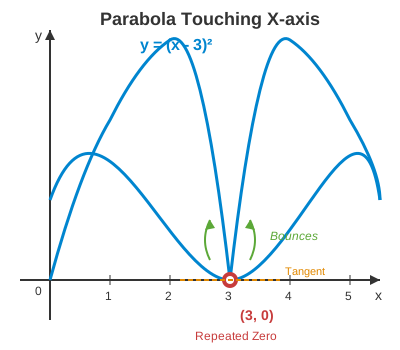
(x3)2=x26x+9(x - 3)^2 = x^2 - 6x + 9This expression equals zero at only one place has degree 2Even with degree 2, we only get one distinct zero. It equals 0 only when x3=0x - 3 = 0, giving x=3x = 3The only place where the expression equals zero. That's one distinct zeroOnly one distinct zero despite degree being 2.

Parabola y = (x-3)^2 touching x-axis at point (3,0), showing the curve bounces off the axis at the repeated zero

But the factor (x3)(x - 3)The factor appears twice in the expression appears twice, so we say x=3x = 3 has multiplicity 2'How many times the factor appears.

Counting with multiplicity, there are 2 zerosBoth zeros equal to 3 when counted with multiplicity (both equal to 3), which is consistent with degree 2The degree rule still works when counting with multiplicity.

✍️ MCQ
Choose one
The polynomial (x5)3(x - 5)^3 has degree 3. How many distinct real zeros does it have?
Let me update the right parabola to show (x-3)² instead — this will make the repeated zero at x = 3 clearer, showing how the parabola just touches the axis without crossing it.
-15-10-551015-50x-axisy = x² + 1No intersection with x-axis = No Real ZerosNo real zeros (never crosses x-axis)y = (x-2)²x=7.92x=8.08Only 1 zero at x = 2Graph is tangent to x-axisy = (x-3)²x=2.92x=3.08x = 3 has multiplicity 2 (1 distinct zero)Graph is tangent to x-axis
✍️ FIB
Fill in the blank
The polynomial (x3)2(x-3)^2 has degree 2 and one distinct zero at x=3x = 3. What is the multiplicity of this zero?
22

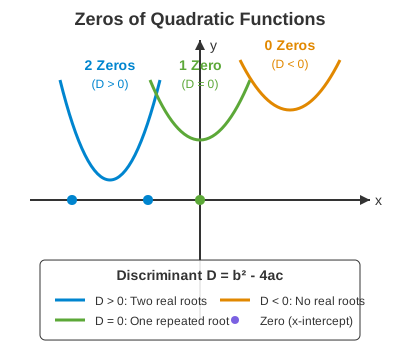
So a degree-2 polynomial can have 0, 1, or 2 distinct real zerosAll three outcomes are valid for a quadratic. The degree is the maximumNot how many you will definitely get, not the guaranteed count.

Look at the three parabolas on the board — they tell the whole story:
Three parabolas showing: one crossing x-axis twice (2 zeros), one touching x-axis at vertex (1 zero), one floating above x-axis (0 zeros), with labels
  • The first one crosses the x-axis twice2 distinct zeros
  • The second one touches the axis at its vertex → 1 distinct zero (repeated)
  • The third one floats above the axis → 0 real zeros
✍️ MCQ
Choose one
A polynomial of degree 4 is found to have exactly 2 distinct real zeros. Is this possible, or did someone make a mistake?

This understanding prevents you from worrying when a problem yields fewer zeros than expected — it's completely normal!

In exams:Important advice for test situations If you find fewer zeros than the degree, don't panicStay calm if you find fewer zeros and don't invent extra zerosNever make up answers that aren't there. Check your work, but trust the mathThe polynomial simply has fewer real zeros — some polynomials genuinely have fewer real zeros.