Notebook
00:05
12 Apr 2026

Scaling to Integer Coefficients and the Verification Loop

Welcome! Today we're tackling Scaling to Integer Coefficients and the Verification Loop — a crucial skill for cleaning up your polynomial answers.

Many construction problems produce polynomials with fractional coefficients.

The standard presentation expects integer coefficients.

You need a systematic way to clear fractions without changing the zeros.

What changesWhat stays the same
CoefficientsZeros
AppearanceRoots of the equation

In this lesson, you will master:

  • The LCM scaling procedure — the systematic technique
  • The construction-verification loop — catching errors before they go unnoticed

1. The LCM scaling procedure

Scaling: The Clean-Up Step 🧹

Scaling is the clean-up step after construction. The procedure is simple:

  1. Find the LCM of all denominators
  2. Multiply every term by it

But the 'every term' part is critical — including terms that already have integer coefficients.

📋 Given Info

Given Information:

For x276x12x^2 - \frac{7}{6}x - \frac{1}{2}, the denominators are 1, 6, and 2.

LCM(1,6,2)=6\text{LCM}(1, 6, 2) = 6

Multiply every term by 6LCM.

✍️ Question

Your Turn ✏️

Scale x276x12x^2 - \frac{7}{6}x - \frac{1}{2} to have integer coefficients.

Show your work: multiply each term by the LCM (which is 6) and write the final polynomial.

The scaling procedureSystematically clearing fractions:

  1. List all denominators: x2x^2 has denominator 11Even the hidden ones like 1, 76x\frac{7}{6}x has denominator 6, 12\frac{1}{2} has denominator 2.
  1. Find the LCMThis single number eliminates all fractions: LCM(1,6,2)=\text{LCM}(1, 6, 2) = 66key!Will eliminate all fractions at once
  1. Multiply EVERY term by 6Not just the terms with fractions:
    • 6×x2=6 \times x^2 = 6x26x^2
    • 6×(76x)=7×66x=6 \times \left(-\frac{7}{6}x\right) = -\frac{7 \times 6}{6}x = 7x-7x
    • 6×(12)=62=6 \times \left(-\frac{1}{2}\right) = -\frac{6}{2} = 3-3
✍️ MCQ
Choose one
When we multiplied 6×(76x)6 \times \left(-\frac{7}{6}x\right), why did the fraction disappear?

Result: 6x27x36x^2 - 7x - 3

We've successfully converted our fractional quadratic into one with integer coefficientsNo fractions left, factorisation becomes straightforward!

✍️ T/F
True or False?
The scaled polynomial 6x27x36x^2 - 7x - 3 has the same roots as the original x276x12x^2 - \frac{7}{6}x - \frac{1}{2}. True or False?

⚠️ Common mistake: Multiplying only the fractional terms by 6, leaving x2x^2This is the key mistake to avoid unchanged.

This gives x27x3x^2 - 7x - 3wrong!The roots won't match anymore, which is a completely different polynomial.

✍️ Yes/No
Yes or No?
If we multiply only the fractional terms by 6 (leaving x2x^2 unchanged), we get x27x3x^2 - 7x - 3. Will this polynomial have the same roots as the original x276x12x^2 - \frac{7}{6}x - \frac{1}{2}?

When you scale, EVERY termIncluding ones with integer coefficients gets multiplied — including the ones that already have integer coefficients.

TermCorrect scalingWrong approach
x2x^26×x2=6x26 \times x^2 = 6x^2Left as x2x^2
76x-\frac{7}{6}x6×(76x)=7x6 \times (-\frac{7}{6}x) = -7x7x-7x
12-\frac{1}{2}6×(12)=36 \times (-\frac{1}{2}) = -33-3

So always ask yourself — did I multiply EVERY term by the same number?If any term was skipped, the polynomial changes

2. Why scaling preserves zeros

🤔 A Natural Question

When working with polynomials, we often need to multiply them by constants to clear fractions and get integer coefficients.

But here's something worth thinking about:

If you multiply a polynomial by 6, do the zeros change?

Understanding why they do (or don't) is important for mathematical confidence — and for knowing when scaling is safe.

📋 Given Info

Here's a key fact to keep in mind:

If p(α)=0p(\alpha) = 0, then for any constant kk (where k0k \neq 0):

kp(α)=k0=0k \cdot p(\alpha) = k \cdot 0 = 0

Scaling a polynomial by a non-zero constant preserves all its zeros.

✍️ Question

Your Turn 📝

A student worries:

"If I multiply the polynomial by 6, won't it have different zeros?"

Explain why this concern is unfounded.

Here is why scaling is safeMultiplying by a constant preserves zeros.

Let p(x)=x276x12p(x) = x^2 - \frac{7}{6}x - \frac{1}{2}. Suppose α\alpha is a zeroAlpha makes the polynomial equal zero of this polynomial, meaning p(α)=0p(\alpha) = 0This is the condition we're preserving.

Now create a new polynomial by scalingScaling to get integer coefficients: q(x)=6p(x)=6x27x3q(x) = 6 \cdot p(x) = 6x^2 - 7x - 3.

What happens when we plug in α\alpha?

q(α)=6p(α)=60=0q(\alpha) = 6 \cdot p(\alpha) = 6 \cdot 0 = 0

See? If p(α)=0p(\alpha) = 0, then 6p(α)6 \cdot p(\alpha) is just 6×06 \times 0, which is still zerokey!Zero multiplied by anything is still zero!

The zero stays a zero!We don't lose or gain any roots

✍️ MCQ
Choose one
If p(α)=0p(\alpha) = 0 and we define q(x)=10p(x)q(x) = 10 \cdot p(x), what is q(α)q(\alpha)?

Let's evaluate qq at α\alpha:

q(α)=6p(α)=60=0q(\alpha) = 6 \cdot p(\alpha) = 6 \cdot 0 = 0

So α\alpha is also a zero of q(x)q(x). The zeros are identical.

This is the key principleThis is the essential principle to keep in mind: multiplying a polynomial by any non-zero constant kk preserves all its zerosScaling preserves all the roots.

✍️ MCQ
Choose one
If p(α)=0p(\alpha) = 0 and we define q(x)=100p(x)q(x) = 100 \cdot p(x), what is q(α)q(\alpha)?

This works because multiplying zero by any number gives zeroZero times anything is still zero. As long as the constant is not 0Zero multiplier destroys everything (which would make the polynomial vanish entirely), scaling preserves all zerosAll roots remain unchanged.

✍️ MCQ
Choose one
If p(α)=0p(\alpha) = 0, what is kp(α)k \cdot p(\alpha) for any non-zero constant kk?

Note: Scaling by a NEGATIVE constantSign doesn't matter for zeros also works. If you multiply by 6-6still worksAny non-zero value works, the zeros are still the same. Only multiplying by 00 would destroy information.

3. The construction-verification loop

The Construction-Verification Loop 🔄

The final skill is the verification loop: after constructing a polynomial, factor it back and check that you recover the original zeros.

This circular check catches sign errorswatch out! and arithmetic mistakescareful! that would otherwise go unnoticed.
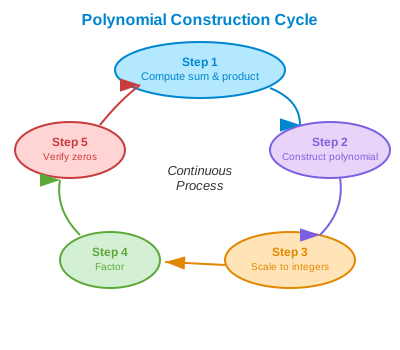
Circular flow diagram showing 5 steps in a loop: 1. Compute sum and product -> 2. Construct polynomial -> 3. Scale to integers -> 4. Factor -> 5. Verify zeros -> back to step 1, with arrows connecting each step in a cycle

The Complete Loop:

  1. Compute sum and product from given zeros
  2. Construct using the formula p(x)=x2(sum)x+(product)p(x) = x^2 - (\text{sum})x + (\text{product})
  3. Scale to integer coefficients
  4. Factor the scaled polynomial
  5. Verify the zeros match the original

This circular process is your built-in error-checking system.

✍️ Question

Your Turn ✏️

Construct a quadratic polynomial whose zeros are 52\frac{5}{2} and 11.

Complete the full verification loop:

  • Scale to integer coefficients
  • Then factor the result to verify you get back the original zeroscheck

Let's do the full loop.

Step 1: Zeros are 52\frac{5}{2} and 11The verification loop: find zeros, sum, product, check coefficients.

Finding SumConnects directly to the coefficient of x (S):

S=52+1=52+22=S = \frac{5}{2} + 1 = \frac{5}{2} + \frac{2}{2} = 72\frac{7}{2}SThis links to the x coefficient in your polynomial

Finding ProductConnects to the constant term (P):

P=(52)(1)=P = \left(\frac{5}{2}\right)(1) = 52\frac{5}{2}PThe product relates to the constant term

denominator 2Both have denominator 2, so multiply by 2 to clear fractions

✍️ MCQ
Choose one
Using the formula p(x)=x2(sum)x+(product)p(x) = x^2 - (\text{sum})x + (\text{product}), what is the coefficient of xx in the unscaled polynomial?

Step 2: Construct.

p(x)=x272x+52p(x) = x^2 - \frac{7}{2}x + \frac{5}{2}The formula pattern you use every single time

Step 3: Scale. Denominators: 2 and 2. LCM = 2keyFind the LCM, multiply through, and you're done.

2x27x+52x^2 - 7x + 5Scale to get integer coefficients, zeros stay the same

✍️ Yes/No
Yes or No?
If we had scaled by 4 instead of 2, would the zeros of the polynomial change?

Step 4: Factor the polynomial 2x27x+52x^2 - 7x + 5

We use the splitting the middle termYour go-to technique when coefficient of x squared is not 1 method.

First, find ac=2×5=10a \cdot c = 2 \times 5 = 10

We need two numbers that:

  • Multiply to give 1010First condition - numbers must multiply to give a times c
  • Add to give 7-7Second condition - must add to give the middle coefficient (the coefficient of xx)

The pair is: 5-5 and 2-2

✍️ MCQ
Choose one
Why do we need the two numbers to multiply to 1010 specifically (and not some other number)?

Factoring by grouping:

2x27x+52x^2 - 7x + 5

=2x25x2x+5= 2x^2 - 5x - 2x + 5 (splitting 7x-7x as 5x2x-5x - 2x)

=x(2x5)1(2x5)= x(2x - 5) - 1(2x - 5) (grouping)If they don't match, something went wrong in splitting

(factored)=(2x5)(x1)= (2x - 5)(x - 1)The matching bracket lets you factor it out

✍️ MCQ
Choose one
From the factored form (2x5)(x1)=0(2x - 5)(x - 1) = 0, what are the two zeros?

Step 5: Zeros. 2x5=02x - 5 = 0 gives x=52x = \frac{5}{2}. x1=0x - 1 = 0 gives x=1x = 1.

These match the original zeros. Construction verified.Matching zeros confirms your construction is correct

✍️ MCQ
Choose one
Why is the verification step (checking that the zeros match) necessary in the construction-verification loop?

If the zeros had NOT matched, there would be an error somewhere — most likely a sign error in the construction formula or a mistake in computing SS or PP.

Common culprits:

  • Forgetting the negative signSigns are where most students slip up in x2Sx+Px^2 - Sx + PThe minus before S is the common mistake
  • Arithmetic errors when adding fractions for SS
  • Sign errors when multiplying for PP(Check signs in sum and product calculations)