The Three Cubic Formulas and the Alternating Sign Pattern
Welcome! Today we're exploring The Three Cubic Formulas and the Alternating Sign Pattern — the natural extension of what you already know about quadratics.
You derived two formulas for quadratics. Now a cubic has three zeros — , , — so you need three formulas.
The good news is they follow a beautiful pattern: the signs alternate.
| Formula | Sign |
|---|---|
| First | minus− |
| Second | plus+ |
| Third | minus− |
If you remember that pattern, you never need to memorise three separate formulas.
In this lesson, you will:
- Learn all three relationships between roots and coefficients
- Practise the tricky one: the sum of pairwise products
- Master listing all three pairs without missing any
1. All three cubic formulas with correct signs
You derived two formulas for quadratics. Now a cubic has three zeros — , , — so you need three formulas.
The good news? They follow a beautiful pattern:
The signs alternate — minus, plus, minus.
For a cubic polynomial with zeros , , and , there are three relationships connecting the zeros to the coefficients.
The key to remembering them is the alternating sign pattern: , ,
Your turn ✍️
Write all three zeros-coefficients relationships for a cubic polynomial with zeros , , .
Remember the alternating sign pattern!
The three cubic formulas are:
- Sum of zeros:
-
Sum of pairwise products:
-
Product of zeros:
The sign pattern alternates: minus, plus, minus. Minus, plus, minus.
This alternating pattern comes from expanding : the alternating signs in the factors produce alternating signs in the relationships.
When you multiply out , each factor has a minuskey before the zero. These minus signs interact during expansion — sometimes they cancel (giving a plus), sometimes they don't (giving a minus). That's exactly why we get: minus, plus, minus!
For quadratics we had: , (minus, plus).
Cubics continue the pattern: , , .
If you ever study quartics: , , , .
2. Computing the sum of pairwise products (three pairs)
You've seen how quadratics have two zeros and two formulas connecting them to coefficients.
Now we're working with cubics — and a cubic has three zeros: , , and .
The first and third formulas are pretty straightforward. But the second one — the sum of pairwise productstricky! — is where mistakes tend to happen.
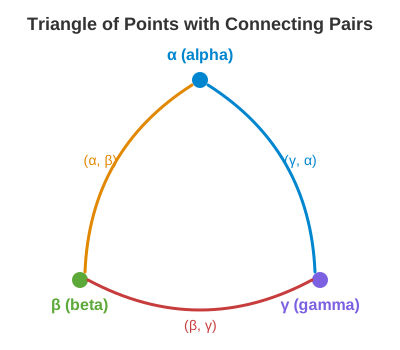
Here's why it's tricky:
For three zeros, there are exactly three pairs:
You must compute each product separately and then add them all together.
⚠️ Missing even one pair gives the wrong sum.
Your turn ✏️
The zeros of a cubic are , , and .
Compute the sum of pairwise products:
Three zeros produce exactly three pairs. Write them as a checklist:
- Pair 1: result
- Pair 2: (Negative times negative = positive)
- Pair 3: result
Now add all three pairwise products:
Convert to common denominator:
So the sum of pairwise products answer
⚠️ The most common error: computing only two of the three pairs.
If you miss the third pairforgotten! (), you get , which is wrong.
Always use the three-pair checklist.
3. Complete cubic verification
Complete Cubic Verification 🎯
You've now understood all three formulas linking a cubic's zeros to its coefficients, and you've built the skill of computing pairwise products.
Now it's time to put it all together — we'll verify all three relationships for a single cubic polynomial, comparing what we get from the zeros with what we get from the coefficients.
Given:
with zeros:
- α
- β
- γ
Standard form coefficients:
| Coefficient | Value |
|---|---|
Your Task ✍️
Verify all three zeros-coefficients relationships for the cubic with zeros , , and .
For each relationship:
- Compute the value from the zeros
- Compute the value from the coefficients
- Check that they match
Show your work for all three relationships:
- Sum of zeros vs
- Sum of pairwise products vs
- Product of zeros vs
Let's go through all three relationships for the polynomial with zeros and .
Coefficients: , , , .
Relationship 1 (Sum):
From zeros: .
From formula: , so flip sign. Thus .
. ✓ Verified.
Relationship 2 (Pairwise products):
Remember — three zeros means exactly three pairs. Let's find each one:
Pair 1:
Pair 2:
Pair 3:
Sum: .
From formula: .
. ✓ Verified.
Relationship 3 (Product):
From zeros: .
From formula: = = .
. ✓ Verified.
Watch the Signs! Notice the double negatives: with , and with . The first gives a double negative (resolved to positive), the second is straightforward.