Notebook
00:04
12 Apr 2026

The Zero Product Property and the Factor Theorem

Welcome! Today we're exploring The Zero Product Property and the Factor Theorem — the single most important principle for finding zeros of polynomials.

It starts with a simple fact about numbers:

If two things multiply to give 0, at least one of them must be 0.

From this, the factor theorem builds a bridge:

ConnectionMeaning
Zero → FactorEvery zero corresponds to a factor
Factor → ZeroEvery factor reveals a zero

Understanding this bridge is essential because factoring is the primary method for finding zeros throughout this chapter.

1. The zero product property

🎯 The Zero Product Property

Everything starts with a basic fact about multiplication:

If a product equals 0, then at least one of the factors must be 0.

This is the foundation on which the entire factoring approach is built.

📋 Given Info

The Rule:

If A×B=0A \times B = 0, then A=0A = 0 or B=0B = 0 (or both).

Think about it:

  • 3×73 \times 7 cannot be 00
  • (5)×2(-5) \times 2 cannot be 00

For a product to be 00, at least one factor must be 00.

✍️ Question

Your Turn ✏️

If p(x)=(x+4)(2x3)=0p(x) = (x + 4)(2x - 3) = 0, what are the zeros of p(x)p(x)?

Show the solving step for each factor.

The Zero Product PropertyYour main tool for factored equations: If A×B=0A \times B = 0When a product equals zero, then A=0A = 0 or B=0B = 0One of the factors must be zero (or both).

This is the foundation — when a product equals zero, at least one of the factors must be zeroRequired for a product to equal zero.

Think about it: 3×7=213 \times 7 = 21, not zero. (5)×2=10(-5) \times 2 = -10, not zero. The only way to get zeroNo other combination works is if at least one factor is already zerokeyThis is the key requirement!

✍️ MCQ
Choose one
If (x5)(x+2)=0(x - 5)(x + 2) = 0, which of the following must be true?

For (x+4)(2x3)=0(x + 4)(2x - 3) = 0:

We have a product of two factorsThis is the structure that triggers the property equal to zerokeyWhen this happens, Zero Product Property kicks in.

✍️ MCQ
Choose one
According to the Zero Product Property, if (x+4)(2x3)=0(x + 4)(2x - 3) = 0, what must be true?

Case 1: Either x+4=0x + 4 = 0

Solving: x=4x = -4

Case 2: Or 2x3=02x - 3 = 0

Solving: 2x=32x = 3, so x=32x = \frac{3}{2}

✍️ FIB
Fill in the blank
We found x=4x = -4 from the first factor. What value of xx did we get from solving 2x3=02x - 3 = 0?
3/23/2

The zeros of p(x)p(x) are: x=4x = -4zero 1First factor gives first zero and x=32x = \frac{3}{2}zero 2Second factor gives second zero

⚠️ A common trap:Most common error in factorization Seeing +4+4 in (x+4)(x + 4) and writing x=+4x = +4wrong!Appears frequently on tests.

This is one of the most frequent mistakes students make!

✍️ MCQ
Choose one
If (x+4)=0(x + 4) = 0, is the solution x=+4x = +4 or x=4x = -4?

But x+4=0x + 4 = 0 means x=4x = -4Set equal to zero and solve. The sign FLIPSSign changes when solving.

📌 Always solve the equationDon't just copy the number from the bracket rather than just reading off the number from the factor.

Quick check: Substitute x=4x = 4 into (x+4)(x + 4):

4+4=4 + 4 = 808 \neq 0

Now substitute x=4x = -4:

4+4=0-4 + 4 = 0 \checkmark

The zero is x=4x = -4answerThe zero is negative 4, not positive 4, not x=+4x = +4Don't just read off the number you see.

✍️ MCQ
Choose one
If (x7)=0(x - 7) = 0, what is xx?

2. The factor theorem as a two-way bridge
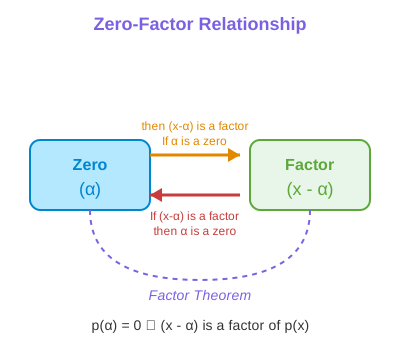
A two-way bridge diagram: left side labeled 'Zero (α)' with an arrow pointing right to 'Factor (x-α)' on the right side, and another arrow pointing left back, showing bidirectional relationship

The zero product property tells us how to get zeros from factors. The factor theorem goes further: it says the bridge works in both directions.

If α\alpha is a zero, then (xα)(x - \alpha) is a factor, and vice versa.

DirectionWhat it means
Zero → FactorIf α\alpha is a zero of p(x)p(x), then (xα)(x - \alpha) is a factor
Factor → ZeroIf (xα)(x - \alpha) is a factor of p(x)p(x), then α\alpha is a zero

The Factor Theorem states:

A real number α\alpha is a zero of p(x)p(x) if and only if (xα)(x - \alpha) is a factor of p(x)p(x).

Notice the "if and only if"both directions hold.

✍️ Question

Question 🤔

If (x+3)(x + 3) is a factor of a polynomial p(x)p(x), what is the corresponding zero?

Be careful with the sign.

The factor theorem says: (x - α)If alpha is a zero, this is the factor is a factor when αThe zero value that makes the polynomial equal zero is a zero.

The sign convention is crucial here: the factor has a MINUS signStudents see a zero and write the wrong sign in front of the zero.

Let's see this pattern in action:

Zero (α)Factor (x - α)
55(x5)(x - 5)
3-3tricky!This negative case catches people(x(3))=(x+3)(x - (-3)) = (x + 3)You write x minus negative 3, which simplifies
12\frac{1}{2}(x12)(x - \frac{1}{2})

Key observation: When the zero is negativeOpposite signs in the factor, the factor ends up with a plus signThe signs flip when the zero is negative!

✍️ MCQ
Choose one
If (x+3)(x + 3) is a factor of p(x)p(x), what is the corresponding zero?

Going backwards (from factor to zero):

  • Factor (x + 3)The factor tells you the zero → zero is 3-3Solve by setting the factor to zero (the sign flips)
  • Factor (x - 5) → zero is +5+5
✍️ MCQ
Choose one
If (x7)(x - 7) is a factor of a polynomial, what is the corresponding zero?
  • Factor (2x + 7)Same method even with coefficients → set 2x+7=02x + 7 = 0Set factor equal to zero and solve, get x=72x = -\frac{7}{2}
✍️ FIB
Fill in the blank
If (3x12)(3x - 12) is a factor of a polynomial, what is the corresponding zero?
44

The safest approach: always SOLVEThis is when you should reach for this method the equation factor = 0.

Do not try to read off the zero by eyeThis is exactly when sign errors sneak in — that's where sign errorsMake solving your default approach creep in!

Example: If (x+3)(x + 3)The factor has plus 3, but the zero is negative 3 is a factor, solve:

x+3=0x + 3 = 0

x=3x = -3
zero
(This is why solving matters)

So the zero is 3-3The factor has plus 3, but the zero is negative 3, not +3+3If you just looked at x plus 3 and guessed, you'd get it wrong.

✍️ MCQ
Choose one
If (x7)(x - 7) is a factor of a polynomial, what is the corresponding zero?

3. Constant factors do not contribute zeros

When a polynomial is written in factored form like a(xα)(xβ)a(x - \alpha)(x - \beta), the leading constant aa is a factor too.

But constants are never zero, so they do not produce zeros.

Recognising this prevents false zeros — only variable factors like (xα)(x - \alpha) contribute zeros.

📋 Given Info

Consider the factored form:

p(x)=5(x2)(3x+7)p(x) = 5(x - 2)(3x + 7)

This has three factors:

  • 55constant
  • (x2)(x - 2)
  • (3x+7)(3x + 7)

Not all of them produce zeros.

✍️ Question

Find all zeros of p(x)=5(x2)(3x+7)p(x) = 5(x - 2)(3x + 7).

How many zeros are there, and does the factor 55constant contribute one?

In the factored form p(x)=5(x2)(3x+7)p(x) = 5(x - 2)(3x + 7), there are three factorsCount the factors — we have three here. Let's examine each one to see which contribute zeros.

Factor 1: 5Constants like 5 can never equal zero

This is a constantThis is a constant factor — it equals 5 no matter what xx is. Since 5 is never 0, it does not produce a zeroOnly factors with x can give zeros.

✍️ T/F
True or False?
The constant factor 55 in p(x)=5(x2)(3x+7)p(x) = 5(x-2)(3x+7) contributes a zero to the polynomial.

Factor 2: (x2)(x - 2)

Set x2=0x - 2 = 0: solving gives x=2x = 2Setting the factor to zero finds the solution. This is a zeroThis is how we find zeros of the polynomial.

Factor 3: (3x+7)(3x + 7)

Set 3x+7=03x + 7 = 0: solving gives 3x=73x = -7, so x=73x = -\frac{7}{3}. This is a zero.

✍️ MCQ
Choose one
For the polynomial p(x)=5(x2)(3x+7)p(x) = 5(x - 2)(3x + 7), how many zeros are there in total?

Summary: The zeros are x=2x = 2zero 1First of our two zeros and x=73x = -\frac{7}{3}zero 2Second of our two zeros.

Two zeros for a degree-2 polynomialThe degree tells you the maximum number of zeros — exactly as expected!

This connects to the factored form from the previous cluster: p(x)=a(xα)(xβ)p(x) = a(x - \alpha)(x - \beta)The standard way to write any quadratic when you know its zeros.

The 'aastretchIt controls the stretch but can never equal zero' out front ensures the leading coefficient is correct but never produces a zeroIt's just a constant, not a factor with x. Only the (xα)(x - \alpha) and (xβ)(x - \beta)These are the ones that can actually become zero factors do.