Notebook
00:05
12 Apr 2026

The Conjugate Pair Property and Finding All Cubic Zeros

Welcome! Today we're exploring The Conjugate Pair Property and Finding All Cubic Zeros — a powerful shortcut that will save you a lot of work.

Before tackling the 'find all zeros' chain, there is a property that saves enormous work:

Irrational zeros of rational-coefficient polynomials come in conjugate pairs.

Here's what this means for you:

What you knowWhat you get for free
One surd zeroIts conjugate partner
Two zerosA quadratic factor with rational coefficients

This means the subsequent division involves only rational arithmeticno messy surds in the middle of long division.

1. The conjugate pair property and forming quadratic factors

Let's explore an important property that can save you a lot of work when finding zeros of polynomials.

When a polynomial has rational coefficients and one of its zeros is a surd like (a+b)(a + \sqrt{b}):

The conjugate (ab)(a - \sqrt{b}) must also be a zero.

Together, these conjugate pairs form a quadratic factor with rational coefficients.

📋 Given Info

Here's a useful fact to keep in mind:

If a polynomial with rational coefficients has zero (3+5)(3 + \sqrt{5}), then (35)(3 - \sqrt{5}) must also be a zero.

  • Their sum = (3+5)+(35)=6(3 + \sqrt{5}) + (3 - \sqrt{5}) = 6 (rational!)(the surds cancel out)
  • Their product = (3+5)(35)=95=4(3 + \sqrt{5})(3 - \sqrt{5}) = 9 - 5 = 4 (using difference of squares)
✍️ Question

Your turn 🤔

If (3+5)(3 + \sqrt{5}) is a zero of a polynomial with rational coefficients:

  1. What is the other conjugate zero?
  2. Form the quadratic factor from this pair.

Hint: Use the sum and product of the zeros to write the quadratic

The Conjugate Pair PropertyYour automatic trigger when you spot a surd zero:

If (a+b)(a + \sqrt{b})When you see an irrational zero like this is a zero of a polynomial with rational coefficientsMust have rational coefficients for this to work, then (ab)(a - \sqrt{b})Immediately write down the conjugate as another zero is also a zero.

So for (3+5)(3 + \sqrt{5}), the conjugate is (35)(3 - \sqrt{5})(3 plus root 5 becomes 3 minus root 5).

You change the sign of the surd part ONLYOnly flip the sign of the surd part, never the rational, not the rational partDon't change the rational part — this is where students lose marks.

ZeroConjugate Zero
3+53 + \sqrt{5}353 - \sqrt{5}
✍️ MCQ
Choose one
What is the conjugate of (7+3)(7 + \sqrt{3})?

⚠️ Common mistake: Writing (3+5)(-3 + \sqrt{5}) or (35)(-3 - \sqrt{5}) as the conjugate.

These are NOT conjugates — they negate the rational partThe rational part cannot change, which is wrong.

Only the sign in front of the surd changes.(Only the sign before the surd flips, nothing else)

Original✅ Correct Conjugate❌ Wrong
(3+5)(3 + \sqrt{5})(35)(3 - \sqrt{5})The 3 stays, only the plus becomes minus(3+5)(-3 + \sqrt{5})Changing the rational part is incorrect
✍️ MCQ
Choose one
What is the conjugate of (72)(7 - \sqrt{2})?

From the conjugate pair, we find:

Sum = (3+5)+(35)=6(3 + \sqrt{5}) + (3 - \sqrt{5}) = 6. The surds cancelcancel!The surds cancel out completely.

✍️ MCQ
Choose one
Why do the surds cancel when we add (3+5)(3 + \sqrt{5}) and (35)(3 - \sqrt{5})?

Product = (3+5)(35)=32(5)2=95=4(3 + \sqrt{5})(3 - \sqrt{5}) = 3^2 - (\sqrt{5})^2 = 9 - 5 = 4. This uses the difference of squaresa plus b times a minus b equals a squared minus b squared.

✍️ MCQ
Choose one
If (2+3)(2 + \sqrt{3}) and (23)(2 - \sqrt{3}) are conjugate zeros, what is their product?

Quadratic factor:Use sum and product to construct it x2(sum)x+product=x^2 - (\text{sum})x + \text{product} = x26x+4x^2 - 6x + 4The formula for building the quadratic. All integer coefficients!Conjugate pairs always give rational results

2. The complete chain: known zero to all zeros of a cubic

Finding All Zeros of a Cubic 🔍

When you know one zero of a cubic polynomial, you can find all the zeros by following a three-step chain:

  1. Known zero → Factor: If α\alpha is a zero, then (xα)(x - \alpha) is a factor
  2. Divide: Divide the cubic by (xα)(x - \alpha) to get a quadratic quotient
  3. Factor the quadratic: Solve the quadratic to find the remaining two zeros

Let's see if you can execute this complete chain!

✍️ Question

Problem 📝

Given that 11 is a zero of f(x)=x3+7x6f(x) = -x^3 + 7x - 6, find all zeros.

Show the complete chain:

  • Step 1: Write the factor from the known zero
  • Step 2: Perform polynomial division to get the quadratic quotient
  • Step 3: Factor the quadratic and list all three zeros

Let's trace through the complete chain.

Step 1: Since 11When you know a zero, you know a factor is a zero, (x1)(x - 1)(That's the Factor Theorem — it works both ways) is a factor.

✍️ MCQ
Choose one
Why does knowing that 11 is a zero tell us that (x1)(x - 1) is a factor?
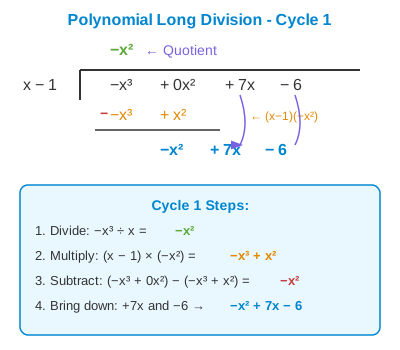
Polynomial long division setup: -x^3 + 0x^2 + 7x - 6 divided by (x-1), showing Cycle 1 with -x^2 in quotient, subtraction yielding -x^2 + 7x - 6

Step 2: Divide x3+0x2+7x6-x^3 + 0x^2 + 7x - 6 by (x1)(x - 1). Note the 0x20x^2 placeholderWrite zero times that power to keep columns aligned.

Cycle 1: x3x=x2\frac{-x^3}{x} = -x^2. Multiply: x2(x1)=x3+x2-x^2(x-1) = -x^3 + x^2Divide leading term of what remains by leading term of divisor. Subtract: (0x2x2)+7x6=(0x^2 - x^2) + 7x - 6 = x2+7x6-x^2 + 7x - 6.

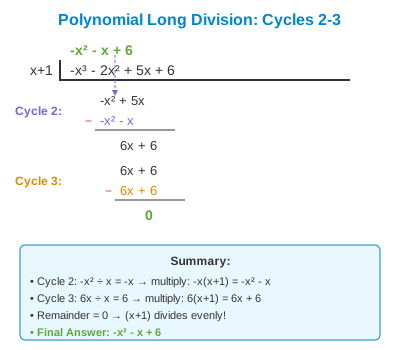
Continuation of long division showing Cycles 2-3: quotient building to -x^2 - x + 6, final subtraction yielding remainder 0

Cycle 2: x2x=x\frac{-x^2}{x} = -x. Multiply: x(x1)=x2+x-x(x-1) = -x^2 + x. Subtract: (7xx)6=(7x - x) - 6 = 6x66x - 6.

Cycle 3: 6xx=6\frac{6x}{x} = 6. Multiply: 6(x1)=6x66(x-1) = 6x - 6. Subtract: 00zero!.

✍️ MCQ
Choose one
We got a remainder of 00 after dividing by (x1)(x - 1). What does this confirm?

Quotient: x2x+6-x^2 - x + 6. Remainder: 00confirms!Confirms the divisor is indeed a factor (confirms 1 is a zeroThis is how you verify your work in exams).

Step 3: Factor x2x+6-x^2 - x + 6.

First, factor out 1-1Makes factoring easier with positive numbers: (x2+x6)-(x^2 + x - 6)Easier to factor when leading coefficient is positive

Now factor x2+x6x^2 + x - 6:

  • ProductFind two numbers with this product =6= -6
  • Sum(The same two numbers must have this sum) =1= 1

We need two numbers that multiply to 6-6 and add to 11The core pattern for factoring quadratics.

The pair: 33 and 2-2These numbers satisfy both conditions

✍️ MCQ
Choose one
We found that 33 and 2-2 work. How do we write the factored form of x2+x6x^2 + x - 6?

So x2+x6=(x+3)(x2)x^2 + x - 6 = (x + 3)(x - 2)

Therefore: x2x+6=(x+3)(x2)-x^2 - x + 6 = -(x + 3)(x - 2)

Zeros: x=3x = -3First zero from the factors and x=2x = 2Second zero from the factors (the 1-1no zero!Just a constant, no x, can never equal zero factor does not give a zero).

✍️ MCQ
Choose one
Why doesn't the factor 1-1 give us a zero of the polynomial?

All three zeros: 1,3,21, -3, 2.