The Four-Shape Decision Tree
Welcome! Today we're tackling The Four-Shape Decision Tree — the systematic method that turns your distance calculations into a definitive answer.
You can now compute all six distances for any quadrilateral.
But what do the numbers mean?
Here's the problem:
| What you observe | Could be... |
|---|---|
| All sides equal | Square OR Rhombuseither! |
| Opposite sides equal | Rectangle OR Parallelogrameither! |
The numbers alone do not tell you — you need a systematic decision process.
In this section, you will learn the decision tree that converts six distance values into a definitive classification.
Key insight: The diagonal comparison is always the tiebreaker.
1. The side-equality checks: all equal vs opposite equal
We start with the first level of the decision tree: checking the sides.
There are two possible outcomes:
- All four sides are equal
- Only opposite sides are equal
This first check narrows the classification from four shapes down to two.
After computing all four side-lengths, you compare them. There are two important outcomes:
-
All four sides are equal:
- Shape is either a square or a rhombus
-
Opposite sides are equal but not all four: and , but
- Shape is either a rectangle or a parallelogram
This single comparison splits the four shapes into two groups of two.
Your Turn 🤔
Two quadrilaterals have been computed:
Quadrilateral 1:
Quadrilateral 2:
For each quadrilateral:
- What does the side comparison tell you?
- Which two shapes are still possible?
The decision tree starts with a side comparison:
Check 1: Are all four sides equal?
If (all the same number), the shape has equal sides.
But this does NOT automatically mean square. A rhombus also has all four sides equal.
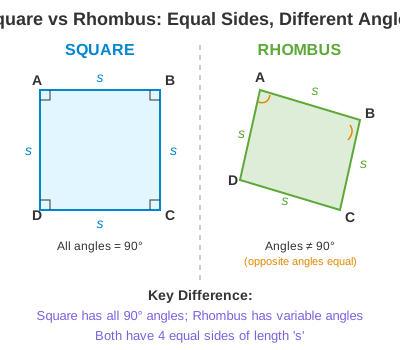
So 'all sides equal' narrows it to: SQUARE or RHOMBUS.
Check 2: If not all equal, are opposite sides equal?
If and (opposite pairs match, but the two pairs are different numbers), the shape has the parallelogram property.
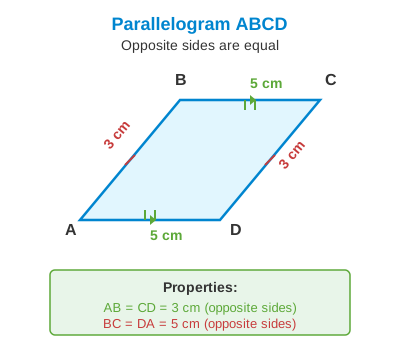
But this does NOT automatically mean rectangle.
So 'opposite sides equal' narrows it to: RECTANGLE or PARALLELOGRAM.
In both cases, you cannot make a final decision from sides alone. You MUST proceed to the diagonal check.
This is the critical takeaway from our decision tree so far:
- Quadrilateral 1 (all sides = 6): Could be square OR rhombus
- Quadrilateral 2 (opposite sides equal: 8 and 5): Could be rectangle OR parallelogram
Sides narrow it down to two options, but sides alone never give you the final answer.
⚠️ The common mistake: seeing 'all sides = 6' and immediately declaring 'It's a square!'
Look at the board — both shapes have all sides equal to 6. But are they the same shape?
This skips the diagonal check and will be wrong whenever the shape is actually a rhombus.
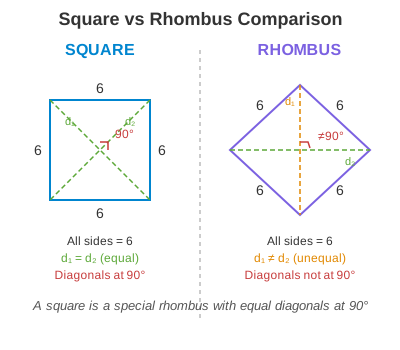
| Correct approach | Wrong approach |
|---|---|
| All sides equal → Could be square OR rhombus → Must check diagonals | All sides equal → "It's a square!" |
Remember: Equal sides narrow it down to two options, not one!
2. The diagonal tiebreaker: equal vs unequal diagonals
The side check narrowed the possibilities to two shapes in each case. Now we bring in the diagonals as the tiebreaker.
- Equal diagonals → push toward the 'higher' shape (square or rectangle)
- Unequal diagonals → give the 'lower' shape (rhombus or parallelogram)
The Rule:
| Side Check Result | Diagonals Equal | Diagonals Unequal |
|---|---|---|
| All sides equal | SQUARE | RHOMBUS |
| Opposite sides equal | RECTANGLE | PARALLELOGRAM |
Your turn! 🔍
Look at the two quadrilaterals with their diagonals now drawn:
| Quadrilateral | Side Information | Diagonal | Diagonal |
|---|---|---|---|
| Quadrilateral 1 | All sides = 6 | ||
| Quadrilateral 2 | Opposite sides 8 and 5 |
Give the final classification for each quadrilateral with justification.
For each one, state: What is it? Why?
The diagonal comparison is the tiebreaker. Here is the complete decision tree:
Path 1: All sides equal
- Diagonals equal → SQUARE (all sides equal AND diagonals equal)
- Diagonals NOT equal → RHOMBUS (all sides equal but diagonals differ)
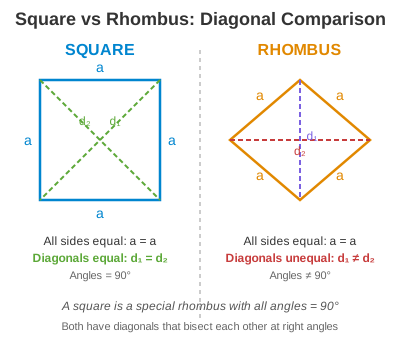
Path 2: Opposite sides equal (not all four)
- Diagonals equal → RECTANGLE (opposite sides equal AND diagonals equal)
- Diagonals NOT equal → PARALLELOGRAM (opposite sides equal but diagonals differ)
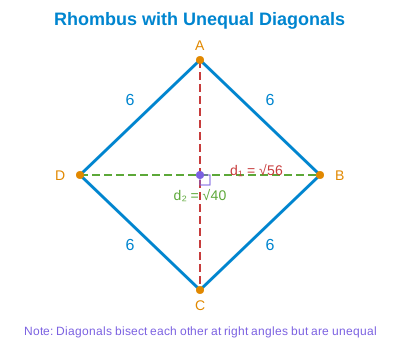
For Quadrilateral 1: sides are all 6 (Path 1). Diagonals: and . Since , the diagonals are unequal. Path 1 + unequal diagonals = RHOMBUS.
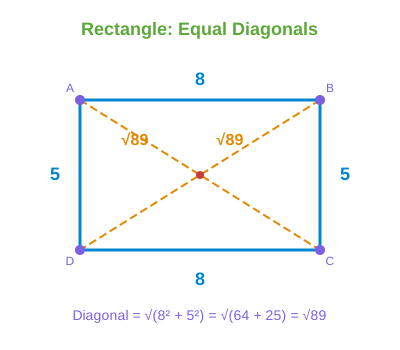
For Quadrilateral 2: opposite sides are 8 and 5 (Path 2). Diagonals: both . Equal. Path 2 + equal diagonals = RECTANGLE.
The key insight: the diagonal check is never optional.
'All sides equal' is necessary for a square but not sufficient — you ALSO need equal diagonals.
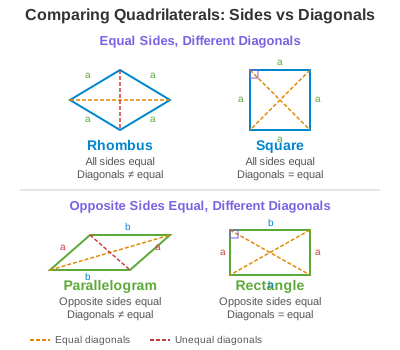
'Opposite sides equal' is necessary for a rectangle but not sufficient — you ALSO need equal diagonals.
3. Full classification from raw distance data
You've learned the decision tree in pieces. Now it's time to test the full process.
Given six computed squared distances for a fresh quadrilateral, your task is to run the complete decision tree and arrive at the classification.
The Decision Tree:
| Step | Check | Outcome |
|---|---|---|
| 1 | Check sides | All equal → square/rhombus path |
| Opposite equal → rectangle/parallelogram path | ||
| 2 | Check diagonals | Equal → square or rectangle |
| Unequal → rhombus or parallelogram |
Quadrilateral JKLM has the following squared distances:
| Sides | Diagonals |
|---|---|
Run the decision tree and state the classification with full justification.
(Show both checks — don't skip straight to the answer!)
Let's run the decision tree step by step.
Step 1: Check the sides.
, , , .
All four squared sides are 20. Since they are all equal, all four sides are equal: .
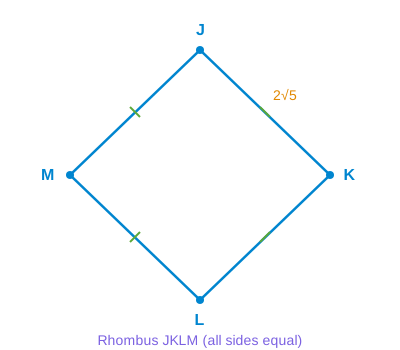
This puts us on Path 1 of the decision tree: the shape is either a SQUARE or a RHOMBUS.
Step 2: Check the diagonals.
, .
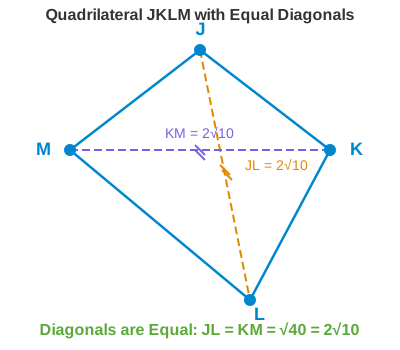
Both squared diagonals are 40. Since they are equal, the diagonals are equal: .
Step 3: Combine.
All sides equal (from Step 1) + diagonals equal (from Step 2) = SQUARE.
Look at the decision tree on the board — we followed the "Yes" path at both checkpoints!
If the diagonals had been UNEQUAL (say but ), the answer would have been RHOMBUS instead.
The decision tree always has exactly two steps: sides, then diagonals. Never skip Step 2.